“It's the first week of November, and Christmas is coming fast. Santa's elves are working overtime, and why not? His toys have guaranteed distribution.
“Things aren't so simple at Toronto-based Spin Master Ltd. "
That’s the opening to my feature story on Spin Master, Canada's largest toy company, in the latest issue of PROFIT Magazine. It’s a pretty long piece, but it’s one of my all-time favorites, and I think it’s worth your time.
For the first time, the reclusive management team at one of Canada’s most innovative and globally successful firms opens up about how they work, their greatest challenges and where they’re heading next. They offered me full access to their daily schedules for five days, enabling a rare inside glimpse into the workings of one of Canada’s most-honored growth companies.
Adding a human element to the piece: the three owner/founders are all still in their early 30s, and they’ve been friends since university. This is a very human story about a huge business success and the founders’ remarkable ability to trust, squabble and move on.
Here’s an excerpt, for those who are too busy to click through right now and think they’ll remember tomorrow:
Despite Spin Master's many successes, [co-CEO] Anton Rabie sees its evolution as a daily battle to exist. "Every day I wake up, I am being attacked," he says, eyes flashing with characteristic intensity. "I've come to realize that this is my life."
We're in his tidy, spacious office in late October, trying to conduct an interview while the phone rings and colleagues rush in looking for urgent decisions. "The LC is four weeks late!" complains one. Whenever there's a lull, Rabie rolls his highback chair to his computer table to check his inbox. "Wow," he says. "I just got an ugly e-mail."
At its size [more than $300-million], you'd think Spin Master had earned the right to give other people ulcers. But here are just a few of the challenges Rabie is dealing with this day:
* The rising cost of plastic foam following the hurricanes in the Gulf of Mexico has forced Rabie to request an emergency price increase for its kids' beds. But one buyer has just turned Rabie down flat. In a terse e-mail, the buyer adds archly, "Let us know if you don't want to ship. We have alternative product lined up."
* Meanwhile, Spin Master has been trying for weeks to license an exciting new toy technology. The deal is all but done, but the inventor just found another problem with Spin Master's proposed terms. (This haggling will continue for weeks, threatening the company's spring schedule for rolling out the new product.)
* A movie producer is about to award product licences for its next animated feature. Spin Master has a new product that would fit this property perfectly—but isn't ready to announce it. Rabie gets on the phone, lobbying hard for the producer to await Spin Master's bid.
* Meanwhile, the acquisition of a niche toy company in the U.S. seems stalled, and Rabie has to get things moving again. "Let's schedule a meeting, anywhere in the world you want to meet," he tells the prospect over the phone. His goal is to get his CFO, Mark Segal, and his outside legal counsel in the same room as the U.S. toymaker until a deal is done. "How about you send the markup by Tuesday, we meet in New York Thursday at 4 p.m., and we either leave happy or sad?" In the end, the meeting is cancelled.
"Either it's a retailer cancelling an order, competitors coming into our category or an acquisition where the terms are falling apart," says Rabie grimly. "Our business is under attack every single day." Then, flashing a grim smile, he adds, "It's great entertainment."
Read the rest of the story here.
(Hint: to read it all without having to click to a new page every few paragraphs, scroll to the bottom of the page and click on "Print Story." You can also copy and paste the story from that pop-up window if you want to save it for later.)
And let me know what you think. Leave a comment below.

Monday, December 12, 2005

Saturday, December 10, 2005
When entrepreneurs make money
Most of my career has been about helping entrepreneurs make more money. What they did with it was their business.
Until now.
This week I agreed to start writing a personal finance column for MoneySense Magazine (a sister publication to PROFIT). My first column is due in January, so it won't be out for months, but I hope you will follow along.
MoneySense editor Ian McGugan and I agree that entrepreneurs have a lot of issues around diversifying their investment portfolios, business succession, tax planning, saving for retirement, and so on, so I am looking forward to jumping into all of these areas.
If you're an entrepreneur with suggestions for topics to cover, please let me know. You can leave a comment here or email me at rick@rickspence.ca
In case you're keeping track, this is now three regular column gigs: I write "Frontlines" for PROFIT, and "From the Outside In" for Alberta Venture. I try to write regularly for Corporate Knights as well, when other business doesn't get in the way.
Until now.
This week I agreed to start writing a personal finance column for MoneySense Magazine (a sister publication to PROFIT). My first column is due in January, so it won't be out for months, but I hope you will follow along.
MoneySense editor Ian McGugan and I agree that entrepreneurs have a lot of issues around diversifying their investment portfolios, business succession, tax planning, saving for retirement, and so on, so I am looking forward to jumping into all of these areas.
If you're an entrepreneur with suggestions for topics to cover, please let me know. You can leave a comment here or email me at rick@rickspence.ca
In case you're keeping track, this is now three regular column gigs: I write "Frontlines" for PROFIT, and "From the Outside In" for Alberta Venture. I try to write regularly for Corporate Knights as well, when other business doesn't get in the way.
Tuesday, December 06, 2005
Canadian Entrepreneurs Unite! (you too, Sir Walter Scott)
More and more Canadian entrepreneurs seem to be finding Canadian Entrepreneur. How do they get here? In about half the cases they seem to be following blog directories or other links that bring them here. The other half come from search engines: mainly Google, Yahoo, and MSN.
What search terms bring them here? Glad you asked. Here’s a list of the search terms used in the past week by visitors to Canadian Entrepreneur. Some make sense, others will make you scratch your head. But they got here all the same.
Search terms that led to Cdn Ent in the past week. (Some duplicates have been removed.)
voip customer success stories
chris staples, rethink, quote
bravo bmo
rick Spence blog
SALES NEGOTIATING TIPS
Dr. Seuss specialist
canadian business fortunes 2005
hardware store coming to cornwall ont
canadian entrepreneur
ethical businesses
quotes by chris staples, rethink
Jack Welch sucks (I swear, Jack, I never said this, exactly!)
canadian the young and the restless
diff'rent strokes. media domain.
kiessling Toronto
canada's greatest entrepreneur
one entrepreneur history
shasha bread company inc
JIM ESTILL DELL
history of Sir Walter Scott as entrepreneur (huh?)
examples of poorly written e-mails
Canadian entrepreneur
There you go: that’s what people are looking for on the Internet this week.
What search terms bring them here? Glad you asked. Here’s a list of the search terms used in the past week by visitors to Canadian Entrepreneur. Some make sense, others will make you scratch your head. But they got here all the same.
Search terms that led to Cdn Ent in the past week. (Some duplicates have been removed.)
voip customer success stories
chris staples, rethink, quote
bravo bmo
rick Spence blog
SALES NEGOTIATING TIPS
Dr. Seuss specialist
canadian business fortunes 2005
hardware store coming to cornwall ont
canadian entrepreneur
ethical businesses
quotes by chris staples, rethink
Jack Welch sucks (I swear, Jack, I never said this, exactly!)
canadian the young and the restless
diff'rent strokes. media domain.
kiessling Toronto
canada's greatest entrepreneur
one entrepreneur history
shasha bread company inc
JIM ESTILL DELL
history of Sir Walter Scott as entrepreneur (huh?)
examples of poorly written e-mails
Canadian entrepreneur
There you go: that’s what people are looking for on the Internet this week.
The future of Google :^)
Google has emerged as one of the most ambitious and innovative forces in business today.
So I thought you’d appreciate a look at what it might be up to in a few more years…
It’s a joke, okay? Thanks to my daughter, who found this at http://www.jumbojoke.com/000521.html
So I thought you’d appreciate a look at what it might be up to in a few more years…

It’s a joke, okay? Thanks to my daughter, who found this at http://www.jumbojoke.com/000521.html
Stamps are back!
I’ve given up reading most of the marketing-related e-newsletters I receive, but there was an interesting item from Dan Kennedy (the “No B.S.” marketing consultant and author) this morning.
Noting that California’s new anti-spam laws make it illegal to send a marketing e-mail to anyone in that state who has not consented to receiving it, he wonders if that doesn’t just about kill e-mail marketing.
So he says "the Next Big Thing" in marketing is – old-fashioned direct mail! He calls it “the only targeted medium that hasn't been almost regulated out of existence.”
Sure, e-mail marketing is cheap, says Kennedy. But, he writes, “you just cannot beat a letter in an envelope, and if your business can't bear that cost, it's a lousy business. Fix it or get out.”
Kennedy’s rules of direct mail:
“QUALITY OF LIST has as much to do with success as MESSAGE.
“GETTING IT DELIVEREDAND OPENED is essential, or the MESSAGE doesn't matter. Once opened, COPY IS KING, so if you're going to be a really serious student of anything, pick direct-response copy.
"Nothing out-pulls a NURTURED 'HOUSE LIST' OF YOUR OWN CUSTOMERS, so you usually profit by mailing to them more frequently. A good resolution for this year might be to double your frequency.”
See you at the post office.
And if you like reading lots of capital letters, see more Dan Kennedy stuff at (where else?) http://www.dankennedy.com/.
Noting that California’s new anti-spam laws make it illegal to send a marketing e-mail to anyone in that state who has not consented to receiving it, he wonders if that doesn’t just about kill e-mail marketing.
So he says "the Next Big Thing" in marketing is – old-fashioned direct mail! He calls it “the only targeted medium that hasn't been almost regulated out of existence.”
Sure, e-mail marketing is cheap, says Kennedy. But, he writes, “you just cannot beat a letter in an envelope, and if your business can't bear that cost, it's a lousy business. Fix it or get out.”
Kennedy’s rules of direct mail:
“QUALITY OF LIST has as much to do with success as MESSAGE.
“GETTING IT DELIVEREDAND OPENED is essential, or the MESSAGE doesn't matter. Once opened, COPY IS KING, so if you're going to be a really serious student of anything, pick direct-response copy.
"Nothing out-pulls a NURTURED 'HOUSE LIST' OF YOUR OWN CUSTOMERS, so you usually profit by mailing to them more frequently. A good resolution for this year might be to double your frequency.”
See you at the post office.
And if you like reading lots of capital letters, see more Dan Kennedy stuff at (where else?) http://www.dankennedy.com/.
Deck the halls with profit-sharing
Want to increase your company’s profits? Give some of 'em away.
That’s the experience of Vancouver entrepreneur Brian Scudamore, founder of 1-800-GOT-JUNK?, North America's largest junk-removal service with more than 150 franchi se locations.
As related in his column in the latest issue of PROFIT Magazine, Scudamore decided two years ago to create a company-wide profit-sharing program. He committed 25% of his company’s profits to the pool – and it’s worked beyond his wildest expectations.
“Like most business owners,” he writes , “I thought that profit-sharing would increase the company's overall profits, but not enough to cover the profit-sharing payout; thus, 1-800-GOT-JUNK? would recoup less of its net earnings. Was I ever wrong! In fiscal 2004, the program's first year, our bottom line after profit-sharing payouts increased by almost 800%. This year, our annual profit is trending 50% higher than it was in 2004. To me, that's a clear sign the program is working.”
An example of the benefits: “People started watching everything from the macro, including company-wide revenue and profit, to the micro, such as the entertainment or telephone expenses of individual departments.
“One employee took the initiative to replace our expensive bottled-water service with a filtered-water system, cutting our drinking-water costs by a third and inspiring the rest of the team to find wins of their own.”
Read the whole column HERE.
'Tis the season.
That’s the experience of Vancouver entrepreneur Brian Scudamore, founder of 1-800-GOT-JUNK?, North America's largest junk-removal service with more than 150 franchi
 se locations.
As related in his column in the latest issue of PROFIT Magazine, Scudamore decided two years ago to create a company-wide profit-sharing program. He committed 25% of his company’s profits to the pool – and it’s worked beyond his wildest expectations.
“Like most business owners,” he writes , “I thought that profit-sharing would increase the company's overall profits, but not enough to cover the profit-sharing payout; thus, 1-800-GOT-JUNK? would recoup less of its net earnings. Was I ever wrong! In fiscal 2004, the program's first year, our bottom line after profit-sharing payouts increased by almost 800%. This year, our annual profit is trending 50% higher than it was in 2004. To me, that's a clear sign the program is working.”
An example of the benefits: “People started watching everything from the macro, including company-wide revenue and profit, to the micro, such as the entertainment or telephone expenses of individual departments.
“One employee took the initiative to replace our expensive bottled-water service with a filtered-water system, cutting our drinking-water costs by a third and inspiring the rest of the team to find wins of their own.”
Read the whole column HERE.
'Tis the season.
Monday, December 05, 2005
Technopreneurs on the Town
I’ve gotta blog about my meeting with two people at a downtown café last week. As we were talking about putting on an initiative together, the other two (only one of whom I had known before) both told me it’s too bad a fourth guy wasn’t there. Mark’s an actor as well as a business consultant, and they were dying for me to see this commercial he’s done.
So Ron, on my right, says to Richard on my left, “Did you bring your laptop?” Richard says yes. Ron releases a chain around his neck that holds a USB storage device no bigger than your fingernail. He pops it into Richard’s USB drive and Richard copies the file onto his laptop. Then he goes to play it.
Oops. The commercial is formatted in Quicktime, and Richard doesn’t have it.
No problem. This café is wired for wireless Internet (if that makes sense to you), so Richard downloads it while we talk. Within three minutes, we are watching Mark’s commercial.
It didn’t really advance our conversation much, but I was struck by how cool this whole process was.
My first PC had a 20-mb hard drive and weighed 80 pounds (including monitor). Now we carry gigabytes of storage around our neck, haul many megahertz of processing power around in a briefcase, and download the programs we need out of the ether. As we've said around here before, it’s an amazing time to be in business.
So Ron, on my right, says to Richard on my left, “Did you bring your laptop?” Richard says yes. Ron releases a chain around his neck that holds a USB storage device no bigger than your fingernail. He pops it into Richard’s USB drive and Richard copies the file onto his laptop. Then he goes to play it.
Oops. The commercial is formatted in Quicktime, and Richard doesn’t have it.
No problem. This café is wired for wireless Internet (if that makes sense to you), so Richard downloads it while we talk. Within three minutes, we are watching Mark’s commercial.
It didn’t really advance our conversation much, but I was struck by how cool this whole process was.
My first PC had a 20-mb hard drive and weighed 80 pounds (including monitor). Now we carry gigabytes of storage around our neck, haul many megahertz of processing power around in a briefcase, and download the programs we need out of the ether. As we've said around here before, it’s an amazing time to be in business.
Friday, December 02, 2005
Buying a business? Learn from the pros
Community newspapers can be very profitable businesses. Did you ever want to buy one, but didn’t want to pay a fair price?
Here’s how the pros do it. It's a long read, but very enlightening. (As you go through this, you'll realize why you don't read about this stuff in the newspapers.)
This is an edited version of a transcript of the Proceedings of the Standing Senate Committee on Transport and Communications. In its mission to probe the state of Canadian media, it held a session in Dieppe, N.B. on April 21, 2005.
Senator Joan Fraser (Chairman) led the investigation. The first witness was David Henley, who had owned four community newspapers in New Brunswick. That is the province where the Irving family owns most of the daily newspapers, the weeklies, the TV stations, and the biggest industrial employers (forestry, agriculture, oil, etc.).
Here is the abridged transcript.
Mr. Henley: I am from Woodstock, N.B., and I am the former owner, with my wife, of Henley Publishing Ltd., which owned four community papers in Western New Brunswick until November 2002, when we sold those properties to the Irving-owned Brunswick News....
When it was announced that a committee was being formed to study Canadian media and, specifically, the concentration of ownership, I told my wife I would like to appear before this committee. She said, "What is the point? The barn door is already open and the horses are gone.'' My daughter then added, "Yes, and they have taken all the hay.''
…
Senator Munson: Why did you sell?
Mr. Henley: Well, I am 68 years old... It was becoming time to sell. Some pressures were brought to bear as we got closer to making that decision that had a great effect on what we eventually did.
Senator Munson: Are those confidential pressures, or is it the same story of a big company marching forward and gobbling up little newspapers?
...
Mr. Henley: Essentially, a former employee started a shopper in competition with us in Woodstock. They could not make a go of it, so they transferred it over to another person, who also could not make a go of it. In any case, the ownership eventually came into Irving hands and things then changed, because we noticed a definite increase in the competition in a number of ways.
The Chairman: What do you mean by, "a number of ways''?
Mr. Henley: For instance, before the sale, the shopper offered free classified advertising and put out a price list [for other types of ads]. There is nothing wrong with this, I suppose, but they sold ads that were far under the price list.
…. Obviously, by offering free classifieds, that cut into the classified advertising revenue of our publication. Newspapers are usually sold based on their revenue, and so when the time came to sell, obviously, the price would have reflected the decreased revenue.
(Rick: Nice work. Now here's the kicker...)
Henley: By the way, there is certainly a price now to put your classified ad in the shopper. Since The Bugle is now the only publication in the area, the classified rates are now double what they were when we owned the paper.
Rick talking: I had to omit a lot of interesting details - how Irving consolidated those papers, their alleged "predatory" pricing, why it would be hard for anyone else to enter these markets, and why Henley rejected the idea of going to the Competition Bureau.
When you have some free time, read the whole story here.
Here’s how the pros do it. It's a long read, but very enlightening. (As you go through this, you'll realize why you don't read about this stuff in the newspapers.)
This is an edited version of a transcript of the Proceedings of the Standing Senate Committee on Transport and Communications. In its mission to probe the state of Canadian media, it held a session in Dieppe, N.B. on April 21, 2005.
Senator Joan Fraser (Chairman) led the investigation. The first witness was David Henley, who had owned four community newspapers in New Brunswick. That is the province where the Irving family owns most of the daily newspapers, the weeklies, the TV stations, and the biggest industrial employers (forestry, agriculture, oil, etc.).
Here is the abridged transcript.
Mr. Henley: I am from Woodstock, N.B., and I am the former owner, with my wife, of Henley Publishing Ltd., which owned four community papers in Western New Brunswick until November 2002, when we sold those properties to the Irving-owned Brunswick News....
When it was announced that a committee was being formed to study Canadian media and, specifically, the concentration of ownership, I told my wife I would like to appear before this committee. She said, "What is the point? The barn door is already open and the horses are gone.'' My daughter then added, "Yes, and they have taken all the hay.''
…
Senator Munson: Why did you sell?
Mr. Henley: Well, I am 68 years old... It was becoming time to sell. Some pressures were brought to bear as we got closer to making that decision that had a great effect on what we eventually did.
Senator Munson: Are those confidential pressures, or is it the same story of a big company marching forward and gobbling up little newspapers?
...
Mr. Henley: Essentially, a former employee started a shopper in competition with us in Woodstock. They could not make a go of it, so they transferred it over to another person, who also could not make a go of it. In any case, the ownership eventually came into Irving hands and things then changed, because we noticed a definite increase in the competition in a number of ways.
The Chairman: What do you mean by, "a number of ways''?
Mr. Henley: For instance, before the sale, the shopper offered free classified advertising and put out a price list [for other types of ads]. There is nothing wrong with this, I suppose, but they sold ads that were far under the price list.
…. Obviously, by offering free classifieds, that cut into the classified advertising revenue of our publication. Newspapers are usually sold based on their revenue, and so when the time came to sell, obviously, the price would have reflected the decreased revenue.
(Rick: Nice work. Now here's the kicker...)
Henley: By the way, there is certainly a price now to put your classified ad in the shopper. Since The Bugle is now the only publication in the area, the classified rates are now double what they were when we owned the paper.
Rick talking: I had to omit a lot of interesting details - how Irving consolidated those papers, their alleged "predatory" pricing, why it would be hard for anyone else to enter these markets, and why Henley rejected the idea of going to the Competition Bureau.
When you have some free time, read the whole story here.
Mission Statement Impossible
I hope to blog more thoroughly about the Workplace Education and Learning conference I participated in yesterday, but I have to share this thought with you. It gets my vote as Quote of the Day.
The speaker was Prem Benimadhu, VP of Organizational Performance for The Conference Board of Canada (which put on the conference). While talking about what makes companies great, he criticized companies that put more effort into coming up with their vision and mission statements than in actually living up to them. (We all know companies like that.)
Says Benimadhu: “Vision without execution is hallucination.”
Put that in your back pocket for the next time your marketing people activate the spin cycle without dealing with the fundamentals.
Vision without execution is hallucination.
The speaker was Prem Benimadhu, VP of Organizational Performance for The Conference Board of Canada (which put on the conference). While talking about what makes companies great, he criticized companies that put more effort into coming up with their vision and mission statements than in actually living up to them. (We all know companies like that.)
Says Benimadhu: “Vision without execution is hallucination.”
Put that in your back pocket for the next time your marketing people activate the spin cycle without dealing with the fundamentals.
Vision without execution is hallucination.
Tuesday, November 29, 2005
Survivor: Tofino
Belated congratulations to CBC-TV’s Venture for winning a Gemini award this month. One of the Corp’s longest-running shows, Venture consistently proves just how fascinating business can be when you focus on the personal challenges of doing business.
The Gemini for Best Reality Program went to a Venture episode from last February, “The Town Doctor.” It showed what happened when Venture brought in a big-time U.S. marketing consultant to help three stressed-out small businesses in Tofino, BC (fabulous town on the west coast of Vancouver Island. Email me for my whale-watching pics off Tofino one blissful summer evening.)
Can Doug Hall deliver big-city marketing miracles for the town grocer, a cleaning lady and a whale captain? You have to watch the show to find out. I will look into whether they plan to broadcast the episode again.
A show like this exists at the very epicenter of journalism and blatant stunting. But it’s all the more valuable for that. Business is all about outside-the-box solutions – and the simple belief that we can shape our own destinies by thinking in new ways.
Kudos to Venture – a tiny little part of the CBC that actually “gets it” – for daring Canadian entrepreneurs to think bigger.
(A few years ago, we tried something similar at PROFIT Magazine. We had a contest where the prize was a chance to work with sales consultant Tom Stoyan [AKA “Canada’s Sales Coach”]. It would have been a great story if we had been able to match Tom with a company whose sales force could benefit from his mentoring. But the guy who won was a self-employed sales consultant. We never got the happy ending we had hoped for.)
The Gemini for Best Reality Program went to a Venture episode from last February, “The Town Doctor.” It showed what happened when Venture brought in a big-time U.S. marketing consultant to help three stressed-out small businesses in Tofino, BC (fabulous town on the west coast of Vancouver Island. Email me for my whale-watching pics off Tofino one blissful summer evening.)
Can Doug Hall deliver big-city marketing miracles for the town grocer, a cleaning lady and a whale captain? You have to watch the show to find out. I will look into whether they plan to broadcast the episode again.
A show like this exists at the very epicenter of journalism and blatant stunting. But it’s all the more valuable for that. Business is all about outside-the-box solutions – and the simple belief that we can shape our own destinies by thinking in new ways.
Kudos to Venture – a tiny little part of the CBC that actually “gets it” – for daring Canadian entrepreneurs to think bigger.
(A few years ago, we tried something similar at PROFIT Magazine. We had a contest where the prize was a chance to work with sales consultant Tom Stoyan [AKA “Canada’s Sales Coach”]. It would have been a great story if we had been able to match Tom with a company whose sales force could benefit from his mentoring. But the guy who won was a self-employed sales consultant. We never got the happy ending we had hoped for.)
Friday, November 25, 2005
Your Weekend Smile
Last post of the week. So let's make it pointless, but fun.
I was talking to a client the other day, and they were boasting that when their people go to a customer site on a service call, their sole concern is just that: service. Unlike many of their competitors, "our guys have no incentives to sell the customer anything he doesn't need."
And then my client sighed and added, with a sad grin, "We can barely get them to sell the stuff the customer does need."
I was talking to a client the other day, and they were boasting that when their people go to a customer site on a service call, their sole concern is just that: service. Unlike many of their competitors, "our guys have no incentives to sell the customer anything he doesn't need."
And then my client sighed and added, with a sad grin, "We can barely get them to sell the stuff the customer does need."
Can you help?
Canadian Entrepreneur is garnering more reader comments lately, which I appreciate. They add life and depth to a blog!
But here’s a comment you may have missed, since it was recently attached to a post from six weeks ago (Oct. 11).
Cheerily titled “Let's All Work with Google!” the post linked to a blog entry from Chris Sacca, who is one of Google’s principals for New Business Development. I thought his discussion on how to partner with Google amount to a manifesto on how to do business today. (Click here for my original post.)
Well, somebody (his name's Kevin) googled Sacca and was led here. He read the post, and – well, I’ll let him tell it. Can you help this guy? His e-mail address is at the end of his note.
“I just read about Mr. Sacca in a Business 2.0 (print edition) article, Googled him and ended up here. The hints are good ones and compare well with the ones I found at garage.com.
I have a new media idea that I have been researching and test-pitching to friends and family. The idea involves the reuse of digital content (songs, movies, still images) and addresses the copyright issues that arise from the creation of combined and/or re-edited presentations (of existing, legally licensed, copyrighted content.
I would like to approach Mr. Sacca of Google or firms like Garage Ventures (Guy Kawasaki) with this idea, but need to make a solid first impression. I do not wish to dilute the idea's reputation or risk it being stolen by spamming VCs with poorly written or incomplete proposals.
I am not sure whether I should be pitching the intellectual property (and IP licensing) opportunities, or the finished products. Perhaps both are appropriate, depending on the target audience.
I have ZERO experience pitching VCs. I come from an engineering background and already have a couple of patents that have earned me nothing.
Mr. Spence's post states that "Sacca’s job is to find new ideas and new people to partner with – even though 90% of the people he meets will never be appropriate partners." I want to be in the 10% that succeed.
Success in this journey requires a sherpa, a guide, someone who has successfully (or near-successfully) pitched ideas to VCs. If you are reading this and are (or know) someone who is up to the challenge, I promise not to waste your time.
I will, however, require an NDA.
E-mail: kpkpkp AT gmail DOT com
--posted by Kevin Pierce to Canadian Entrepreneur at 11/23/2005 10:27:22 AM
C'mon, folks. Let's prove Canadians still care. (name that tune!)
But here’s a comment you may have missed, since it was recently attached to a post from six weeks ago (Oct. 11).
Cheerily titled “Let's All Work with Google!” the post linked to a blog entry from Chris Sacca, who is one of Google’s principals for New Business Development. I thought his discussion on how to partner with Google amount to a manifesto on how to do business today. (Click here for my original post.)
Well, somebody (his name's Kevin) googled Sacca and was led here. He read the post, and – well, I’ll let him tell it. Can you help this guy? His e-mail address is at the end of his note.
“I just read about Mr. Sacca in a Business 2.0 (print edition) article, Googled him and ended up here. The hints are good ones and compare well with the ones I found at garage.com.
I have a new media idea that I have been researching and test-pitching to friends and family. The idea involves the reuse of digital content (songs, movies, still images) and addresses the copyright issues that arise from the creation of combined and/or re-edited presentations (of existing, legally licensed, copyrighted content.
I would like to approach Mr. Sacca of Google or firms like Garage Ventures (Guy Kawasaki) with this idea, but need to make a solid first impression. I do not wish to dilute the idea's reputation or risk it being stolen by spamming VCs with poorly written or incomplete proposals.
I am not sure whether I should be pitching the intellectual property (and IP licensing) opportunities, or the finished products. Perhaps both are appropriate, depending on the target audience.
I have ZERO experience pitching VCs. I come from an engineering background and already have a couple of patents that have earned me nothing.
Mr. Spence's post states that "Sacca’s job is to find new ideas and new people to partner with – even though 90% of the people he meets will never be appropriate partners." I want to be in the 10% that succeed.
Success in this journey requires a sherpa, a guide, someone who has successfully (or near-successfully) pitched ideas to VCs. If you are reading this and are (or know) someone who is up to the challenge, I promise not to waste your time.
I will, however, require an NDA.
E-mail: kpkpkp AT gmail DOT com
--posted by Kevin Pierce to Canadian Entrepreneur at 11/23/2005 10:27:22 AM
C'mon, folks. Let's prove Canadians still care. (name that tune!)
Thursday, November 24, 2005
The Microsoft Way... out
Fascinating post by Toronto venture capitalist and blogger Rick Segal on his survey of fellow Microsoft alumni now building other businesses.
The always curious Segal interviewed 25 ex-colleagues, and asked if they believe their Microsoft experience gives them an edge in face-to-face meetings, either with people still at Microsoft, or in new interactions.
60% said no. “I was shocked," writes Segal. Probing the point, he got this response from a seven-year Microsoft vet who seems now well on the path to recovery: “I never knew just how arrogant, snotty, and rude it is to flip open a laptop and read mail while in a meeting. I feel like I need to find the hundreds of people I dealt with over the years and apologize. It might be this swaggering, hot shot crap works with internal meetings, but man, is it rude.”
Segal asked if they would go back to MS if they got a call from Bill Gates or another senior guy. 80% said no, with the rest saying maybe. No one said yes.
Then Segal asked if they were using MS-based technology in their new or current role, or “open source”? Three quarters of the respondents said “Open Source,” or some non-Microsoft variation.
Think of these people next time your broker suggests investing in Microsoft.
For the full article (and more questions and lots of comment) click here.
The always curious Segal interviewed 25 ex-colleagues, and asked if they believe their Microsoft experience gives them an edge in face-to-face meetings, either with people still at Microsoft, or in new interactions.
60% said no. “I was shocked," writes Segal. Probing the point, he got this response from a seven-year Microsoft vet who seems now well on the path to recovery: “I never knew just how arrogant, snotty, and rude it is to flip open a laptop and read mail while in a meeting. I feel like I need to find the hundreds of people I dealt with over the years and apologize. It might be this swaggering, hot shot crap works with internal meetings, but man, is it rude.”
Segal asked if they would go back to MS if they got a call from Bill Gates or another senior guy. 80% said no, with the rest saying maybe. No one said yes.
Then Segal asked if they were using MS-based technology in their new or current role, or “open source”? Three quarters of the respondents said “Open Source,” or some non-Microsoft variation.
Think of these people next time your broker suggests investing in Microsoft.
For the full article (and more questions and lots of comment) click here.
Wednesday, November 23, 2005
Your Next Big Thing
The December issue of PROFIT Magazine features the 10th annual Opportunity feature, Your Next Big Thing: The Best Businesses to go Into Now.
(Sometime next week I will look up that first issue and let you know what some of the predictions were way back in 1996. I hope they’re not too embarrassing).
As a free preview of that special issue, PROFITguide.com offers a story on what four prominent Canadians see as the best business bets of the next few years. Here’s a quick summary:
Andy Macaulay, founding partner, ZiG, Toronto:
"There's a market for a concierge service for boomers, to take care of all those little tasks around the home: trimming the tree, getting the fridge fixed, taking care of car maintenance, walking the dog and shopping for groceries.”
Elyse Allan, president & CEO, GE Canada, Mississauga, Ont.
"There is a need for cleaner, more efficient sources of energy and for more abundant clean water.”
Jean-Marc Léger, president, Léger Marketing, Montreal: "Older people are having a difficult time adapting [to new technology]. So manufacturers that can simplify technology products that are in wide use, such as e-mail, cellphones, the Internet and iPods, will have an advantage.”
David Foot, professor of economics, University of Toronto: "The boomers need financial-planning and wealth-management services. They also have the money to buy second homes, so security-system suppliers will do well.”
To read the whole story, click here.
(Sometime next week I will look up that first issue and let you know what some of the predictions were way back in 1996. I hope they’re not too embarrassing).
As a free preview of that special issue, PROFITguide.com offers a story on what four prominent Canadians see as the best business bets of the next few years. Here’s a quick summary:
Andy Macaulay, founding partner, ZiG, Toronto:
"There's a market for a concierge service for boomers, to take care of all those little tasks around the home: trimming the tree, getting the fridge fixed, taking care of car maintenance, walking the dog and shopping for groceries.”
Elyse Allan, president & CEO, GE Canada, Mississauga, Ont.
"There is a need for cleaner, more efficient sources of energy and for more abundant clean water.”
Jean-Marc Léger, president, Léger Marketing, Montreal: "Older people are having a difficult time adapting [to new technology]. So manufacturers that can simplify technology products that are in wide use, such as e-mail, cellphones, the Internet and iPods, will have an advantage.”
David Foot, professor of economics, University of Toronto: "The boomers need financial-planning and wealth-management services. They also have the money to buy second homes, so security-system suppliers will do well.”
To read the whole story, click here.
Tuesday, November 22, 2005
Hard Times in the magazine business
I was just breezing through the pages of the latest issue of Fast Company and wondering if I should renew my subscription when I noticed just how far that magazine has fallen.
They are offering a combined one-year subscription to both Fast Company and Inc. magazine (yes, 12 isues of each!) for $15. That's 24 isues for the price of three on the newsstand.
Or you can get a two-year sub to FC for $15.
I'd pick the combo (except that that offer is good only in USA). I don't think FC will last two more years.
They are offering a combined one-year subscription to both Fast Company and Inc. magazine (yes, 12 isues of each!) for $15. That's 24 isues for the price of three on the newsstand.
Or you can get a two-year sub to FC for $15.
I'd pick the combo (except that that offer is good only in USA). I don't think FC will last two more years.
How NOT to market to small business
Strange “special feature” in yesterday’s National Post.
Roynat Capital took out an ad that wrapped around the business section to salute the winners of the Ernst & Young Entrepreneur of the Year awards program.
Instead of telling us anything intelligent about the winners, this 1.5-page supplement showed us black-tie pictures of some of the winners and their spouses – along with a lot of sponsors (the publisher of the National Post got in there somehow).
The pictures were taken at the unveiling event, held in Ottawa, um, Nov. 3. The text identified the various winners, but actually spent more time talking up the sponsors (look! there’s the publisher of the Post again!).

So here are my questions:
Why is Roynat paying to promote the National Post and Ernst & Young?
Why were the entrepreneurs short-changed in an ad that was supposedly a tribute to them?
Why did it take so long (nearly three weeks!) to recognize these winners?
Why is there nothing in this ad addressing the needs of Roynat’s customers?
And why is this newsprint wraparound called “Special Feature to National Post / Presented by Roynat Capital” instead of just being called an ad?
I have nothing against Roynat. In fact, I appreciate that it is one of the most aggressive supporters of small business in the Canadian marketplace. I just don’t understand why it pisses so much advertising money down the drain.
This “feature” ended with a full-page Roynat ad much like those it has been running every week in the Post. These ads showcase boring, nearly unreadable profiles of supposedly interesting Canadian companies. I actually complained about these ads recently to a Roynat exec, because I think they are the exact antithesis of anything that will help, inform or impress an entrepreneur.
To get entrepreneurs to read this profile, it should be short and punchy, with lots of color and personality, and end with the entrepreneur’s best experience and advice (entrepreneurs don’t care about your company, they want to know what you know that can help them).
Instead, Roynat runs a 900-word profile, with lots of unnecessary history and product detail. No subheads, no boldface, no sidebars to break up the tedious columns of copy. And no advice, no lessons. Which means this is all about him (the profiled entrepreneur), and not about you (the person reading the ad). Which makes for bad advertising, no matter how much they spend.
The executive agreed with me. But he wasn’t in marketing, so he wasn’t about to rock the boat.
Roynat Capital took out an ad that wrapped around the business section to salute the winners of the Ernst & Young Entrepreneur of the Year awards program.
Instead of telling us anything intelligent about the winners, this 1.5-page supplement showed us black-tie pictures of some of the winners and their spouses – along with a lot of sponsors (the publisher of the National Post got in there somehow).
The pictures were taken at the unveiling event, held in Ottawa, um, Nov. 3. The text identified the various winners, but actually spent more time talking up the sponsors (look! there’s the publisher of the Post again!).

So here are my questions:
Why is Roynat paying to promote the National Post and Ernst & Young?
Why were the entrepreneurs short-changed in an ad that was supposedly a tribute to them?
Why did it take so long (nearly three weeks!) to recognize these winners?
Why is there nothing in this ad addressing the needs of Roynat’s customers?
And why is this newsprint wraparound called “Special Feature to National Post / Presented by Roynat Capital” instead of just being called an ad?
I have nothing against Roynat. In fact, I appreciate that it is one of the most aggressive supporters of small business in the Canadian marketplace. I just don’t understand why it pisses so much advertising money down the drain.
This “feature” ended with a full-page Roynat ad much like those it has been running every week in the Post. These ads showcase boring, nearly unreadable profiles of supposedly interesting Canadian companies. I actually complained about these ads recently to a Roynat exec, because I think they are the exact antithesis of anything that will help, inform or impress an entrepreneur.
To get entrepreneurs to read this profile, it should be short and punchy, with lots of color and personality, and end with the entrepreneur’s best experience and advice (entrepreneurs don’t care about your company, they want to know what you know that can help them).
Instead, Roynat runs a 900-word profile, with lots of unnecessary history and product detail. No subheads, no boldface, no sidebars to break up the tedious columns of copy. And no advice, no lessons. Which means this is all about him (the profiled entrepreneur), and not about you (the person reading the ad). Which makes for bad advertising, no matter how much they spend.
The executive agreed with me. But he wasn’t in marketing, so he wasn’t about to rock the boat.
Monday, November 21, 2005
New threat to industry productivity!!!
I’ve been meaning for some time to blog about the study that came out last month reporting that this year, U.S. workers will waste the equivalent of 551,000 years reading blogs.
A study by U.S.-based Advertising Age found that 35 million workers -- one in four people in the labor force -- visit blogs. On average they spend 3.5 hours, or 9%, of the work week, engaged with them. Time spent in the office on non-work blogs this year will take up the equivalent of 2.3 million jobs.
Ad Age even quoted the sales director at Gawker Media, blog home of Gawker (media), Wonkette (politics) and Fleshbot (porn), saying that its audience “is very at-work; it’s an at-work, leisure audience -- a.k.a., people screwing off on the job.“
And a research manager at Nielsen/NetRatings said at-work blog time probably comes in addition to regular at-work surfing -- meaning more total time spent on the Web, and less time on the job.
I’m not sure how one determines what non-work blogging is; many executives make reading the morning newspaper a regular part of their work schedule (and I firmly believe that includes Sports). And I believe that reading even peripherally work-related blogs can offer information, insight, ideas and motivation that might not be available anywhere else - certainly not in today's rushed, erratic workplaces.
Let’s face it: many offices have become soulless, cheerless places where people with very little in common – and in many cases, no continuing business relationship - work side by side. Blogging reconnects with your most interesting, idea-filled industry colleagues or other like-minded people – and it may provide the peer support and social engagement that today’s workplaces lack.
And in case you're wondering, most of this blog’s traffic comes during the daylight hours too.
Says Blogads founder Henry Copeland. “Bottom line: At work, people can’t watch TV or prop up their feet and read a newspaper, but they sure do read blogs.”
OK, back to work. You and me both.
A study by U.S.-based Advertising Age found that 35 million workers -- one in four people in the labor force -- visit blogs. On average they spend 3.5 hours, or 9%, of the work week, engaged with them. Time spent in the office on non-work blogs this year will take up the equivalent of 2.3 million jobs.
Ad Age even quoted the sales director at Gawker Media, blog home of Gawker (media), Wonkette (politics) and Fleshbot (porn), saying that its audience “is very at-work; it’s an at-work, leisure audience -- a.k.a., people screwing off on the job.“
And a research manager at Nielsen/NetRatings said at-work blog time probably comes in addition to regular at-work surfing -- meaning more total time spent on the Web, and less time on the job.
I’m not sure how one determines what non-work blogging is; many executives make reading the morning newspaper a regular part of their work schedule (and I firmly believe that includes Sports). And I believe that reading even peripherally work-related blogs can offer information, insight, ideas and motivation that might not be available anywhere else - certainly not in today's rushed, erratic workplaces.
Let’s face it: many offices have become soulless, cheerless places where people with very little in common – and in many cases, no continuing business relationship - work side by side. Blogging reconnects with your most interesting, idea-filled industry colleagues or other like-minded people – and it may provide the peer support and social engagement that today’s workplaces lack.
And in case you're wondering, most of this blog’s traffic comes during the daylight hours too.
Says Blogads founder Henry Copeland. “Bottom line: At work, people can’t watch TV or prop up their feet and read a newspaper, but they sure do read blogs.”
OK, back to work. You and me both.
Thursday, November 17, 2005
Two milestones for this blog!
Today this blog will receive its 2,000th visitor. That's not a lot for some websites, but I believe it's quite a feat for a blog whose title consists of two long, four-syllable words, neither of which (let's admit it) set most people's hearts a-flutter.
It's also a factor of the steady growth of this blog. It took us seven months to gain our first 1,000 visits, and less than three months to gain our next thousand. Almost a hockey-stick growth rate!
Thank you for visiting.
Anouncement No. 2: Yesterday Google introduced Google Base, its attempt to create a free global bulletin board to compete with eBay and other private databases. As a test, I posted a promo ad for this blog on Google Base yesterday afternoon. At 12:01 am, I had my first visitor click through from that ad.
If this keeps up, I may use Google Base to auction off Pez dispensers.
It's also a factor of the steady growth of this blog. It took us seven months to gain our first 1,000 visits, and less than three months to gain our next thousand. Almost a hockey-stick growth rate!
Thank you for visiting.
Anouncement No. 2: Yesterday Google introduced Google Base, its attempt to create a free global bulletin board to compete with eBay and other private databases. As a test, I posted a promo ad for this blog on Google Base yesterday afternoon. At 12:01 am, I had my first visitor click through from that ad.
If this keeps up, I may use Google Base to auction off Pez dispensers.
More Bad Bosses
Trying to get more productivity out of your employees? According to a new study by HR consultants Towers Perrin, there is a vast reserve of untapped “employee performance potential” at most companies. If you can engage these employees, you will have a new resource of effort, ideas and productivity.
The global survey of more than 85,000 employees found just 14% are fully engaged on the job and willing to go the extra mile for their companies. In the U.S., that figure is just 21%.
“The vast majority of the people we surveyed are moderately engaged at best, and a quarter of them are actively disengaged,” said a TP analyst.
How important is engagement?
* 84% of highly engaged employees believe they can positively impact the quality of their company’s products, compared with 31% of the disengaged.
* 72% of the highly engaged believe they can positively affect customer service, versus 27% of the disengaged.
Engaged employees are also less likely to leave for another job. Worldwide, 59% of the highly engaged survey respondents planned to stay with their current employer, compared with just 24% of the disengaged group.
If you think disengagement is not your fault, think again. The survey find employees have scant faith in management’s ability to inspire and lead.
For instance:
* Just 41% think their senior management supports new ideas and new ways of doing things.
* Only 40% think senior management acts in a way that’s consistent with their values.
* Just 37% believe management tries to be accessible to employees.
* Only 36% think senior management effectively communicates the reasons for important business decisions.
* And a mere third believe management communicates openly and honestly to employees.
“Employees are looking for guidance, direction, vision and clarity -- from both top management and their direct supervisors,” says another TP spokesman. “They don’t believe either are delivering.”
Add that to your to-do list. And in upcoming posts, we’ll look at some solutions.
Click here for our previous post on Bad Bosses.
The global survey of more than 85,000 employees found just 14% are fully engaged on the job and willing to go the extra mile for their companies. In the U.S., that figure is just 21%.
“The vast majority of the people we surveyed are moderately engaged at best, and a quarter of them are actively disengaged,” said a TP analyst.
How important is engagement?
* 84% of highly engaged employees believe they can positively impact the quality of their company’s products, compared with 31% of the disengaged.
* 72% of the highly engaged believe they can positively affect customer service, versus 27% of the disengaged.
Engaged employees are also less likely to leave for another job. Worldwide, 59% of the highly engaged survey respondents planned to stay with their current employer, compared with just 24% of the disengaged group.
If you think disengagement is not your fault, think again. The survey find employees have scant faith in management’s ability to inspire and lead.
For instance:
* Just 41% think their senior management supports new ideas and new ways of doing things.
* Only 40% think senior management acts in a way that’s consistent with their values.
* Just 37% believe management tries to be accessible to employees.
* Only 36% think senior management effectively communicates the reasons for important business decisions.
* And a mere third believe management communicates openly and honestly to employees.
“Employees are looking for guidance, direction, vision and clarity -- from both top management and their direct supervisors,” says another TP spokesman. “They don’t believe either are delivering.”
Add that to your to-do list. And in upcoming posts, we’ll look at some solutions.
Click here for our previous post on Bad Bosses.
Wednesday, November 16, 2005
Change your language, change your life
The language we use can make a big difference ... in life and in business.
In a recent newsletter, retail sales and marketing expert Kelley Robertson asked us to consider the possible customer impact of restating negative concepts as positives.
As an example, compare:
"Oh, we're out of stock."
"We can't get any until next month."
"All we have left is a demo model."
to:
"We're completely sold out!"
"They're selling so fast we can't keep them in stock!"
"We have a display unit available that works great."
Simply rephrasing a sentence, says Kelley, “can change the entire message that the customer will hear. When we emphasize the right words with the appropriate tone of voice, the end result will be a positive message.”
A few more examples:
Change “I can't do that” to "Here's what I can do."
Change "It wasn't my fault" to "Let me help you resolve this."
Change: "I don't know" to "Let me find out."
Small, subtle changes can make a difference in the message your customers hear.
Can you think of any more examples?
Post them in Comments, below.
For more on Kelley Robertson and the Oakville-based Robertson Training Group, click here.
In a recent newsletter, retail sales and marketing expert Kelley Robertson asked us to consider the possible customer impact of restating negative concepts as positives.
As an example, compare:
"Oh, we're out of stock."
"We can't get any until next month."
"All we have left is a demo model."
to:
"We're completely sold out!"
"They're selling so fast we can't keep them in stock!"
"We have a display unit available that works great."
Simply rephrasing a sentence, says Kelley, “can change the entire message that the customer will hear. When we emphasize the right words with the appropriate tone of voice, the end result will be a positive message.”
A few more examples:
Change “I can't do that” to "Here's what I can do."
Change "It wasn't my fault" to "Let me help you resolve this."
Change: "I don't know" to "Let me find out."
Small, subtle changes can make a difference in the message your customers hear.
Can you think of any more examples?
Post them in Comments, below.
For more on Kelley Robertson and the Oakville-based Robertson Training Group, click here.
Tuesday, November 15, 2005
The magic of GrowthCamp
"Entrepreneurs are generally huge skeptics. So you can imagine the frustration as a room full of aggressive entrepreneurs found themselves baffled by one frizzy-haired magician.
"The CEOs from the PROFIT HOT 50 list of Canada's Emerging Growth Companies have faced down steely-eyed bankers and bull-spewing sales reps. But early this fall at GrowthCamp, PROFIT's annual HOT 50 conference, they couldn't figure out how conjuror David Ben knew exactly which cards had been selected from a deck by five volunteers spaced randomly around the room..."
For the rest of my inside story on the 2005 GrowthCamp conference, from the November issue of PROFIT, click here.
Highlight (for those too busy to click):
After lunch, PROFIT editor Ian Portsmouth interviewed Bill Tatham, founder of Janna Systems Inc. Campers were amazed to hear how Tatham transformed Janna from a slumping service provider into a red-hot provider of customer-relationship management software acquired by Siebel Systems Inc. for $1.8 billion.
Tatham showed a hint of his fierce drive in one anecdote. He was working a trade show when a key buyer from Wall Street giant Goldman Sachs walked by without even looking at his booth.
Tatham sent a staffer after him with the warning: "Go get him and bring him back — or don't come back at all."
For more management lessons from GrowthCamp, point your canoe here.
"The CEOs from the PROFIT HOT 50 list of Canada's Emerging Growth Companies have faced down steely-eyed bankers and bull-spewing sales reps. But early this fall at GrowthCamp, PROFIT's annual HOT 50 conference, they couldn't figure out how conjuror David Ben knew exactly which cards had been selected from a deck by five volunteers spaced randomly around the room..."
For the rest of my inside story on the 2005 GrowthCamp conference, from the November issue of PROFIT, click here.
Highlight (for those too busy to click):
After lunch, PROFIT editor Ian Portsmouth interviewed Bill Tatham, founder of Janna Systems Inc. Campers were amazed to hear how Tatham transformed Janna from a slumping service provider into a red-hot provider of customer-relationship management software acquired by Siebel Systems Inc. for $1.8 billion.
Tatham showed a hint of his fierce drive in one anecdote. He was working a trade show when a key buyer from Wall Street giant Goldman Sachs walked by without even looking at his booth.
Tatham sent a staffer after him with the warning: "Go get him and bring him back — or don't come back at all."
For more management lessons from GrowthCamp, point your canoe here.
Monday, November 14, 2005
Peter Drucker
They’ve been calling him the Father of Modern Management, an influential business guru, Visionary of Visionaries, the pioneer of social responsibility, the grand old man of provocative theory, and the greatest management thinker and writer of all time.
And those are just the headlines since Peter Drucker, the Austrian management thinker who fled to the U.S. to escape the Nazis, died Friday (Nov. 11) at the age of 95.
Drucker not only made a science out of management. He shaped many of our concepts of business (he invented “management by objective'' and the term, “knowledge workers''), and was also an influential thinker in entrepreneurship.
Here is the introduction to entrepreneurship in his 1993 book, Innovation and Entrepreneurship:
“The husband and wife who open another delicatessen store or another Mexican restaurant in the American suburb surely take a risk. But are they entrepreneurs? All they do is what has been done many times before. They gamble on the increasing popularity of eating out in their area, but create neither a new satisfaction nor new consumer demand. Seen under this perspective they are surely not entrepreneurs even though theirs is a new venture.
“McDonald's, however, was entrepreneurship. It did not invent anything, to be sure. But by applying management concepts and management techniques (asking, What is "value" to the customer?), standardizing the "product," designing process and tools, and by basing training on the analysis of the work to be done and then setting the standards it required, McDonald's both drastically upgraded the yield from resources, and created a new market and a new customer. This is entrepreneurship.”
It’s the process, not the product.
In tribute to Drucker, here are some of his best quotes:
“Whenever you see a successful business, someone once made a courageous decision.”
“No decision has been made unless carrying it out in specific steps has become someone’s work assignment and responsibility.”
"Executives owe it to the organization and to their fellow workers not to tolerate non-performing individuals in important jobs.”
"Most discussions of decision-making assume that only senior executives make decisions or that only senior executives' decisions matter. This is a dangerous mistake.”
“Almost everybody today believes that nothing in economic history has ever moved as fast as, or had a greater impact than, the Information Revolution. But the Industrial Revolution moved at least as fast in the same time span, and had probably an equal impact if not a greater one.”
Drucker was a big fan of disciplined, sound management – not today’s fetish for leadership. “The three greatest leaders of the 20th century were Hitler, Stalin, and Mao. If that’s leadership, I want no part of it.”
And those are just the headlines since Peter Drucker, the Austrian management thinker who fled to the U.S. to escape the Nazis, died Friday (Nov. 11) at the age of 95.
Drucker not only made a science out of management. He shaped many of our concepts of business (he invented “management by objective'' and the term, “knowledge workers''), and was also an influential thinker in entrepreneurship.
Here is the introduction to entrepreneurship in his 1993 book, Innovation and Entrepreneurship:
“The husband and wife who open another delicatessen store or another Mexican restaurant in the American suburb surely take a risk. But are they entrepreneurs? All they do is what has been done many times before. They gamble on the increasing popularity of eating out in their area, but create neither a new satisfaction nor new consumer demand. Seen under this perspective they are surely not entrepreneurs even though theirs is a new venture.
“McDonald's, however, was entrepreneurship. It did not invent anything, to be sure. But by applying management concepts and management techniques (asking, What is "value" to the customer?), standardizing the "product," designing process and tools, and by basing training on the analysis of the work to be done and then setting the standards it required, McDonald's both drastically upgraded the yield from resources, and created a new market and a new customer. This is entrepreneurship.”
It’s the process, not the product.
In tribute to Drucker, here are some of his best quotes:
“Whenever you see a successful business, someone once made a courageous decision.”
“No decision has been made unless carrying it out in specific steps has become someone’s work assignment and responsibility.”
"Executives owe it to the organization and to their fellow workers not to tolerate non-performing individuals in important jobs.”
"Most discussions of decision-making assume that only senior executives make decisions or that only senior executives' decisions matter. This is a dangerous mistake.”
“Almost everybody today believes that nothing in economic history has ever moved as fast as, or had a greater impact than, the Information Revolution. But the Industrial Revolution moved at least as fast in the same time span, and had probably an equal impact if not a greater one.”
Drucker was a big fan of disciplined, sound management – not today’s fetish for leadership. “The three greatest leaders of the 20th century were Hitler, Stalin, and Mao. If that’s leadership, I want no part of it.”
Saturday, November 12, 2005
75 Reasons to Be Glad You're an American Entrepreneur
Forgive the jingoism. That’s the title of an article at Inc.com (and in the October issue of Inc. magazine) by Michael S. Hopkins. It takes a contemporary and slightly pop-culture look at why entrepreneurship is such a popular and powerful concept right now.
And most of it applies equally to Canadians, eh (not to mention just about everybody else.)
Some of it’s just plain silly, but many of these reasons are important – and even inspiring. Here are some of my favorites:
1. Because things are changing, still and again. But now the changes are incremental and diverse, not overnight and obvious. Start adding the changes up and themes emerge.
5. Jim Collins's website (www.jimcollins.com).
6. Better coffee. Easier to find. Now available in every American hamlet (thanks to Starbucks and its spawn) in time for that next all nighter you swore you wouldn't pull.
9. Because English is, more than ever, the language of international business. There are more Chinese learning English than Americans speaking it.
17. Moore's Law--despite anyone who says it no longer applies. We guarantee that tomorrow the computer your company needs will again be faster, better, and cheaper than it is today.
18. Peer groups. More of them. Less formal. Simpler to start (not least because there are simply more peers). The counsel, empathy, and bracing inspiration of veteran fellow travelers can be as close as you decide to arrange it.
19. Because not just your business problems but our social problems, too, are being attacked more and more frequently with entrepreneurship.
21. Because corporate America's burden of satisfying shortest-term financial performance expectations has never been more crippling.
23. Because big companies still keep Dilbert in fresh material.
It goes on and on, but it’s worth it. Click here for the full story.
And most of it applies equally to Canadians, eh (not to mention just about everybody else.)
Some of it’s just plain silly, but many of these reasons are important – and even inspiring. Here are some of my favorites:
1. Because things are changing, still and again. But now the changes are incremental and diverse, not overnight and obvious. Start adding the changes up and themes emerge.
5. Jim Collins's website (www.jimcollins.com).
6. Better coffee. Easier to find. Now available in every American hamlet (thanks to Starbucks and its spawn) in time for that next all nighter you swore you wouldn't pull.
9. Because English is, more than ever, the language of international business. There are more Chinese learning English than Americans speaking it.
17. Moore's Law--despite anyone who says it no longer applies. We guarantee that tomorrow the computer your company needs will again be faster, better, and cheaper than it is today.
18. Peer groups. More of them. Less formal. Simpler to start (not least because there are simply more peers). The counsel, empathy, and bracing inspiration of veteran fellow travelers can be as close as you decide to arrange it.
19. Because not just your business problems but our social problems, too, are being attacked more and more frequently with entrepreneurship.
21. Because corporate America's burden of satisfying shortest-term financial performance expectations has never been more crippling.
23. Because big companies still keep Dilbert in fresh material.
It goes on and on, but it’s worth it. Click here for the full story.
Friday, November 11, 2005
"...And then she saw the Spitfire"
A remarkable letter in today's Toronto Star: "I am here because of him."
Happy Remembrance Day.
Never forget.
Happy Remembrance Day.
Never forget.
Wednesday, November 09, 2005
Building better business relationships
I recently overheard a very successful entrepreneur advise a less experienced employee on how to build great customer relations.
The employee was just about to fly to the U.S. to meet a new marketing partner and seal a promotional deal that could prove huge for the company. In a gentle, low-key way, the entrepreneur shared some hard-won advice that will probably stay with the employee forever.
“Like always, concentrate on relationship first,” he said. “Make sure you ask her a lot of questions. What’s your agenda? What are you trying to do? What are your objectives?”
Details of the deal - and a valuable new relationship - come later.
The employee was just about to fly to the U.S. to meet a new marketing partner and seal a promotional deal that could prove huge for the company. In a gentle, low-key way, the entrepreneur shared some hard-won advice that will probably stay with the employee forever.
“Like always, concentrate on relationship first,” he said. “Make sure you ask her a lot of questions. What’s your agenda? What are you trying to do? What are your objectives?”
Details of the deal - and a valuable new relationship - come later.
The Four Wins in Business
Much like you, I was too busy to attend last month’s Future Leaders event in Toronto with Thomas Caldwell, chairman of Caldwell Financial Ltd. (My excuse was better than yours, though, 'cuz it was my daughter’s birthday.)
We both missed a great session. Fortunately, Future Leaders writes up summaries of its meetings, so here are a few highlights from Caldwell’s provocative presentation, A Barbarian at the Gate.
Caldwell, now one of the largest seat holders on the New York Stock Exchange, says many successful people were not great achievers early on (think high school). What drives many leaders, he says, is some form of unfinished business.
Caldwell has experienced many setbacks in his career, at one time losing everything. But he considers this the best thing that ever happened to him. He changed his life and his work habits to ensure it never happened again. “Success is great,” he said, “but you only grow in adversity.”
Caldwell identified four wins in business:
1. Win for the customer: a valuable product at a competitive price; keeping the customer satisfied, especially after the sale.
2. Win for the employees: encourage employees to keep going; give them another chance when they screw up; energize your team.
3. Win for the owners: share what you are doing and don’t be greedy.
4. Win for suppliers: pay accounts right away, and pay fair prices; don’t be like the big companies and banks that abuse the system with their payment practices.
For more on Future Leaders, click here.
We both missed a great session. Fortunately, Future Leaders writes up summaries of its meetings, so here are a few highlights from Caldwell’s provocative presentation, A Barbarian at the Gate.
Caldwell, now one of the largest seat holders on the New York Stock Exchange, says many successful people were not great achievers early on (think high school). What drives many leaders, he says, is some form of unfinished business.
Caldwell has experienced many setbacks in his career, at one time losing everything. But he considers this the best thing that ever happened to him. He changed his life and his work habits to ensure it never happened again. “Success is great,” he said, “but you only grow in adversity.”
Caldwell identified four wins in business:
1. Win for the customer: a valuable product at a competitive price; keeping the customer satisfied, especially after the sale.
2. Win for the employees: encourage employees to keep going; give them another chance when they screw up; energize your team.
3. Win for the owners: share what you are doing and don’t be greedy.
4. Win for suppliers: pay accounts right away, and pay fair prices; don’t be like the big companies and banks that abuse the system with their payment practices.
For more on Future Leaders, click here.
Monday, November 07, 2005
Women helping women
Today I moderated a roundtable discussion among seven distinguished women entrepreneurs. They all rank on PROFIT’s 2005 list of Canada’s Top Women Entrepreneurs, and were tremendously successful and articulate.
Nonetheless, the goal at the W100 Idea Exchange, held at the Vaughan Estate in Toronto, was to discuss the challenges these entrepreneurs are currently facing. Graciously, they each came up with one or two.
Here’s a sampling of the issues they are facing, and the solutions offered by their peers.
1. One business owner asked for help improving the margins in her business. Suggestions included raising prices, hiring consultants to cut costs, and selling the company’s real-estate assets. When the entrepreneur said she was reluctant to raise prices, another participant said her company raised prices 15% last year. When it received no complaints, it raised them again.
2. One participant complained about the high cost of buying custom end-to-end management software. Several entrepreneurs said they had found it cheaper to hire their own IT staff to produce home-made solutions where the mass-market packages leave off. Another said she actually asks competitors for advice on topics like this, as they understand her needs best.
3. “I need help finding, contracting and keeping sales people,” said another entrepreneur. “’Good sales people’ is becoming an oxymoron.”
Among the suggestions from the table: Ask more process-oriented questions in the interview to better understand a sales candidate’s abilities and experience; revise commission structures to better reward desired behaviour; offer better training to encourage good people to stay; hire two or three salespeople at a time to reduce training costs and hope that at least one makes the grade.
4. One entrepreneur said her business is ‘plateauing,’ and competitors are eating into her margins. What should she do? Did she need an exit strategy?
One peer picked up on the real problem: “Are you bored with the business?” The table offered several solutions, such as delegating the parts of her job she doesn’t like, or investing in new startups to give her the growth fix she seems to crave. She seemed pretty happy with the feedback.
For more on PROFIT’s W100 list, click here.
Nonetheless, the goal at the W100 Idea Exchange, held at the Vaughan Estate in Toronto, was to discuss the challenges these entrepreneurs are currently facing. Graciously, they each came up with one or two.
Here’s a sampling of the issues they are facing, and the solutions offered by their peers.
1. One business owner asked for help improving the margins in her business. Suggestions included raising prices, hiring consultants to cut costs, and selling the company’s real-estate assets. When the entrepreneur said she was reluctant to raise prices, another participant said her company raised prices 15% last year. When it received no complaints, it raised them again.
2. One participant complained about the high cost of buying custom end-to-end management software. Several entrepreneurs said they had found it cheaper to hire their own IT staff to produce home-made solutions where the mass-market packages leave off. Another said she actually asks competitors for advice on topics like this, as they understand her needs best.
3. “I need help finding, contracting and keeping sales people,” said another entrepreneur. “’Good sales people’ is becoming an oxymoron.”
Among the suggestions from the table: Ask more process-oriented questions in the interview to better understand a sales candidate’s abilities and experience; revise commission structures to better reward desired behaviour; offer better training to encourage good people to stay; hire two or three salespeople at a time to reduce training costs and hope that at least one makes the grade.
4. One entrepreneur said her business is ‘plateauing,’ and competitors are eating into her margins. What should she do? Did she need an exit strategy?
One peer picked up on the real problem: “Are you bored with the business?” The table offered several solutions, such as delegating the parts of her job she doesn’t like, or investing in new startups to give her the growth fix she seems to crave. She seemed pretty happy with the feedback.
For more on PROFIT’s W100 list, click here.
Friday, November 04, 2005
Circle the date, save your pennies
On Wednesday evening, November 23, I will be speaking as part of the Future Leaders Entrepreneurs Forum at the National Club in Toronto.
Update Nov. 8: For various reasons, the organizers have put off this event till February. I will let you know the new date when it's finalized.
My topic will be all-new: Lessons from Canada’s Newest Growth Companies, based on my work this year with the PROFIT 100, Hot 50 emerging growth companies, small-biz clients, and other businesses I have been spending time with and learning from.
I did many presentations on this topic during my years at PROFIT Magazine, culminating in my book, Secrets of Success from Canada's Fastest-Growing Companies. But that was then, this is now, and my content will be all new and updated for 2005 - and beyond.
Here's the promo blurb:
"Far below the radar of the mainstream media, Canada is home to thousands of exciting, successful growth companies. How do they succeed in the face of powerful competition, both at home and abroad? Through a canny combination of vision, strategy and systems – and a bias for execution that is bold, yet measured.
In this exclusive presentation, Rick will introduce you to some of Canada’s top growth companies and share the secrets of their success!"
How can you miss it? For more information or tickets, e-mail info@futureleaders.ca
Update Nov. 8: For various reasons, the organizers have put off this event till February. I will let you know the new date when it's finalized.
My topic will be all-new: Lessons from Canada’s Newest Growth Companies, based on my work this year with the PROFIT 100, Hot 50 emerging growth companies, small-biz clients, and other businesses I have been spending time with and learning from.
I did many presentations on this topic during my years at PROFIT Magazine, culminating in my book, Secrets of Success from Canada's Fastest-Growing Companies. But that was then, this is now, and my content will be all new and updated for 2005 - and beyond.
Here's the promo blurb:
"Far below the radar of the mainstream media, Canada is home to thousands of exciting, successful growth companies. How do they succeed in the face of powerful competition, both at home and abroad? Through a canny combination of vision, strategy and systems – and a bias for execution that is bold, yet measured.
In this exclusive presentation, Rick will introduce you to some of Canada’s top growth companies and share the secrets of their success!"
How can you miss it? For more information or tickets, e-mail info@futureleaders.ca
Bad Bosses mean so much
I believe entrepreneurship is the source of Canada's future jobs, innovation, and economic security.
That's why one of Canada’s greatest natural resources is its near-infinite supply of bad bosses. Bad Bosses inspire talented employees to quit and start their own businesses, to do things smarter/faster/more independently. Their hostility and ineptitude have inspired many great companies and family fortunes.
So it is with pride and relief that I saw a recent Monster.ca poll in which more than 100,000 Canadians rated their bosses on seven factors. They used a scale ranging from -50 to +50, with zero representing fair performance, +50 representing the perfect boss and -50 a clear failure.
Responses to all seven statements produced an overall score of -3, indicating that Canadian bosses rank just below the middle point. In other words, most of them are bad.
Though Monster puts a positive spin on the results, saying “Canadians are sending a clear message: their bosses are halfway to being perfect - with room for improvement."
The poll says bosses have the most room for improvement in the following areas: - Acknowledging their mistakes -7.1; - Being a born leader -6.2; - Helping employees reach their potential -4.3; and - Taking employees' viewpoints into consideration -3.5.
Our bosses performed best (if you can call it that – look how low these scores are) on: - Letting employees know what is expected +3.6; - Taking employees' well-being into consideration +0.7; and, - Making work challenging and stimulating -0.4.
Monster’s press release concluded that “A good boss can make all the difference, and we hope these results will encourage bosses out there to take a look at how to raise their game every day."
If not, don’t worry about it. Canada needs Bad Bosses, too.
That's why one of Canada’s greatest natural resources is its near-infinite supply of bad bosses. Bad Bosses inspire talented employees to quit and start their own businesses, to do things smarter/faster/more independently. Their hostility and ineptitude have inspired many great companies and family fortunes.
So it is with pride and relief that I saw a recent Monster.ca poll in which more than 100,000 Canadians rated their bosses on seven factors. They used a scale ranging from -50 to +50, with zero representing fair performance, +50 representing the perfect boss and -50 a clear failure.
Responses to all seven statements produced an overall score of -3, indicating that Canadian bosses rank just below the middle point. In other words, most of them are bad.
Though Monster puts a positive spin on the results, saying “Canadians are sending a clear message: their bosses are halfway to being perfect - with room for improvement."
The poll says bosses have the most room for improvement in the following areas: - Acknowledging their mistakes -7.1; - Being a born leader -6.2; - Helping employees reach their potential -4.3; and - Taking employees' viewpoints into consideration -3.5.
Our bosses performed best (if you can call it that – look how low these scores are) on: - Letting employees know what is expected +3.6; - Taking employees' well-being into consideration +0.7; and, - Making work challenging and stimulating -0.4.
Monster’s press release concluded that “A good boss can make all the difference, and we hope these results will encourage bosses out there to take a look at how to raise their game every day."
If not, don’t worry about it. Canada needs Bad Bosses, too.
Best Reasons to be an Entrepreneur, part 1
(First in an occasional series)
From a 2004 story in Strategy magazine, Chris Staples, partner of Rethink in Vancouver, talks about why he left a big agency to form his own company:
"Someone once said, 'When you're independent, the accountants work for you. When you're part of a network, you work for the accountants.'"
From a 2004 story in Strategy magazine, Chris Staples, partner of Rethink in Vancouver, talks about why he left a big agency to form his own company:
"Someone once said, 'When you're independent, the accountants work for you. When you're part of a network, you work for the accountants.'"
Wednesday, November 02, 2005
Free! Glossary of Business Terms
Even veteran business people are stumped regularly by unclear technical terms or impenetrable acronyms.
But entrepreneurs are practically defined by their ability (and eagerness) to access needed resources.
So here's one to bookmark. (Or "Add to Favorites," as Bill Gates would put it.)
VISA Canada offers an online glossary of small business terms to help you wade through the jargon and balderdash.
From "abstracts" to "WBT" (Web-based training), you can find help here.
The word list also offers a lot of Internet-related technical terms, although they could use an update. It includes "ListServ", but not Google, permission marketing, or search engine optimization.
On the plus side, it doesn't cover "rightsizing," "going forward," or "Crackberry."
But entrepreneurs are practically defined by their ability (and eagerness) to access needed resources.
So here's one to bookmark. (Or "Add to Favorites," as Bill Gates would put it.)
VISA Canada offers an online glossary of small business terms to help you wade through the jargon and balderdash.
From "abstracts" to "WBT" (Web-based training), you can find help here.
The word list also offers a lot of Internet-related technical terms, although they could use an update. It includes "ListServ", but not Google, permission marketing, or search engine optimization.
On the plus side, it doesn't cover "rightsizing," "going forward," or "Crackberry."
Tuesday, November 01, 2005
The Young and the Restless
Entrepreneurship, says Business Week, “is no longer a dirty word.”
Well, better late than never, I guess. Thanks for getting on the bus 20 YEARS LATE.
B-Week Online is celebrating entrepreneurship this week because it’s running a stunt to identify America’s Best Entrepreneurs Under 25. It’s a pretty impressive list of ventures for folks so young: software companies, video services, telecom, publishing, even hazardous waste transport.
You can read all about these disgustingly young, smart and accomplished people here. At the end of your tour, you can even vote for your favorite.
BusinessWeek: last on the entrepreneurship bandwagon, but first in Web interactivity.
By the way, cynical readers may notice that only two of the 20 nominated entrepreneurs are women.
The stats, as we have noted before, show that women are now starting more businesses than men. But the fact remains that most of those firms are personal-services business – not the fast-growth tech businesses, manufacturers or B-to-B services that tend to impress (or even interest) journalists and VCs.
If you want to read a list of impressive women entrepreneurs, PROFIT magazine published its list this month of Canada’s Top 100 Women-Owned Businesses. Check it out at http://www.profitguide.com/w100/index.asp.
By the way, when I left PROFIT a few years ago, I advised my successor, Ian Portsmouth, that three ambitious lists a year (the PROFIT 100, the Hot 50 emerging growth companies, and the Women 100) were too many for a magazine with limited resources.
Ian didn’t listen. He thinks all three lists are essential to our understanding of today’s economy and to the promotion of Canada’s best entrepreneurs, and he’s exactly right.
(Though overworked.)
Well, better late than never, I guess. Thanks for getting on the bus 20 YEARS LATE.
B-Week Online is celebrating entrepreneurship this week because it’s running a stunt to identify America’s Best Entrepreneurs Under 25. It’s a pretty impressive list of ventures for folks so young: software companies, video services, telecom, publishing, even hazardous waste transport.
You can read all about these disgustingly young, smart and accomplished people here. At the end of your tour, you can even vote for your favorite.
BusinessWeek: last on the entrepreneurship bandwagon, but first in Web interactivity.
By the way, cynical readers may notice that only two of the 20 nominated entrepreneurs are women.
The stats, as we have noted before, show that women are now starting more businesses than men. But the fact remains that most of those firms are personal-services business – not the fast-growth tech businesses, manufacturers or B-to-B services that tend to impress (or even interest) journalists and VCs.
If you want to read a list of impressive women entrepreneurs, PROFIT magazine published its list this month of Canada’s Top 100 Women-Owned Businesses. Check it out at http://www.profitguide.com/w100/index.asp.
By the way, when I left PROFIT a few years ago, I advised my successor, Ian Portsmouth, that three ambitious lists a year (the PROFIT 100, the Hot 50 emerging growth companies, and the Women 100) were too many for a magazine with limited resources.
Ian didn’t listen. He thinks all three lists are essential to our understanding of today’s economy and to the promotion of Canada’s best entrepreneurs, and he’s exactly right.
(Though overworked.)
Sunday, October 30, 2005
Why Jack Welch loves small business
When he was the visionary, no-prisoners CEO at General Electric, Jack Welch tried hard to make his behemoth of a company more focused, effective and efficient. In other words, he wanted GE to be like the best small businesses.
Why does Welch admire smaller businessess? "For one, they communicate better," he says. "Without the din and prattle of bureaucracy, people listen as well as talk; and since there are fewer of them they generally know and understand each other.
"Second, small companies move faster. They know the penalties for hesitation in the marketplace.
"Third, in small companies, with fewer layers and less camouflage, the leaders show up very clearly on the screen. Their performance and its impact are clear to everyone.
"And, finally, smaller companies waste less. They spend less time in endless reviews and approvals and politics and paper drills. They have fewer people; therefore they can only do the important things. Their people are free to direct their energy and attention toward the marketplace rather than fighting bureaucracy."
That's one for your bulletin board. An indictment of modern business and a guide to success - all in 125 words.
Why does Welch admire smaller businessess? "For one, they communicate better," he says. "Without the din and prattle of bureaucracy, people listen as well as talk; and since there are fewer of them they generally know and understand each other.
"Second, small companies move faster. They know the penalties for hesitation in the marketplace.
"Third, in small companies, with fewer layers and less camouflage, the leaders show up very clearly on the screen. Their performance and its impact are clear to everyone.
"And, finally, smaller companies waste less. They spend less time in endless reviews and approvals and politics and paper drills. They have fewer people; therefore they can only do the important things. Their people are free to direct their energy and attention toward the marketplace rather than fighting bureaucracy."
That's one for your bulletin board. An indictment of modern business and a guide to success - all in 125 words.
Saturday, October 29, 2005
7 Deadly Business Mistakes
Courtesy of B.C. entrepreneur Cherilyn Lester, here are 7 mistakes entrepreneurs make before they even start their business:
Mistake # 1: Selling themselves as just another commodity supplier. There nay be a million carpenters in the world, but the most successful ones have a specialty: wood carving, house renovation, specialized pieces.
Mistake # 2: Failing to plan. An idea is not a business plan, a marketing plan, or even just a goal. Although planning may seem tedious, the process will benefit you more than you can imagine: when you are seeking funding, for example, or when your indstry changes.
Mistake # 3: Spending too much on brochures and business cards. Most startup businesses change too quickly for these materials to be effective for very long. Don’t waste time or money on brochures and cards until you can keep your sales presentation the same for six months.
Mistake # 4: Creating a domain name and arranging website hosting before you've completed the marketing plan.
Mistake # 5: Selling yourself instead of your product. Don’t promote your experience or qualifications: promote your solutions.
Mistake # 6: Stopping marketing. If you stop marketing when you run out of new ideas, your new business will peter out too. The key to successful marketing is repetition.
Mistake # 7: When nothing happened, you didn’t try again. Nothing says failure like someone who quits. Motivate yourself! Get up in the morning and say “I’m going to get hits to my website.” Or “I’m going to get a client this week!” You have to try, make mistakes, learn, and try again.
Mistake # 1: Selling themselves as just another commodity supplier. There nay be a million carpenters in the world, but the most successful ones have a specialty: wood carving, house renovation, specialized pieces.
Mistake # 2: Failing to plan. An idea is not a business plan, a marketing plan, or even just a goal. Although planning may seem tedious, the process will benefit you more than you can imagine: when you are seeking funding, for example, or when your indstry changes.
Mistake # 3: Spending too much on brochures and business cards. Most startup businesses change too quickly for these materials to be effective for very long. Don’t waste time or money on brochures and cards until you can keep your sales presentation the same for six months.
Mistake # 4: Creating a domain name and arranging website hosting before you've completed the marketing plan.
Mistake # 5: Selling yourself instead of your product. Don’t promote your experience or qualifications: promote your solutions.
Mistake # 6: Stopping marketing. If you stop marketing when you run out of new ideas, your new business will peter out too. The key to successful marketing is repetition.
Mistake # 7: When nothing happened, you didn’t try again. Nothing says failure like someone who quits. Motivate yourself! Get up in the morning and say “I’m going to get hits to my website.” Or “I’m going to get a client this week!” You have to try, make mistakes, learn, and try again.
Wednesday, October 26, 2005
Have no fear, BMO's here
Every business goes through rough spots. And not acknowledging tough times only makes bad situations worse.
What can you do about it? Here are some useful tips from Bank of Montreal.
(Don’t be so surprised. Years ago, the banks pledged to significantly raise their support for small business. Now if you go to BMO’s site, they have maybe two dozen stories with tips and ideas for small businesses. It’s a pretty sad effort, but you’ll probably find something of value by clicking here.)
So what do you do in tough times? BMO’s article, “Eight Tips and Steps That Can Help,” offers, umm, eight tips.
1. Face the facts
Be realistic about your company's situation.
2. Identify and address the root cause of your problem
Make sure you know exactly how your company makes money. Which activities are the most profitable? Which are the most expensive?
3. Seek help
Look to others within and outside your business for their expertise and assistance.
4. Generate cash quickly
Can you sell some assets that you are not currently using? Can you sell and lease back key assets that are tying up working capital? Can you collect receivables faster?
5. Keep your key business partners fully informed
Inform business partners of your situation well before breaking any commitments with them.
6. Negotiate extended terms with your creditors
Can your banker live with interest-only payments until you get your new plan in order? Did you have an aggressive repayment plan on your loan that can be amended? Will key suppliers accept a partial payment prior to shipping goods?
7. Restructure your debts
Can you restructure your operating debt and obtain a term loan to free working capital? Can you convert some debt into equity? Can you inject personal funds into the company?
8. Formulate a turnaround business plan
Have you got a plan in place to address your root problems? Will you be able to measure the success of your plan in a short time?
Bravo BMO.
Later on we'll check in with some of the other banks to see if they have any better ideas.
What can you do about it? Here are some useful tips from Bank of Montreal.
(Don’t be so surprised. Years ago, the banks pledged to significantly raise their support for small business. Now if you go to BMO’s site, they have maybe two dozen stories with tips and ideas for small businesses. It’s a pretty sad effort, but you’ll probably find something of value by clicking here.)
So what do you do in tough times? BMO’s article, “Eight Tips and Steps That Can Help,” offers, umm, eight tips.
1. Face the facts
Be realistic about your company's situation.
2. Identify and address the root cause of your problem
Make sure you know exactly how your company makes money. Which activities are the most profitable? Which are the most expensive?
3. Seek help
Look to others within and outside your business for their expertise and assistance.
4. Generate cash quickly
Can you sell some assets that you are not currently using? Can you sell and lease back key assets that are tying up working capital? Can you collect receivables faster?
5. Keep your key business partners fully informed
Inform business partners of your situation well before breaking any commitments with them.
6. Negotiate extended terms with your creditors
Can your banker live with interest-only payments until you get your new plan in order? Did you have an aggressive repayment plan on your loan that can be amended? Will key suppliers accept a partial payment prior to shipping goods?
7. Restructure your debts
Can you restructure your operating debt and obtain a term loan to free working capital? Can you convert some debt into equity? Can you inject personal funds into the company?
8. Formulate a turnaround business plan
Have you got a plan in place to address your root problems? Will you be able to measure the success of your plan in a short time?
Bravo BMO.
Later on we'll check in with some of the other banks to see if they have any better ideas.
Tuesday, October 25, 2005
Focus on Winners (or, Managing Expectations)
That's the gist of the following press release we received here this morning (our first!). It was personally e-mailed to us by the PR guy at Babson College - which suggests an interesting blurring between blogs and mainstream media.
But it's right up our alley here at Canadian Entrepreneur, because it's all about growth companies. So here's my version, edited and annotated.
FIRST GLOBAL STUDY OF HIGH EXPECTATION ENTREPRENEURSHIP (note: you know their story is weak when there's no verb in the headline!)
Wellesley, MA -- The first global study of high-expectation entrepreneurship has found that just 9.8% of the world’s entrepreneurs expect to create almost 75% of the jobs generated by new business ventures.
(What's high-expectation entrepreneurship? It's defined as all start-ups and newly formed businesses which expect to employ at least 20 employees within five years.)
A research consortium co-directed by Babson College and London Business School analyzed 505,000 survey responses across 44 countries over a five-year period to study high-expectation entrepreneurship.
These ventures have far-reaching impacts, because of their contribution to job creation and innovation. The report’s key findings include:
* More high-expectation entrepreneurial activity occurs in North America (U.S. and Canada) and Oceania (Australia and New Zealand) than in other country groups. For these groups, high expectation entrepreneurial activity ranges from 0.1% to 1.6% of the adult population;
* High-expectation activity is highest in the U.S. (1.6% of adult population), roughly twice the rate in the UK and Germany;
* High-expectation ventures are most prevalent among well-educated men aged 25-34, with high incomes;
* Worldwide, 9.8% of entrepreneurs expect to create 74.1% of all jobs born out of new business ventures;
* Governments should encourage high-expectation entrepreneurial activity through selective support measures, such as removing disincentives for entrepreneurial growth, and facilitating spin-offs from knowledge-intensive organizations (in high-income countries), and improving elementary and secondary education (in lower-income countries).
Lead researcher Erkko Autio concludes: “This study shows that it is only a small fraction of all new firms that really matter for job creation. Therefore, selective policy measures by governments targeted at high-potential ventures are likely to prove more effective for job-creation purposes."
[Note from me: Ontario, thank goodness, has been targeting its growth-business assistance for years (see here and here and here). The feds, not so much.]
For a copy of the report, click here.
But it's right up our alley here at Canadian Entrepreneur, because it's all about growth companies. So here's my version, edited and annotated.
FIRST GLOBAL STUDY OF HIGH EXPECTATION ENTREPRENEURSHIP (note: you know their story is weak when there's no verb in the headline!)
Wellesley, MA -- The first global study of high-expectation entrepreneurship has found that just 9.8% of the world’s entrepreneurs expect to create almost 75% of the jobs generated by new business ventures.
(What's high-expectation entrepreneurship? It's defined as all start-ups and newly formed businesses which expect to employ at least 20 employees within five years.)
A research consortium co-directed by Babson College and London Business School analyzed 505,000 survey responses across 44 countries over a five-year period to study high-expectation entrepreneurship.
These ventures have far-reaching impacts, because of their contribution to job creation and innovation. The report’s key findings include:
* More high-expectation entrepreneurial activity occurs in North America (U.S. and Canada) and Oceania (Australia and New Zealand) than in other country groups. For these groups, high expectation entrepreneurial activity ranges from 0.1% to 1.6% of the adult population;
* High-expectation activity is highest in the U.S. (1.6% of adult population), roughly twice the rate in the UK and Germany;
* High-expectation ventures are most prevalent among well-educated men aged 25-34, with high incomes;
* Worldwide, 9.8% of entrepreneurs expect to create 74.1% of all jobs born out of new business ventures;
* Governments should encourage high-expectation entrepreneurial activity through selective support measures, such as removing disincentives for entrepreneurial growth, and facilitating spin-offs from knowledge-intensive organizations (in high-income countries), and improving elementary and secondary education (in lower-income countries).
Lead researcher Erkko Autio concludes: “This study shows that it is only a small fraction of all new firms that really matter for job creation. Therefore, selective policy measures by governments targeted at high-potential ventures are likely to prove more effective for job-creation purposes."
[Note from me: Ontario, thank goodness, has been targeting its growth-business assistance for years (see here and here and here). The feds, not so much.]
For a copy of the report, click here.
Monday, October 24, 2005
The Lucky Entrepreneur
“Being a successful entrepreneur is 50% luck,” says Greg Kiessling, one of Toronto’s most accomplished yet least known entrepreneurs.
Greg co-founded software developer Sitraka, which had about 250 employees when he and his partner sold to a U.S. software company in 2002. While he worked hard to grow the company, and planned the sale with the detail of a military operation, Kiessling knows entrepreneurship is always a crapshoot –with a thin line separating the winners from the losers.
That’s one reason so many entrepreneurs, having made their money early, go on to tackle socially responsible projects. Greg could be sitting on a beach now, but instead he is investing in high-risk small businesses, and pushing green energy in Ontario though his newest company, Bullfrog Power.
(If you buy your power from Bullfrog, 100% of your bill goes to support renewable wind, solar and hydro power – not the nuclear and coal industries. Costs a little more, but as they say, it’s worth it.)
Why would a comfortably affluent entrepreneur work full-out on public interest projects? Greg says it’s only natural. Entrepreneurs who have made it, he said, often feel a need to give back – and they are fortunate to have the means to try to do so. He notes he has met several other Canadian software entrepreneurs – Mike Green of Visual Systems and Ron Dembo of Algorithmics – who are tackling similar environmental projects.
And Greg stated his belief that the Bill and Melinda Gates Foundation will someday have a bigger impact on the world than Microsoft.
As part of a project to explore the problems facing growth companies, I did a Q&A with Greg today in Toronto. He offered some telling insights into the business-building process.
* On the two biggest challenges he faced: “An entrepreneur’s two biggest problems are: Do you have a strategy that makes sense, and do you have the skills to execute that strategy?” He says he invested a lot of time in putting the right people in place, with the right motivation to succeed. As for the strategy, well, software was changing all the time. The key, he says, was to continually re-evaluate Sitraka’s strategy, because what worked one year was never going to work two years later.
* Asked to name the biggest problem he never solved, Greg replied: adequately financing the company. “We were two software geeks – we know nothing about finance,” he says. Greg calls Sitraka Canada’s biggest self-financed software company at the time, but adds, “I say that as if it were something to be proud of.” He suggests Sitraka might have grown bigger and seized more opportunities had the partners taken advantage of some of the financing offers presented to them over the years.
* Greg also had an eloquent explanation for why marketers find the entrepreneurial market so price-sensitive: As the boss, he says, “You’re spending every dollar like it’s your own – because it actually is your own.”
For more on Bullfrog Power, click here.
Greg co-founded software developer Sitraka, which had about 250 employees when he and his partner sold to a U.S. software company in 2002. While he worked hard to grow the company, and planned the sale with the detail of a military operation, Kiessling knows entrepreneurship is always a crapshoot –with a thin line separating the winners from the losers.
That’s one reason so many entrepreneurs, having made their money early, go on to tackle socially responsible projects. Greg could be sitting on a beach now, but instead he is investing in high-risk small businesses, and pushing green energy in Ontario though his newest company, Bullfrog Power.
(If you buy your power from Bullfrog, 100% of your bill goes to support renewable wind, solar and hydro power – not the nuclear and coal industries. Costs a little more, but as they say, it’s worth it.)
Why would a comfortably affluent entrepreneur work full-out on public interest projects? Greg says it’s only natural. Entrepreneurs who have made it, he said, often feel a need to give back – and they are fortunate to have the means to try to do so. He notes he has met several other Canadian software entrepreneurs – Mike Green of Visual Systems and Ron Dembo of Algorithmics – who are tackling similar environmental projects.
And Greg stated his belief that the Bill and Melinda Gates Foundation will someday have a bigger impact on the world than Microsoft.
As part of a project to explore the problems facing growth companies, I did a Q&A with Greg today in Toronto. He offered some telling insights into the business-building process.
* On the two biggest challenges he faced: “An entrepreneur’s two biggest problems are: Do you have a strategy that makes sense, and do you have the skills to execute that strategy?” He says he invested a lot of time in putting the right people in place, with the right motivation to succeed. As for the strategy, well, software was changing all the time. The key, he says, was to continually re-evaluate Sitraka’s strategy, because what worked one year was never going to work two years later.
* Asked to name the biggest problem he never solved, Greg replied: adequately financing the company. “We were two software geeks – we know nothing about finance,” he says. Greg calls Sitraka Canada’s biggest self-financed software company at the time, but adds, “I say that as if it were something to be proud of.” He suggests Sitraka might have grown bigger and seized more opportunities had the partners taken advantage of some of the financing offers presented to them over the years.
* Greg also had an eloquent explanation for why marketers find the entrepreneurial market so price-sensitive: As the boss, he says, “You’re spending every dollar like it’s your own – because it actually is your own.”
For more on Bullfrog Power, click here.
Thursday, October 20, 2005
Maybe I’m dumber than a sack of hammers...
... but today was the first time I used that Bell Canada service where, when the line I call is busy, they offer to monitor the line and let me know when it is free. Whether it is the 95-cent charge or the frightening Big Brotherness of it, I had never tried this service before.
Well, it really works! When my target hung up, my phone rang. I picked up the phone and it immediately dialed his number. Five seconds later, we are talking. We exchange the info we need to exchange before he had to hang up to join a conference call that was just about to start.
So this service enabled me to jump into the tiniest of 15-second windows between when my target hung up on one call and when he dialed the next.
O Brave New World! Are there any other similarly valuable services I’ve been missing?
(Of course, if the guy just got voice mail, I wouldn’t have had that problem at all…)
Well, it really works! When my target hung up, my phone rang. I picked up the phone and it immediately dialed his number. Five seconds later, we are talking. We exchange the info we need to exchange before he had to hang up to join a conference call that was just about to start.
So this service enabled me to jump into the tiniest of 15-second windows between when my target hung up on one call and when he dialed the next.
O Brave New World! Are there any other similarly valuable services I’ve been missing?
(Of course, if the guy just got voice mail, I wouldn’t have had that problem at all…)
Tuesday, October 18, 2005
In a hell all their own
I blogged a few days ago about my column this month in PROFIT Magazine. It’s a personal look at some of the frustrations and disappointments of life as an entrepreneur, but kinda funny and kinda hopeful.
As I mentioned in the post “Nine hard truths,” (click here), that column has received an unusually high number of positive responses. I find that interesting, because journalists tend to value the reporting we do (objective, formally researched stories) much more highly than the “lighter,” more personal essays. The readers’ responses are a nice reminder that there is more than one way to serve an audience.
That post was written before I finally got into my previously locked-out PROFIT e-mailbox, where last week I discovered more letters from readers. It was fascinating to see how much other entrepreneurs identified with the problems I wrote about: phones not ringing, customers crying for innovation but having no budget, or “At any given time, everyone you want to contact is in a meeting.”
As I learned long ago, entrepreneurs often feel they are in a hell all their own - that nobody understands what they go through. That’s one of the things that kept me at PROFIT magazine for 13 years – helping entrepreneurs connect with each other.
For insight into entrepreneur isolation, here are excerpts from some of the e-mails I received:
“Hi Rick: As an entrepreneur and a consultant I sometimes feel that my experiences are mine alone. Then I read your Frontlines article; I could have written it myself. Most of the wisdom in the article I have seen first-hand…”
“Good article! You speak the truth and I know the pain of it all too well; I’ve been at this a long time and I still live with it regularly.”
“I wanted to just pass on my endorsement of your lessons and rules and encourage you to keep ‘passing it on’ so that we can successfully grow the entrepreneurial community in Canada!”
“Hello. I enjoyed finding out I am not the only one. Thanks.”
“Mr. Spence: Upon reading your article about entrepreneurship, I immediately searched my home office for hidden cameras and transmitters; you have perfectly described the realities of an entrepreneur. ”
Nonetheless, that last writer adds, “ it is still better to be an entrepreneur than to not be one. We're part of the contrarian subset of culture, like musicians or farmers, who marvel at the throngs of people drinking hot coffee in barely creeping cars on their way to go work for someone else's ideas.”
I couldn’t have said it better. Thanks to all who wrote.
As I mentioned in the post “Nine hard truths,” (click here), that column has received an unusually high number of positive responses. I find that interesting, because journalists tend to value the reporting we do (objective, formally researched stories) much more highly than the “lighter,” more personal essays. The readers’ responses are a nice reminder that there is more than one way to serve an audience.
That post was written before I finally got into my previously locked-out PROFIT e-mailbox, where last week I discovered more letters from readers. It was fascinating to see how much other entrepreneurs identified with the problems I wrote about: phones not ringing, customers crying for innovation but having no budget, or “At any given time, everyone you want to contact is in a meeting.”
As I learned long ago, entrepreneurs often feel they are in a hell all their own - that nobody understands what they go through. That’s one of the things that kept me at PROFIT magazine for 13 years – helping entrepreneurs connect with each other.
For insight into entrepreneur isolation, here are excerpts from some of the e-mails I received:
“Hi Rick: As an entrepreneur and a consultant I sometimes feel that my experiences are mine alone. Then I read your Frontlines article; I could have written it myself. Most of the wisdom in the article I have seen first-hand…”
“Good article! You speak the truth and I know the pain of it all too well; I’ve been at this a long time and I still live with it regularly.”
“I wanted to just pass on my endorsement of your lessons and rules and encourage you to keep ‘passing it on’ so that we can successfully grow the entrepreneurial community in Canada!”
“Hello. I enjoyed finding out I am not the only one. Thanks.”
“Mr. Spence: Upon reading your article about entrepreneurship, I immediately searched my home office for hidden cameras and transmitters; you have perfectly described the realities of an entrepreneur. ”
Nonetheless, that last writer adds, “ it is still better to be an entrepreneur than to not be one. We're part of the contrarian subset of culture, like musicians or farmers, who marvel at the throngs of people drinking hot coffee in barely creeping cars on their way to go work for someone else's ideas.”
I couldn’t have said it better. Thanks to all who wrote.
Sunday, October 16, 2005
Marketing Tip No.212, or “Hulk Hanging Up Now”
I love this business! Hollywood is Calling is a tacky little company that will someday be huge. It lets ordinary people buy a phone call or message from real Hollywood stars ... well, assuming you consider Ron Palillo (Welcome Back Kotter’s Arnold Horshack), boxer Leon Spinks or Russell Johnson (the Professor from Gilligan’s Island) to be Hollywood stars.
The service works. I paid $40 a few years ago to have Lou Ferrigno (The Incredible Hulk) call a business acquaintance to say Thank You for appearing at a conference. When I talked to the recipient later, she was pleased as punch – even though Lou wasn’t in the mood for a conversation. As soon as he read his little spiel, he hung up. (The company says it is up to the stars whether or not to continue the conversation beyond the script they contract to do.)
It’s a wonderfully sick business: Its latest promotion is to suggest you hire horror stars to call your friends on Hallowe’en. Their top suggestion: Kane Hodder, who played Jason in the Friday the 13th movies. (I personally think the guy who played Horshack would also qualify.)
Other celebrity callers include James Drury (The Virginian), two actors wh o played the killer Leatherface in various Texas Chainsaw Massacre movies, former Bond girl Lana Wood (Natalie Wood’s sister), Lorenzo Lamas from Falcon Crest, former Blue Jay pitcher Tom Candiotti, Diff'rent Strokes’ Todd Bridges, and notorious housesitter Kato Kaelin.
The whole thing may be cheesy, but the price point is right. And a strategically contrived call from the right person might just impress certain clients. Check out the complete list of former stars here.
Four reasons why I think this business is a fabulous entrepreneurial venture:
* It plays into people’s growing obsession with celebrity;
* It offers a unique interactive experience at a time when bored consumers are looking for one-of-a-kind experiences they can brag about;
* It has both business and consumer applications (celebrate a friend’s birthday in a memorable way, or use it to cut through the clutter in communicating with a client or prospect);
* It uses communications technology to create the illusion of a relationship.
Homework: How could you exploit these trends in your business?

The service works. I paid $40 a few years ago to have Lou Ferrigno (The Incredible Hulk) call a business acquaintance to say Thank You for appearing at a conference. When I talked to the recipient later, she was pleased as punch – even though Lou wasn’t in the mood for a conversation. As soon as he read his little spiel, he hung up. (The company says it is up to the stars whether or not to continue the conversation beyond the script they contract to do.)
It’s a wonderfully sick business: Its latest promotion is to suggest you hire horror stars to call your friends on Hallowe’en. Their top suggestion: Kane Hodder, who played Jason in the Friday the 13th movies. (I personally think the guy who played Horshack would also qualify.)

Other celebrity callers include James Drury (The Virginian), two actors wh
 o played the killer Leatherface in various Texas Chainsaw Massacre movies, former Bond girl Lana Wood (Natalie Wood’s sister), Lorenzo Lamas from Falcon Crest, former Blue Jay pitcher Tom Candiotti, Diff'rent Strokes’ Todd Bridges, and notorious housesitter Kato Kaelin.
The whole thing may be cheesy, but the price point is right. And a strategically contrived call from the right person might just impress certain clients. Check out the complete list of former stars here.
Four reasons why I think this business is a fabulous entrepreneurial venture:
* It plays into people’s growing obsession with celebrity;
* It offers a unique interactive experience at a time when bored consumers are looking for one-of-a-kind experiences they can brag about;
* It has both business and consumer applications (celebrate a friend’s birthday in a memorable way, or use it to cut through the clutter in communicating with a client or prospect);
* It uses communications technology to create the illusion of a relationship.
Homework: How could you exploit these trends in your business?
Friday, October 14, 2005
SOHO Report: Love what you do, hire those you hate
I attended the Soho Business Conference in Toronto today, and was privileged to moderate the opening panel featuring three wildly successful entrepreneurs: Andrea Slingsby of Flight Centre North America, Franc Nemanic of Hostopia (No. 1 on the PROFIT 100 list of Canada’s Fastest-Growing Companies), and Bruce Poon Tip of Gap Adventures.
I have known Bruce for a while (since his company made the PROFIT 100 seven times), but he really impressed me today (and the audience) with the news that his adventure travel company has just bought its first icebreaker. How cool is that? The M/V Explorer is 300 feet long and used for touring the Arctic ocean in summer and the Antarctic Ocean in winter (although I guess that would be their summer, wouldn’t it?). Bruce said it costs $30,000 a day to run. But its trips are sold out till 2008, so he’s not worried.
The panelists’ job was to offer the audience inspiration and ideas for succeeding in their own businesses. A few highlights:
Frank Nemanic on vision and strategy: “I believe that everything is created twice: once in your head, once in reality. To succeed, you have to know what you want to accomplish.”
Asked which are more important to pursue, new customers or existing ones, Andrea Slingsby acknowledged a common business failing: “We don’t spend enough time taking care of our [existing] customers. It’s a mistake we’ve made, that we’re making up for now. It really should be 50-50.”
“I can’t invest enough in HR,” said Bruce Poon Tip in response to a question on the importance of employees and motivation. “Most companies have physical assets. My assets leave every day, and I want them to come back.” While admitting that HR remains an undervalued function in most companies, he said employee excellence also stems from having a unifying vision in your organization. “You need to focus on something more than just selling what you’re selling.”
A little later, Bruce tossed in a zinger that had attendees buzzing afterward: “Hire people you don’t like.” He believes entrepreneurs tend to hire people they like – which usually means people with backgrounds and skills very much like their own. But entrepreneurs need to ensure they hire people with complementary skills, he says: “So I hire people I hate.”
One attendee later asked me if I thought Bruce was serious. I hope not, but I believe he was pointing out a basic truth: the need to hire people who will challenge you. As Franc noted: “If two people agree on everything, one is not necessary.”
At the close, I asked each panelist for the best advice they’d offer other entrepreneurs.
Bruce Poon Tip: “Love what you do and be passionate about it. If you’re not passionate about your product, no one’s going to buy it.”
Andrea Slingsby: “Surround yourself with the best people – which is not necessarily people you hate.”
Franc Nemanic: “Be bold. And take more risks.”
I hope to report soon on the other conference speakers, including Michael Gerber.
I have known Bruce for a while (since his company made the PROFIT 100 seven times), but he really impressed me today (and the audience) with the news that his adventure travel company has just bought its first icebreaker. How cool is that? The M/V Explorer is 300 feet long and used for touring the Arctic ocean in summer and the Antarctic Ocean in winter (although I guess that would be their summer, wouldn’t it?). Bruce said it costs $30,000 a day to run. But its trips are sold out till 2008, so he’s not worried.
The panelists’ job was to offer the audience inspiration and ideas for succeeding in their own businesses. A few highlights:
Frank Nemanic on vision and strategy: “I believe that everything is created twice: once in your head, once in reality. To succeed, you have to know what you want to accomplish.”
Asked which are more important to pursue, new customers or existing ones, Andrea Slingsby acknowledged a common business failing: “We don’t spend enough time taking care of our [existing] customers. It’s a mistake we’ve made, that we’re making up for now. It really should be 50-50.”
“I can’t invest enough in HR,” said Bruce Poon Tip in response to a question on the importance of employees and motivation. “Most companies have physical assets. My assets leave every day, and I want them to come back.” While admitting that HR remains an undervalued function in most companies, he said employee excellence also stems from having a unifying vision in your organization. “You need to focus on something more than just selling what you’re selling.”
A little later, Bruce tossed in a zinger that had attendees buzzing afterward: “Hire people you don’t like.” He believes entrepreneurs tend to hire people they like – which usually means people with backgrounds and skills very much like their own. But entrepreneurs need to ensure they hire people with complementary skills, he says: “So I hire people I hate.”
One attendee later asked me if I thought Bruce was serious. I hope not, but I believe he was pointing out a basic truth: the need to hire people who will challenge you. As Franc noted: “If two people agree on everything, one is not necessary.”
At the close, I asked each panelist for the best advice they’d offer other entrepreneurs.
Bruce Poon Tip: “Love what you do and be passionate about it. If you’re not passionate about your product, no one’s going to buy it.”
Andrea Slingsby: “Surround yourself with the best people – which is not necessarily people you hate.”
Franc Nemanic: “Be bold. And take more risks.”
I hope to report soon on the other conference speakers, including Michael Gerber.
Wisdom for Winners
What makes a business person successful? John S. McCallum, professor of finance at the University of Manitoba, has taught MBA students for 32 years – and given a lot of thought to this question as he's watched his students make their mark (or not) on the business world.
He put down his thoughts on this subject in a column in the Ivey Business Journal in October 2004. If you missed it, click here to link to a very engaging and thoughtful article.
If your clicker isn’t working, here is McCallum’s top 10 list of characteristics that he believes play into executive success.
1. CONFIDENCE: If you don’t believe you can lead, then it will show and hurt your progress, says McCallum, “especially under pressure when the stakes are highest.” And why is it, he asks, “that those with the fewest legitimate reasons to be confident are so often the most confident, while those with real talent struggle with insecurity?"
2. BE ETHICAL: “Ethics is not only honesty, justice and fairness but also treating people with dignity and respect.” If doing the right thing for its own sake doesn’t inspire you, he adds, do it because unethical players will always be caught out.
3. THINK: “So often I have seen things go wrong because those responsible did not think things through.” The key, he says, is self-discipline and taking your time.
4. WORK HARD: “Working hard is not sufficient to get you to the executive suite and keep you there, but it certainly is necessary.”
5. GET OVER IT: Everyone experiences setbacks. In McCallum’s experience, those who do not let disappointments distract them enjoy the most career success.
6. LISTEN: Most communications training focuses on writing and speaking, says McCallum – not listening. Yet it is through listening that we gain most of the information we need to succeed.
7. GET HELP: McCallum says he’s seen many executives stubbornly fight their way through problems when they should have asked for help. “A reputation for not getting help when you clearly need it is no help to those who appoint and promote.”
8. READ: Books (fiction and non-fiction), professional and technical material, magazines and newspapers, short stories and poems can all help you gain business knowledge and, more importantly, wisdom, people smarts, and judgement. (No mention of blogs, though.)
9. BE BOLD: In talking to business people on their retirement, McCallum says many expressed regrets they had not been bolder in their careers. Not only because it might have brought more rewards, “but also because it might have been more fun and satisfying.”
10. NEVER GIVE YOUR HEART AND SOUL TO AN ENTERPRISE: “Hearts and souls belong to family and friends.”
He put down his thoughts on this subject in a column in the Ivey Business Journal in October 2004. If you missed it, click here to link to a very engaging and thoughtful article.
If your clicker isn’t working, here is McCallum’s top 10 list of characteristics that he believes play into executive success.
1. CONFIDENCE: If you don’t believe you can lead, then it will show and hurt your progress, says McCallum, “especially under pressure when the stakes are highest.” And why is it, he asks, “that those with the fewest legitimate reasons to be confident are so often the most confident, while those with real talent struggle with insecurity?"
2. BE ETHICAL: “Ethics is not only honesty, justice and fairness but also treating people with dignity and respect.” If doing the right thing for its own sake doesn’t inspire you, he adds, do it because unethical players will always be caught out.
3. THINK: “So often I have seen things go wrong because those responsible did not think things through.” The key, he says, is self-discipline and taking your time.
4. WORK HARD: “Working hard is not sufficient to get you to the executive suite and keep you there, but it certainly is necessary.”
5. GET OVER IT: Everyone experiences setbacks. In McCallum’s experience, those who do not let disappointments distract them enjoy the most career success.
6. LISTEN: Most communications training focuses on writing and speaking, says McCallum – not listening. Yet it is through listening that we gain most of the information we need to succeed.
7. GET HELP: McCallum says he’s seen many executives stubbornly fight their way through problems when they should have asked for help. “A reputation for not getting help when you clearly need it is no help to those who appoint and promote.”
8. READ: Books (fiction and non-fiction), professional and technical material, magazines and newspapers, short stories and poems can all help you gain business knowledge and, more importantly, wisdom, people smarts, and judgement. (No mention of blogs, though.)
9. BE BOLD: In talking to business people on their retirement, McCallum says many expressed regrets they had not been bolder in their careers. Not only because it might have brought more rewards, “but also because it might have been more fun and satisfying.”
10. NEVER GIVE YOUR HEART AND SOUL TO AN ENTERPRISE: “Hearts and souls belong to family and friends.”
Tuesday, October 11, 2005
Let's All Work with Google!
A few years back, everyone was talking about the new economy. Then the bubble popped, and we all went back to sleep.
But business continues to change. And in a recent blog by Chris Sacca, who is one of Google’s Principals for New Business Development, I found a masterful summary of the new improved rules of doing business.
Google is a relentlessly innovative company. Sacca’s job is to find new ideas and new people to partner with – even though 90% of the people he meets will never be appropriate partners. Many of us could learn from Sacca's proactive attitude. Our chances of meeting people who can help us are probably much better than his. So how open are we to new ideas?
Sacca's guidelines (he politely calls them “hints”) for proposing deals make rewarding reading. You can click here, or read my summary below.
Email rules - Phones are very yesterday. Voicemail is so broken. Email allows me to ensure that I get back to you. It also helps me bring in all the folks whose input would matter on your topic.
Thesis Statements - Lead with what you want [from Google]. Put it in the first sentence or two. Please don't make me go too far. This is particularly tough when I have to forward your message to a lot of other execs who are also looking for a thesis statement.
What problem are you solving? - Many times I have conversations with folks who can't answer that question.
Differentiate - Tell me right away why you guys are different and what comparative advantage you have on the market. Why are you the best to help us?
Follow-up - Following up by repeat email is perfectly fine with me and may often help if I have fallen behind. When doing so, please propose a concrete next step. That said, what doesn't help is when you go over our heads to other execs.
Meetings aren't always necessary - Often, vendors are in a rush to meet in person. Start with email. Send us a deck. Maybe next we can do a brief call. There is no need to hold a meeting with me to build a relationship. I swear I have done business over instant messaging networks.
Lead with engineering - I would rather have a meeting with technical people in the room than just business people any day.
Threats don't work - A surprising number of people write to me saying "If you do not act in 5 days I am taking this to Microsoft . . . " I am very inclined to let those proposals go. To me, partnerships are as much about the partner as they are about the technology.
Don't assume we have thought about X already - [People] presume we have a big honking master plan document somewhere and have the next few years set forth step by step. Truth is, we are constantly learning. You have a killer idea for us? Fire away!
Bottom line is that I/we want to work with you and your company! Partnerships are an essential part of our strategy and have been the impetus for massive value creation at Google. So, send those proposals and let's do some cool deals! Thanks.”
Thanks?!
If I were a smarter man, I would kill to do business with this guy.
But business continues to change. And in a recent blog by Chris Sacca, who is one of Google’s Principals for New Business Development, I found a masterful summary of the new improved rules of doing business.
Google is a relentlessly innovative company. Sacca’s job is to find new ideas and
 new people to partner with – even though 90% of the people he meets will never be appropriate partners. Many of us could learn from Sacca's proactive attitude. Our chances of meeting people who can help us are probably much better than his. So how open are we to new ideas?
Sacca's guidelines (he politely calls them “hints”) for proposing deals make rewarding reading. You can click here, or read my summary below.
Email rules - Phones are very yesterday. Voicemail is so broken. Email allows me to ensure that I get back to you. It also helps me bring in all the folks whose input would matter on your topic.
Thesis Statements - Lead with what you want [from Google]. Put it in the first sentence or two. Please don't make me go too far. This is particularly tough when I have to forward your message to a lot of other execs who are also looking for a thesis statement.
What problem are you solving? - Many times I have conversations with folks who can't answer that question.
Differentiate - Tell me right away why you guys are different and what comparative advantage you have on the market. Why are you the best to help us?
Follow-up - Following up by repeat email is perfectly fine with me and may often help if I have fallen behind. When doing so, please propose a concrete next step. That said, what doesn't help is when you go over our heads to other execs.
Meetings aren't always necessary - Often, vendors are in a rush to meet in person. Start with email. Send us a deck. Maybe next we can do a brief call. There is no need to hold a meeting with me to build a relationship. I swear I have done business over instant messaging networks.
Lead with engineering - I would rather have a meeting with technical people in the room than just business people any day.
Threats don't work - A surprising number of people write to me saying "If you do not act in 5 days I am taking this to Microsoft . . . " I am very inclined to let those proposals go. To me, partnerships are as much about the partner as they are about the technology.
Don't assume we have thought about X already - [People] presume we have a big honking master plan document somewhere and have the next few years set forth step by step. Truth is, we are constantly learning. You have a killer idea for us? Fire away!
Bottom line is that I/we want to work with you and your company! Partnerships are an essential part of our strategy and have been the impetus for massive value creation at Google. So, send those proposals and let's do some cool deals! Thanks.”
Thanks?!
If I were a smarter man, I would kill to do business with this guy.
Monday, October 10, 2005
Nine hard truths
I’ve received an unusual number of positive comments about my most recent “Frontlines” column in PROFIT Magazine.
It’s called “Nine hard truths: The immutable laws of being your own boss, and five ways to transcend them all.” Basically, I just tried to set down a few thoughts about some of the lessons I’ve learned in two years of being an entrepreneur instead of a wage slave.
For those who don’t want to click, here’s an excerpt:
“Lesson 1: The 40-hour workweek is not your friend. There is no way to do everything you need to get done between 9 and 5-especially since most of the people you deal with in big corporations only work from 10 to 4 (and take a lunch, too). Fortunately, the entrepreneur has two secret weapons that competitors in big business usually shun: Saturday and Sunday.”
To read more, click here:
And have a great Thanksgiving!
It’s called “Nine hard truths: The immutable laws of being your own boss, and five ways to transcend them all.” Basically, I just tried to set down a few thoughts about some of the lessons I’ve learned in two years of being an entrepreneur instead of a wage slave.
For those who don’t want to click, here’s an excerpt:
“Lesson 1: The 40-hour workweek is not your friend. There is no way to do everything you need to get done between 9 and 5-especially since most of the people you deal with in big corporations only work from 10 to 4 (and take a lunch, too). Fortunately, the entrepreneur has two secret weapons that competitors in big business usually shun: Saturday and Sunday.”
To read more, click here:
And have a great Thanksgiving!
Friday, October 07, 2005
Free Ticket Giveaway!
I have just been given a free ticket to the SOHO-SME Business Show in Toronto on Oct. 14 (see just a few posts down, or click here).
Even the discounted value of this ticket is $159.
The conference features special guests such as authors Michael Gerber and T. Harv Ecker, along with many other notables. I myself will be moderating the panel of leading entrepreneurs, consisting of Franc Nemanic, Andrea Slinsby and Bruce Poon Tip, at 9 in the morning.
To get your free ticket, you must be the first email I receive that says FREE TICKET in the subject line. Plus (since Ontario law requires a skill-testing question), you must tell me: What is your favourite post here on Canadian Entrepreneur?
Note: You must let me know where you live. I reserve the right not to send you the ticket if you are not from the Toronto area or otherwise unlikely to use it.
Email me at rick@rickspence.ca
Good luck!
Even the discounted value of this ticket is $159.
The conference features special guests such as authors Michael Gerber and T. Harv Ecker, along with many other notables. I myself will be moderating the panel of leading entrepreneurs, consisting of Franc Nemanic, Andrea Slinsby and Bruce Poon Tip, at 9 in the morning.
To get your free ticket, you must be the first email I receive that says FREE TICKET in the subject line. Plus (since Ontario law requires a skill-testing question), you must tell me: What is your favourite post here on Canadian Entrepreneur?
Note: You must let me know where you live. I reserve the right not to send you the ticket if you are not from the Toronto area or otherwise unlikely to use it.
Email me at rick@rickspence.ca
Good luck!
Eight measures of a winning business
When you're assessing a company, how do you know it is a healthy business that is going to grow?
If you're a banker of venture capitalist, you look at all sort of measurements, mainly financial. But what if you're not privy to the balance sheet?
Here's a handy list of non-financial indicators that often I use to divine the prospects for entrepreneurial businesses. Take a look to see if I'm missing anything:
Eight indicators that a business will thrive and grow
1) Written business plan, reviewed and updated at least once a year
2) The company exists at the convergence of two or more compelling trends (e.g. iPod: storage technology, great design, miniaturization, digital-music management);
3) Management is a partnership of experienced people with complementary skills (i.e., finance and technical)
4) The company targets niche business-to-business markets that have money to pay for innovative products
5) The company’s product offers a clear solution and a unique selling proposition (i.e., we can help you manage your geophysical data faster than anyone else)
6) The company is well capitalized in anticipation of future financial needs
7) Management is constantly (and willingly) developing new administrative processes to help the firm “keep its edge” as it grows
8) Presence of a paid board of directors (consisting mainly of outsiders) or a board of advisors
If I left out any other essential factors, feel free to leave a comment here.
If you're a banker of venture capitalist, you look at all sort of measurements, mainly financial. But what if you're not privy to the balance sheet?
Here's a handy list of non-financial indicators that often I use to divine the prospects for entrepreneurial businesses. Take a look to see if I'm missing anything:
Eight indicators that a business will thrive and grow
1) Written business plan, reviewed and updated at least once a year
2) The company exists at the convergence of two or more compelling trends (e.g. iPod: storage technology, great design, miniaturization, digital-music management);
3) Management is a partnership of experienced people with complementary skills (i.e., finance and technical)
4) The company targets niche business-to-business markets that have money to pay for innovative products
5) The company’s product offers a clear solution and a unique selling proposition (i.e., we can help you manage your geophysical data faster than anyone else)
6) The company is well capitalized in anticipation of future financial needs
7) Management is constantly (and willingly) developing new administrative processes to help the firm “keep its edge” as it grows
8) Presence of a paid board of directors (consisting mainly of outsiders) or a board of advisors
If I left out any other essential factors, feel free to leave a comment here.
Thursday, October 06, 2005
A Week to Remember
My idea of Small Business Week is the week that oil prices drop 30%, the feds roll back business taxes, the prime rate falls 50 basis points, customers pay in 10 days instead of 60 and Microsoft offers free software to everyone using bootleg programs who promises not to do it again.
Until then, we’ll have to settle for the real Small Business Week, founded by the Business Development Bank and coming your way Oct. 16-22. (Regional dates may vary.) The theme this year: "YOU'RE THE POWER behind the Canadian economy, let's share the energy!"
(No, I am not making this up. That really is the theme. If you’re so smart, come up with something better.)
SB Week is an opportunity for local communities to put on awards dinners, business conferences, speaker breakfasts and other events to aid and celebrate local business. You wouldn’t think they would need a Crown corporation to get them to do this, but this is Canada, after all.
If you want to locate an event in your area, visit http://www.bdc.ca/en/no_navigation/prov_events.htm
If you’re in southern Ontario, click here
http://www.bdc.ca/en/branches/ontario/barrie/calendar.htm
I am surprised to see no big Toronto events. Guess you will have to settle for the SOHO SME Business Conference (put on by a bunch of entrepreneurs from British Columbia) on Oct. 14. It is cited in my previous post (below).
Let's share the energy, darn it.
Until then, we’ll have to settle for the real Small Business Week, founded by the Business Development Bank and coming your way Oct. 16-22. (Regional dates may vary.) The theme this year: "YOU'RE THE POWER behind the Canadian economy, let's share the energy!"
(No, I am not making this up. That really is the theme. If you’re so smart, come up with something better.)
SB Week is an opportunity for local communities to put on awards dinners, business conferences, speaker breakfasts and other events to aid and celebrate local business. You wouldn’t think they would need a Crown corporation to get them to do this, but this is Canada, after all.
If you want to locate an event in your area, visit http://www.bdc.ca/en/no_navigation/prov_events.htm
If you’re in southern Ontario, click here
http://www.bdc.ca/en/branches/ontario/barrie/calendar.htm
I am surprised to see no big Toronto events. Guess you will have to settle for the SOHO SME Business Conference (put on by a bunch of entrepreneurs from British Columbia) on Oct. 14. It is cited in my previous post (below).
Let's share the energy, darn it.
Wednesday, October 05, 2005
Upcoming conference alert (and discount!)
Michael E. Gerber has been writing (and rewriting) the entrepreneurial rulebook for three decades. As author of The E-Myth: Why Most Small Businesses Don’t Work, and What to Do About It, he was instrumental in helping thousands of business owners discover the secret of success: "working ON the business, not IN it."
Just a reminder that Michael Gerber is coming to Toronto on October 14, at the Soho Business Conference and Expo at the Metro Convention Centre. (He will also be in Vancouver on Oct. 20, if you’re that way inclined.) A lot of people I know are really looking forward to this.
In preparation, I am currently reading Gerber’s latest sequel, E-Myth Mastery. Cleverly, the book is divided into two parts: overcoming your personal limitations to achieve success, followed by “seven essential disciplines for building a world-class company.”
Do you know what the seven disciplines are? Give it a guess.
Ok, here they are:
* Leadership
* Marketing
* Money
* Management
* Fulfillment
* Lead Conversion (maybe he’s an alchemist)
* Lead Generation
Fulfillment, by the way, refers to how well you fulfill your customers' needs. Some businesses use the term to refer to merely delivering a product or service, but Gerber’s definition actually incorporates the imperative of delivering well.
For mroe info on Gerber, visit http://www.e-myth.com/
For more info on the conference, click here.
If you want to register, I can get you an $80 discount off the $249 price. Click here. And don’t forget to quote your SOHOSavings Code, soho-RISP, to claim your discount.
See you there. I’ll be moderating a panel of three dynamic entrepreneurs at 9 am.
Just a reminder that Michael Gerber is coming to Toronto on October 14, at the Soho Business Conference and Expo at the Metro Convention Centre. (He will also be in Vancouver on Oct. 20, if you’re that way inclined.) A lot of people I know are really looking forward to this.
In preparation, I am currently reading Gerber’s latest sequel, E-Myth Mastery. Cleverly, the book is divided into two parts: overcoming your personal limitations to achieve success, followed by “seven essential disciplines for building a world-class company.”
Do you know what the seven disciplines are? Give it a guess.
Ok, here they are:
* Leadership
* Marketing
* Money
* Management
* Fulfillment
* Lead Conversion (maybe he’s an alchemist)
* Lead Generation
Fulfillment, by the way, refers to how well you fulfill your customers' needs. Some businesses use the term to refer to merely delivering a product or service, but Gerber’s definition actually incorporates the imperative of delivering well.
For mroe info on Gerber, visit http://www.e-myth.com/
For more info on the conference, click here.
If you want to register, I can get you an $80 discount off the $249 price. Click here. And don’t forget to quote your SOHOSavings Code, soho-RISP, to claim your discount.
See you there. I’ll be moderating a panel of three dynamic entrepreneurs at 9 am.
Tuesday, October 04, 2005
Motivation spelled backwards is noitavitom
You know all those plaques with the beautiful nature photographs and the meaningful, motivational statements that make you feel like you're doing something important and worthwhile...?
Well, http://www.despair.com doesn't sell those.

Well, http://www.despair.com doesn't sell those.
Move ’em up, clear ’em out
Next Wednesday (Oct. 12), the Toronto Venture Group is holding a breakfast meeting featuring a speaker on Topgrading – the title of a book with a revolutionary approach to HR development. It might be worth attending.
The book is Topgrading: How Leading Companies Win by Hiring, Coaching and Keeping the Best People, by industrial psychologist Bradford D. Smart. It came out in 1999, but its principles seem to be gaining traction now. The idea basically is for companies to rank their employees as A, B or C players – A being those in the top 10% in their field. Then companies must learn to develop and attract more A players – and clear out the C players.
Sounds like a plan to me. As an employee, journalist and consultant, I have constantly been frustrated by companies’ unwillingness to cull staff for poor performance, potential or attitude (It’s not just the right thing to do for the organization – I believe it’s the decent thing to do in the long run.)
And most companies have no clue about training and developing their best people, beyond “You’re doing a good job. Keep it up.” So bringing some discipline and sense of process to both these neglected management functions is long overdue.
This technique probably works best with growth companies whose needs are always changing and growing, which is probably why the TVG is getting involved. Should be a good session.
Click here for more on the Toronto Venture Group
Click here for reviews and excerpts from the book
The book is Topgrading: How Leading Companies Win by Hiring, Coaching and Keeping the Best People, by industrial psychologist Bradford D. Smart. It came out in 1999, but its principles seem to be gaining traction now. The idea basically is for companies to rank their employees as A, B or C players – A being those in the top 10% in their field. Then companies must learn to develop and attract more A players – and clear out the C players.
Sounds like a plan to me. As an employee, journalist and consultant, I have constantly been frustrated by companies’ unwillingness to cull staff for poor performance, potential or attitude (It’s not just the right thing to do for the organization – I believe it’s the decent thing to do in the long run.)
And most companies have no clue about training and developing their best people, beyond “You’re doing a good job. Keep it up.” So bringing some discipline and sense of process to both these neglected management functions is long overdue.
This technique probably works best with growth companies whose needs are always changing and growing, which is probably why the TVG is getting involved. Should be a good session.
Click here for more on the Toronto Venture Group
Click here for reviews and excerpts from the book
Google vs the Universe
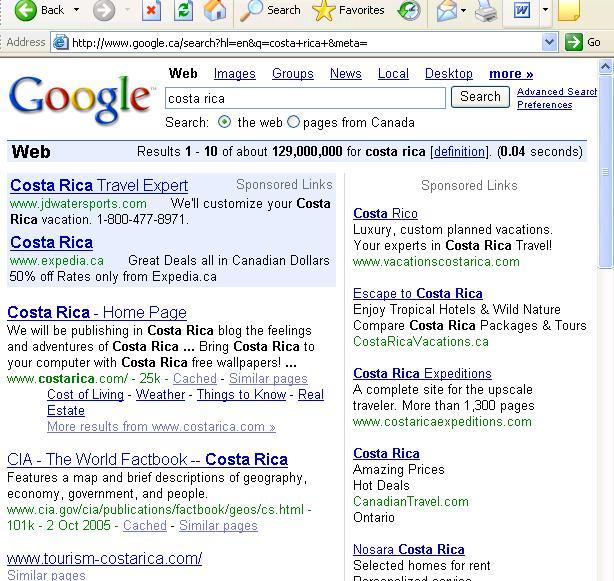
“Search Engine Optimization” has become the tactic of choice for many marketers, and the most powerful example of it is Google’s AdWords service. AdWords is so simple, it terrifies many companies.
AdWords allows marketers to place ads on search results pages when web surfers use specific key words. If you were Burger King, you could make sure your ad popped up under "Sponsored Links"(see example at right) every time someone did a search for McDonald’s. (Yes, I know how expensive that would be. It’s just an example!)
The question is: is this legal? Or does trademark protection mean that other companies have no right to buy or sell ad space on pages that include your trademarks?
The answer is: no one knows. For the first time, one U.S. court (in Virginia) has ruled that what Google is doing is okay. But it drew the line on allowing companies to use competitors’ trademarked names in their own ads. (A lot of people have been running ads that say things like, “Looking for Coca-Cola? Try Pepsi instead.”) And Google has apparently not been very consistent about shutting these offending ads down.
But similar cases are heading toward other U.S. courts, and the experts aren’t sure the AdWords business model can survive them all. Here’s a link to a recent story by Bob Heyman that says the whole thing could end up in the Supreme Court.
Heyman’s conclusion: Marketers shouldn’t worry – yet. In the meantime, “Do be sure that client search ads don't include third party trademarks...
"While lawsuits so far have only named Google as a Defendant, no agency would want to be responsible for having a client be sued as a party to yet another Google lawsuit. And good search practice needs to include policing competitor's ads to be sure they don't infringe your clients' marks. Don't rely on Google to enforce this...
“But nothing about the Geico rulings changes the fact that buying competitors’ trademarked keywords remains a best practice for SEM. Indeed, anecdotal evidence indicates it may well be the most successful of all search tactics.
"However, the wise Search marketer will prepare for the day when a Federal District Court may rule against Google and backup strategies will be needed.”
My take? AdWords is a powerful medium that levels the playing field between entrepreneurs and giant marketing organizations. Expect big business to fight it all the way.
Monday, October 03, 2005
The news story you thought you'd never see
Scientists are now talking seriously about: Teleportation.
According to today's Globe & Mail, "the U.S. military recently spent $25,000 for a report on teleportation by U.S. theoretical physicist Eric W. Davis. He identified several possible types of teleportation, including "psychic teleportation," moving objects through space-time deformities called wormholes, and manipulating empty space or "the cold vacuum."
Apparently, even Einstein is in on this action. Transport yourself here for the full story.
(And guess how the story starts.
If you guessed "Beam me up, Scotty" you too can get a job with The Globe and Mail.)
According to today's Globe & Mail, "the U.S. military recently spent $25,000 for a report on teleportation by U.S. theoretical physicist Eric W. Davis. He identified several possible types of teleportation, including "psychic teleportation," moving objects through space-time deformities called wormholes, and manipulating empty space or "the cold vacuum."
Apparently, even Einstein is in on this action. Transport yourself here for the full story.
(And guess how the story starts.
If you guessed "Beam me up, Scotty" you too can get a job with The Globe and Mail.)
Subscribe to:
Posts (Atom)