PROFIT Magazine’s Pitch4Profit contest has attracted a surprising number of entries. Most are painful to sit through, but that’s Web video for you. It’s still fun to hear about (and see) all these new business ideas and products.
Check out the pitches for less than $1 million here.
You’ll find the folks looking for more than a million here.
And if you can't wait to make your own pitch, you can get your 90-second elevator speech put on tape following the Toronto Venture Group meeting Wednesday morning (Feb. 14).
Special guest at the meeting is Scott Paterson, the former Yorkton Securities superstar who has reinvented himself as CEO of JumpTV (speaking of Web video), which may be the world's leading internet ethnic television broadcaster with 254 channel partnerships and subscribers in 90 countries.
(It’s a bit of a coming-out party for Paterson, who has been pretty quiet since his 2001 agreement with the Ontario Securities Commission to settle allegations that he acted “contrary to the public interest” in helping convince Yorkton clients to buy into a lot of sketchy, tech-related IPOs prior to the 2000 market meltdown.)
Click here for the TVG homepage.
Back to the pitches: Once you've viewed the videos at Pitch4PROFIT, don't forget to leave a comment or vote for your favourites.
If you do make a pitch, come back and let us know. Feel free to ask the whole community at Canadian Entrepreneur to vote for you!
Note: The entry deadline is Feb. 15!

Monday, February 12, 2007

Best-Ever Entrepreneurship Quotes: Week 19
Continuing our series of powerful motivational quotes personally selected to get your week off to a flying start.
This week, the secret advantage of small business:
"One of the unique things we small companies have over the big guys is the ability to establish personal relationships. Big companies really can't do that. You read about effective organizations, learning organizations, lean and mean organizations, but small companies can be virtuous. We as small companies can have virtue because we as small companies are basically the embodiment of one or two people, and people can have virtue, while organizations really can't."
-- Jim Koch, founder of Boston Beer Company, maker of Sam Adams beer.
This week, the secret advantage of small business:
"One of the unique things we small companies have over the big guys is the ability to establish personal relationships. Big companies really can't do that. You read about effective organizations, learning organizations, lean and mean organizations, but small companies can be virtuous. We as small companies can have virtue because we as small companies are basically the embodiment of one or two people, and people can have virtue, while organizations really can't."
-- Jim Koch, founder of Boston Beer Company, maker of Sam Adams beer.
Tuesday, February 06, 2007
Who is... the Greatest Canadian Entrepreneur?
Nominations close Feb. 9 to name Canada's Greatest Entrepreneur of All Time, as part of the festivities around the Year of the Canadian Entrepreneur (see previous post).
I have no idea why they're in such a hurry, but you can cast your vote by clicking here.
You can vote once a day. I voted for Franz Strohsack today. Tomorrow I'll likely vote for someone else.
I have no idea why they're in such a hurry, but you can cast your vote by clicking here.
You can vote once a day. I voted for Franz Strohsack today. Tomorrow I'll likely vote for someone else.
Special Offer if you're looking for a speaker: The Future of Entrepreneurship
I am developing an exciting new presentation, suitable as a luncheon or keynote speech for entrepreneurial organizations, business associations and service clubs.
It’s called The Future of Entrepreneurship, and it’s based on five years of conversations, interviews, trends and original study.
This presentation explores the reasons that entrepreneurship has exploded in this country, and offers 10 reasons why this revolution will not only continue, but grow. Then it looks at the flipside: the challenges facing Canadian entrepreneurs, and why they must become stronger to seize the opportunities of today and tomorrow.
Finally, it looks at innovative strategies developed by today’s most successful Canadian entrepreneurs to survive and win in today’s global, get-tough markets.
It’s everything but the kitchen sink (although a kitchen sink does make an appearance) in 45 minutes.
I’m eager to road-test this speech and get some reaction from live audiences. If you'd like to be among the first to hear this original, informative and empowering presentation, drop me a line.
The first five organizations to book me will get 75% off my usual speaking fee.
For more information, please e-mail Rick (at) rickspence.ca
It’s called The Future of Entrepreneurship, and it’s based on five years of conversations, interviews, trends and original study.
This presentation explores the reasons that entrepreneurship has exploded in this country, and offers 10 reasons why this revolution will not only continue, but grow. Then it looks at the flipside: the challenges facing Canadian entrepreneurs, and why they must become stronger to seize the opportunities of today and tomorrow.
Finally, it looks at innovative strategies developed by today’s most successful Canadian entrepreneurs to survive and win in today’s global, get-tough markets.
It’s everything but the kitchen sink (although a kitchen sink does make an appearance) in 45 minutes.
I’m eager to road-test this speech and get some reaction from live audiences. If you'd like to be among the first to hear this original, informative and empowering presentation, drop me a line.
The first five organizations to book me will get 75% off my usual speaking fee.
For more information, please e-mail Rick (at) rickspence.ca
Other workshop and keynote topics available at regular prices. Feel free to contact me for information:
Secrets of Entrepreneurial Success
20 business-building strategies in 40 minutes
The Four Communication Gaps in Business
Writing for Results
Breakthrough Questions
Get the Publicity you Deserve: PR for CEOs
Why Businesses Fail
Previous testimonials for Rick Spence:
“You gave us a delightful, insightful talk and I want you to know that I carry your list of 10 business success factors in my purse like a portable mantra. I have had very positive comments from our members... It was a pleasure to be with you.”
“Thank you for speaking at our recent conference. Your generosity, preparation and participation were all import to the success of the event. Your event was of extreme interest to our members, and very important to the organization.”
“The audience thoroughly enjoyed your presentation. You were able to set the stage for the balance of the Symposium.”
Straw homes, bongo drums, horror movies and climate change (Long post, but you can quit any time)
You can build businesses on trends – if you can tell a fad from a trend.
A fad, of course, is when one person you know is doing something new or different: e.g., having their baby at home, trekking to Nepal, building a barn. A trend is when you know two people doing it.
Browsing through the “Class Notes” of the latest issue of York University's alumni magazine, I discovered numerous offbeat careers and lifestyle changes that reflect dozens of trends and changes in society.
So here’s a list of interesting choices some people are making these days. Which do you think offer the best business opportunities?
Class of 1970: A female grad is building a straw-bale home.
1978: A musician has just released a new DVD, The Art of Bongo Drumming.
1981: A PhD is teaching archival sciences. A BA grad working for a disaster-services organization also runs a private psychotherapy practice. A couple just bought a Kumon Math and Reading Centre franchise.
1982: A grad is working on South Africa’s National Transportation Master Plan, made more challenging due to South Africa’s hosting of the World Cup in 2010.
1988: One grad is a “Six Sigma Black Belt” with PricewaterhouseCoopers. An MBA grad works for a Texas software company from his home in Thornhill, Ont.
1989: An MBA grad has returned to the west coast to “resume retirement” after taking a break to work on a two-year engineering contract in Ontario.
1992: One grad started her own concierge business in Toronto. Another grad has a job in dispute management for the Canada Revenue Agency. Another grad exchanged vows with his life partner in the Himalayas.
1995: A grad left teaching to go into housing construction.
1996: One grad reported she is working “in a job she enjoys.”
1997: A BA grad has become director of a Centre for Conflict Resolution Studies at UPEI.
1998: A science grad is working as a contaminants-surveillance biologist for the Great Lakes. Two guys named Steven just got engaged. A self-described “artist with disabilities” has just released her third CD.
1999: A BA grad is a technical writer in Australia.
2002: An honours business grad is running several used-car dealerships in Indonesia.
2003: A BA grad is working in marketing for a sci-fi and horror film festival. A science grad is managing Telus’s wholesale U.S. marketing strategy.
2005: A law grad is now a policy analyst for the climate change division of DFAIT in Ottawa.
What’s it all mean? As mass markets fragment, a list like this demonstrates that there are more emerging market niches and new opportunities than any of us can really imagine.
A fad, of course, is when one person you know is doing something new or different: e.g., having their baby at home, trekking to Nepal, building a barn. A trend is when you know two people doing it.
Browsing through the “Class Notes” of the latest issue of York University's alumni magazine, I discovered numerous offbeat careers and lifestyle changes that reflect dozens of trends and changes in society.
So here’s a list of interesting choices some people are making these days. Which do you think offer the best business opportunities?
Class of 1970: A female grad is building a straw-bale home.
1978: A musician has just released a new DVD, The Art of Bongo Drumming.
1981: A PhD is teaching archival sciences. A BA grad working for a disaster-services organization also runs a private psychotherapy practice. A couple just bought a Kumon Math and Reading Centre franchise.
1982: A grad is working on South Africa’s National Transportation Master Plan, made more challenging due to South Africa’s hosting of the World Cup in 2010.
1988: One grad is a “Six Sigma Black Belt” with PricewaterhouseCoopers. An MBA grad works for a Texas software company from his home in Thornhill, Ont.
1989: An MBA grad has returned to the west coast to “resume retirement” after taking a break to work on a two-year engineering contract in Ontario.
1992: One grad started her own concierge business in Toronto. Another grad has a job in dispute management for the Canada Revenue Agency. Another grad exchanged vows with his life partner in the Himalayas.
1995: A grad left teaching to go into housing construction.
1996: One grad reported she is working “in a job she enjoys.”
1997: A BA grad has become director of a Centre for Conflict Resolution Studies at UPEI.
1998: A science grad is working as a contaminants-surveillance biologist for the Great Lakes. Two guys named Steven just got engaged. A self-described “artist with disabilities” has just released her third CD.
1999: A BA grad is a technical writer in Australia.
2002: An honours business grad is running several used-car dealerships in Indonesia.
2003: A BA grad is working in marketing for a sci-fi and horror film festival. A science grad is managing Telus’s wholesale U.S. marketing strategy.
2005: A law grad is now a policy analyst for the climate change division of DFAIT in Ottawa.
What’s it all mean? As mass markets fragment, a list like this demonstrates that there are more emerging market niches and new opportunities than any of us can really imagine.
Monday, February 05, 2007
My latest column in the National Post
My new column in the “Entrepreneur” section of today’s Financial Post is online at the Post’s website today (and still available on newsstands if you hurry).
It tells the story of Shaheel Hooda, a 35-year-old entrepreneur running CodeBaby, an exciting software company in Edmonton that makes 3-d “virtual agents” for customer service portions of websites. The company was founded to license animation software from a local games developer, BioWare, but since then it has blazed its own trail.
The story was supposed to be a profile, but it developed a life of its own as Shaheel described to me some of the company’s mistakes, decisions and life lessons. And so it became a step-by-step guide to one entrepreneur’s education in business (made all the more interesting by the fact he already has a degree from Harvard).
You can read the story here.
Here’s the six lessons learned, for those who have no time to read newspapers:
It tells the story of Shaheel Hooda, a 35-year-old entrepreneur running CodeBaby, an exciting software company in Edmonton that makes 3-d “virtual agents” for customer service portions of websites. The company was founded to license animation software from a local games developer, BioWare, but since then it has blazed its own trail.
The story was supposed to be a profile, but it developed a life of its own as Shaheel described to me some of the company’s mistakes, decisions and life lessons. And so it became a step-by-step guide to one entrepreneur’s education in business (made all the more interesting by the fact he already has a degree from Harvard).
You can read the story here.
Here’s the six lessons learned, for those who have no time to read newspapers:
- Talk to customers. When Hooda arrived at Code Baby as chief executive in 2002, the company was still in stealth mode. "They had multiple concepts of what they wanted to do."
- Simplicity rules. Code- Baby presumed that Bio Ware's artificial intelligence technology would give its clients the most powerful "virtual agents" in the business. Real life, however, indicated clients wanted virtual agents to just follow the scripts they were given (like live call-centre employees).
- Follow the money. CodeBaby learned while most companies support employee training, they don't like to spend as much money on it as they do on other things.
- Avoid exclusives. As much as the company loves blue-chip clients like RBC, it offers customers just six months' exclusivity with its technology before it will talk to their rivals.
- Make things easy for your customers. Code Baby has moved away from proprietary processes to open-source tools like Flash to ensure customers get the most from its products. Tech-savvy companies can walk away with a licence to the technology and develop their own scripts and animations in-house.
- Leverage the biggest price-insensitive market you can find.
Entrepreneurship Quote of the Week, part 18
Continuing our series of powerful motivational quotes personally selected to start your week on an inspiring note.
This week, we hear from a contemporary Canadian entrepreneur who has figured out the difficult business of delegating. It’s a management manifesto in miniature:
“I expect people to work hard and take charge in their areas, but to have the judgement to be able to tell me when they can't handle a situation."
Nick Laperle, president of Sonomax Hearing Healthcare Inc. of Montreal, quoted by Libby Znaimer in the Financial Post, January 27, 2007
This week, we hear from a contemporary Canadian entrepreneur who has figured out the difficult business of delegating. It’s a management manifesto in miniature:
“I expect people to work hard and take charge in their areas, but to have the judgement to be able to tell me when they can't handle a situation."
Nick Laperle, president of Sonomax Hearing Healthcare Inc. of Montreal, quoted by Libby Znaimer in the Financial Post, January 27, 2007
Saturday, February 03, 2007
Your starter guide to Social Media
Sean Moffitt of BuzzCanuck is probly be Canada’s top expert on word-of-mouth marketing – which in these days of wikis and blogs and YouTube and social media can be more powerful than ever.
“Unfortunately,” says Sean, “word of mouth just doesn't happen, and like most great things in life, it starts with a first courageous step into the unknown.”
Fortunately, he has offered 29 links to get you started. I hope he doesn't mind sharing them with you here.
Visit http://buzzcanuck.typepad.com/ for much, much more.
Great introductions to word-of-mouth marketing:
- How To Sell In Word of Mouth Campaigns to Your Boss
- The 10 Steps to Building Your Corporate Podcast
- An Entry Level Guide to Vlogging
- How to Visit Second Life
- How to Be Blogged About
- How Bloggers Should Approach Companies
- How Companies Should Approach Bloggers
- Setting Up in My Space
- Posting on YouTube
- Mastering Word of Mouth Conversations
- Setting Up a Photo Blog
- How to Get Traffic To Your PhotoBlog
- How To Generate Buzz
- How to Use Linked In
- Conducting an SMS Campaign
- Nailing the Tricks to Viral Advertising
- Researching Word of Mouth
- Measuring Word of Mouth
- Keeping it Ethical
- How to Look At Social Media from 3 Corporate Angles
- Steps to Building Brand Communities
- Mastering The Ultimate Question You Should Be Asking
- BuIlding Great Brand Experiences
- Setting Up Corporate Blogging Guidelines
- Building Your Social Media Optimization
- How to build Consumer Generated Media
- How to Harness Happy Employee Word of Mouth
- How to Start a Wiki
Visit Sean’s website http://www.agentwildfire.com/
“Unfortunately,” says Sean, “word of mouth just doesn't happen, and like most great things in life, it starts with a first courageous step into the unknown.”
Fortunately, he has offered 29 links to get you started. I hope he doesn't mind sharing them with you here.
Visit http://buzzcanuck.typepad.com/ for much, much more.
Great introductions to word-of-mouth marketing:
- How To Sell In Word of Mouth Campaigns to Your Boss
- The 10 Steps to Building Your Corporate Podcast
- An Entry Level Guide to Vlogging
- How to Visit Second Life
- How to Be Blogged About
- How Bloggers Should Approach Companies
- How Companies Should Approach Bloggers
- Setting Up in My Space
- Posting on YouTube
- Mastering Word of Mouth Conversations
- Setting Up a Photo Blog
- How to Get Traffic To Your PhotoBlog
- How To Generate Buzz
- How to Use Linked In
- Conducting an SMS Campaign
- Nailing the Tricks to Viral Advertising
- Researching Word of Mouth
- Measuring Word of Mouth
- Keeping it Ethical
- How to Look At Social Media from 3 Corporate Angles
- Steps to Building Brand Communities
- Mastering The Ultimate Question You Should Be Asking
- BuIlding Great Brand Experiences
- Setting Up Corporate Blogging Guidelines
- Building Your Social Media Optimization
- How to build Consumer Generated Media
- How to Harness Happy Employee Word of Mouth
- How to Start a Wiki
Visit Sean’s website http://www.agentwildfire.com/
Friday, February 02, 2007
The New Outlook for Exports
If you're interested in the latest outlook for specific geographical markets, commodities, or selected industrial sectors, look no further.
Export Development Canada's newly revised Global Export Forecast has everything you want to know, from forecasts for advanced technology markets to the outlook for canola prices.
And most of it is surprisingly readable.
Here's the bottom-line forecast, for those with no time to click on the above link:
"For 2007, we now expect a better export performance for agri-food, industrial metals, high-tech goods and communications equipment. Export volumes (where price effects are netted out) are also expected to come in a little stronger in 2007. On the downside, the export outlook for energy, chemicals, fertilizers, forestry, aircraft and services have deteriorated."
Export Development Canada's newly revised Global Export Forecast has everything you want to know, from forecasts for advanced technology markets to the outlook for canola prices.
And most of it is surprisingly readable.
Here's the bottom-line forecast, for those with no time to click on the above link:
"For 2007, we now expect a better export performance for agri-food, industrial metals, high-tech goods and communications equipment. Export volumes (where price effects are netted out) are also expected to come in a little stronger in 2007. On the downside, the export outlook for energy, chemicals, fertilizers, forestry, aircraft and services have deteriorated."
The remarkable coup of Teresa Cascioli
The big news today is Labatt’s $200-million bid for Hamilton-based Lakeport Brewing. It’s one of Ontario’s biggest entrepreneurial success stories.
Teresa Cascioli was brought in by a group of Hamilton investors to revive a bankrupt brewery. She brought it back to life by producing branded alcoholic drinks (I swore not to tell about Mike’s Hard Lemonade) for other companies, as well as producing a line of largely generic beers.
Then in her backyard one day, she came up with the concept of “24 for $24” – the idea of owning the value-priced beer market. With that single, crystal-clear marketing message, she built Lakeport into Ontario's third-largest brewery, with 11% of the market.
And now, according to the Globe & Mail, she stands to make $40 million out of the deal. That’s because she rolled up her sleeves and sacrificed salary for equity – shopping the supermarket specials and drawing down her savings (once earmarked for law school) because she believed so strongly in Lakeport’s future.
Congrats to Teresa, for demonstrating the incredible value of one good idea – and executing so well and so courageously.
Strategic Note: Under Cascioli, Lakeport became Ontario’s third-largest brewer. "This looks quite a bit like an attempt to take out a low-cost competitor," one investment analyst told the Globe in a burst of stunning clarity.
Best Advice: Cascioli was the closing keynote speaker at last year’s Small Business Big Thinking Conference in Toronto, sponsored by Visa Canada. Here are five management lessons she shared with the audience:
• Be passionate and work hard.
• Listen to your employees. Their insights can give you a competitive advantage.
• Partner well. Surround yourself with good advisors (lawyers, bankers, accountants), and
don’t nickel-and-dime them.
• When you think you've done well, forget it. Don't rest on your laurels or do things just to
win awards.
• Whenever you're in front of a microphone, sell, sell, sell!
(For more on Cascioli's Visa presentation, or other presentations from the conference, click here.)
Disclosure: I helped plan the conference last year, and am doing so again in 2007.
Teresa Cascioli was brought in by a group of Hamilton investors to revive a bankrupt brewery. She brought it back to life by producing branded alcoholic drinks (I swore not to tell about Mike’s Hard Lemonade) for other companies, as well as producing a line of largely generic beers.
Then in her backyard one day, she came up with the concept of “24 for $24” – the idea of owning the value-priced beer market. With that single, crystal-clear marketing message, she built Lakeport into Ontario's third-largest brewery, with 11% of the market.
And now, according to the Globe & Mail, she stands to make $40 million out of the deal. That’s because she rolled up her sleeves and sacrificed salary for equity – shopping the supermarket specials and drawing down her savings (once earmarked for law school) because she believed so strongly in Lakeport’s future.
Congrats to Teresa, for demonstrating the incredible value of one good idea – and executing so well and so courageously.
Strategic Note: Under Cascioli, Lakeport became Ontario’s third-largest brewer. "This looks quite a bit like an attempt to take out a low-cost competitor," one investment analyst told the Globe in a burst of stunning clarity.
Best Advice: Cascioli was the closing keynote speaker at last year’s Small Business Big Thinking Conference in Toronto, sponsored by Visa Canada. Here are five management lessons she shared with the audience:
• Be passionate and work hard.
• Listen to your employees. Their insights can give you a competitive advantage.
• Partner well. Surround yourself with good advisors (lawyers, bankers, accountants), and
don’t nickel-and-dime them.
• When you think you've done well, forget it. Don't rest on your laurels or do things just to
win awards.
• Whenever you're in front of a microphone, sell, sell, sell!
(For more on Cascioli's Visa presentation, or other presentations from the conference, click here.)
Disclosure: I helped plan the conference last year, and am doing so again in 2007.
YokeSmoke's resource list of entrepreneurial sites
One more gala birthday post.
Here's a list of entrepreneurial blogs and websites dug up by YokeSmoke, a blog for Web 2.0 entrepreneurs.
If you have a minute, why not check some out? In the spirit of Web 2.0 community, you could even leave a comment if you find anything of value on any of these sites.
Happy Surfing! Canadian entrepreneurs will thank you.
Forums
Site Point
Digital Point
Young Go Getter
Young Entrepreneur Forums
WebmasterWorld
SitePoint
SEO Chat
TalkSEO Forums
TheWarriorForum - Online Marketing
WebHostingTalk
Webmaster-Talk
Blogs
Entrepreneur’s Journey
Trizoko Business Journal
Guy Kawasaki’s Blog
Ben Casnocha’s Blog
Josiah MacKenzie’s Blog
Problogger - Darren Rowse
On Startups
Startup Nation
Startup Guide
Flush the Toilet
Young Money Blog
Networking Blogger
Just a Week
New Age Entrepreneur
MBA Xploit
The Entrepreneurial Endeavor
Trep Network
Entrepreneur in the Making
Scott Taylor’s Blog
Mind Petals
Dorm Room Biz
Blogtrepreneur.com
EntrepreneursBlog.eu
Driven Entrepreneur
ePublishing Daily
Results Driven Solutions
PA Services
Free Internet Marketing Resources
Selling to Small Business
Canadian Entrepreneur
Jack Yoest
Emmanuel’s “Business Traveller”
Selling it Online
Wil Schroter
Customer Experience Strategy
Local Internet Marketing
Small Business Trends
Virtual Assistant - THE Blog
CoolBusinessIdeas.com
Duct Tape Marketing
Online Marketing Resource Blog
Ben Reich
R.E.A.L. Marketing
Burts osCommerce & More Blog
Blog SEO
Internet Marketing Blog Directory
The Marketing Tools Review
Professional Freelancer
Steven Cardinale
Java Entrepreneur
WorkHappy
To-Done
Venturus
Craig McGinty
Marketing Headhunter.com
Wise & Young: The Blog
The Millionaire Blog
BarryBlog - Barry Moltz
Business Opportunities Weblog - Dane Carlson
HomeOfficeVoice - Martin Neumann
PlusOne - Matt E
SavvySolo - Michael Pollock
Apollyon - Alborz Fallah
The Marketer’s Podcast - Alan & Andrew
A crash course in entrepreneurship - Chris Pund
Thinking Home Business - Des Walsh
Young Entrepreneur Journey
Retire Young And Wealthy
Affiliate Moneymaking
Dave Ryan’s Internet Marketing Blog
Attract More Customers
Marketing Defined Blog
Marketing Comet
Spiritual Marketing
IF from PSFK
PSFK
Trigger
KeyLiberty Marketing
Franco’s e-commerce World
The Bar Project Project
Higher Profits
The Internet Cashflow Guy
Reid Morrow
Rohailrizvi
Magazines
Entrepreneur Magazine - [ Entrepreneur.com ]
Fast Company Magazine - [ FastCompany.com ]
Inc. Magazine - [ Inc.com ]
Business 2.0 Magazine - [ Business 2.0 Site ]
Wired Magazine - [ Wired.com ]
Harvard Business Review
Home Business Magazine
Business Resource Center
BusinessWeek Small Business
Home Business Journal
Home Business Magazine
Minority Business Entrepreneur (MBE)
PROFITguide
Joshua Feinberg’s Small Biz Tech Talk
EasilyWealthy.com
Fortune Small Business
Biztalk
Work-At-Home Success
ZDNet Small Business Advisor
Home Business Report
Upsize Magazine
Smart Business Network Online
Entrepreneur’s Home Office Magazine
Edward Lowe PeerSpectives
CanadaOne Magazine
Articles, & News Sites
Entrepreneur America - Rob Ryan
The Secret to Successful Startups
Where are all the Angel Investors?
The Notion of Entrepreneurship: Historical and Emerging Issues
The Entrepreneur’s Help Page
Free Legal Forms
Entrepreneur Career Guide
Minority Business Entrepreneur Magazine
Small Business Resource Sites
Small Business Adminstration (SBA)
Business.gov
SCORE
eVenturing.org
Idea Cafe
Business Know How
Yahoo Small Business
Working Solo
Power Home Business
Guru.com
eLance.com
Rentacoder.com
Finance
22 Dollars
Personal Money Tips
Quicken Small Business
The Money Spot
The Million Dollar Portfolio
Expletus Blogger
Financial Freedom 4 All
The Dividend Guy
Very Personal Finance
Byrne’s Marketview
MyMoneyBlog
Venture Capitalists
William Tai, Charles River Ventures
Devin Thorpe, Thorpe Capital Group
Ari Newman, Newman Venture Advisors
Tim Keane, Kohler Center at Marquette University
Stu Phillips, Ridgelift Ventures
Robert Goldberg, Ridgelift Ventures
Stewart Alsop, Alsop Louie Partners
Sophie Forest, Mark Skapinker, Tony Davis, Brightspark Ventures
Kara Nortman, Battery Ventures
Leland Cheung, Masthead Venture Partners
Personal Growth
Can You Become Good At Everything?
StevePavlina.com
Success Begins Today
Internet & Technology
Web Teacher - Resources for teaching web design
Skype Journal
Entrepreneur Podcasts
500 Entrepreneur Podcasts on Loomia
Entrepreneur Podcasts on Odeo
Entrepreneur Podcasts on Podomatic
Venture Voice
Venture Week
IT Conversations
American Copywriter
Revision 3
WebMaster Radio
PodTech
The Marketer’s Podcast
SavvySoloCAST
Here's a list of entrepreneurial blogs and websites dug up by YokeSmoke, a blog for Web 2.0 entrepreneurs.
If you have a minute, why not check some out? In the spirit of Web 2.0 community, you could even leave a comment if you find anything of value on any of these sites.
Happy Surfing! Canadian entrepreneurs will thank you.
Forums
Site Point
Digital Point
Young Go Getter
Young Entrepreneur Forums
WebmasterWorld
SitePoint
SEO Chat
TalkSEO Forums
TheWarriorForum - Online Marketing
WebHostingTalk
Webmaster-Talk
Blogs
Entrepreneur’s Journey
Trizoko Business Journal
Guy Kawasaki’s Blog
Ben Casnocha’s Blog
Josiah MacKenzie’s Blog
Problogger - Darren Rowse
On Startups
Startup Nation
Startup Guide
Flush the Toilet
Young Money Blog
Networking Blogger
Just a Week
New Age Entrepreneur
MBA Xploit
The Entrepreneurial Endeavor
Trep Network
Entrepreneur in the Making
Scott Taylor’s Blog
Mind Petals
Dorm Room Biz
Blogtrepreneur.com
EntrepreneursBlog.eu
Driven Entrepreneur
ePublishing Daily
Results Driven Solutions
PA Services
Free Internet Marketing Resources
Selling to Small Business
Canadian Entrepreneur
Jack Yoest
Emmanuel’s “Business Traveller”
Selling it Online
Wil Schroter
Customer Experience Strategy
Local Internet Marketing
Small Business Trends
Virtual Assistant - THE Blog
CoolBusinessIdeas.com
Duct Tape Marketing
Online Marketing Resource Blog
Ben Reich
R.E.A.L. Marketing
Burts osCommerce & More Blog
Blog SEO
Internet Marketing Blog Directory
The Marketing Tools Review
Professional Freelancer
Steven Cardinale
Java Entrepreneur
WorkHappy
To-Done
Venturus
Craig McGinty
Marketing Headhunter.com
Wise & Young: The Blog
The Millionaire Blog
BarryBlog - Barry Moltz
Business Opportunities Weblog - Dane Carlson
HomeOfficeVoice - Martin Neumann
PlusOne - Matt E
SavvySolo - Michael Pollock
Apollyon - Alborz Fallah
The Marketer’s Podcast - Alan & Andrew
A crash course in entrepreneurship - Chris Pund
Thinking Home Business - Des Walsh
Young Entrepreneur Journey
Retire Young And Wealthy
Affiliate Moneymaking
Dave Ryan’s Internet Marketing Blog
Attract More Customers
Marketing Defined Blog
Marketing Comet
Spiritual Marketing
IF from PSFK
PSFK
Trigger
KeyLiberty Marketing
Franco’s e-commerce World
The Bar Project Project
Higher Profits
The Internet Cashflow Guy
Reid Morrow
Rohailrizvi
Magazines
Entrepreneur Magazine - [ Entrepreneur.com ]
Fast Company Magazine - [ FastCompany.com ]
Inc. Magazine - [ Inc.com ]
Business 2.0 Magazine - [ Business 2.0 Site ]
Wired Magazine - [ Wired.com ]
Harvard Business Review
Home Business Magazine
Business Resource Center
BusinessWeek Small Business
Home Business Journal
Home Business Magazine
Minority Business Entrepreneur (MBE)
PROFITguide
Joshua Feinberg’s Small Biz Tech Talk
EasilyWealthy.com
Fortune Small Business
Biztalk
Work-At-Home Success
ZDNet Small Business Advisor
Home Business Report
Upsize Magazine
Smart Business Network Online
Entrepreneur’s Home Office Magazine
Edward Lowe PeerSpectives
CanadaOne Magazine
Articles, & News Sites
Entrepreneur America - Rob Ryan
The Secret to Successful Startups
Where are all the Angel Investors?
The Notion of Entrepreneurship: Historical and Emerging Issues
The Entrepreneur’s Help Page
Free Legal Forms
Entrepreneur Career Guide
Minority Business Entrepreneur Magazine
Small Business Resource Sites
Small Business Adminstration (SBA)
Business.gov
SCORE
eVenturing.org
Idea Cafe
Business Know How
Yahoo Small Business
Working Solo
Power Home Business
Guru.com
eLance.com
Rentacoder.com
Finance
22 Dollars
Personal Money Tips
Quicken Small Business
The Money Spot
The Million Dollar Portfolio
Expletus Blogger
Financial Freedom 4 All
The Dividend Guy
Very Personal Finance
Byrne’s Marketview
MyMoneyBlog
Venture Capitalists
William Tai, Charles River Ventures
Devin Thorpe, Thorpe Capital Group
Ari Newman, Newman Venture Advisors
Tim Keane, Kohler Center at Marquette University
Stu Phillips, Ridgelift Ventures
Robert Goldberg, Ridgelift Ventures
Stewart Alsop, Alsop Louie Partners
Sophie Forest, Mark Skapinker, Tony Davis, Brightspark Ventures
Kara Nortman, Battery Ventures
Leland Cheung, Masthead Venture Partners
Personal Growth
Can You Become Good At Everything?
StevePavlina.com
Success Begins Today
Internet & Technology
Web Teacher - Resources for teaching web design
Skype Journal
Entrepreneur Podcasts
500 Entrepreneur Podcasts on Loomia
Entrepreneur Podcasts on Odeo
Entrepreneur Podcasts on Podomatic
Venture Voice
Venture Week
IT Conversations
American Copywriter
Revision 3
WebMaster Radio
PodTech
The Marketer’s Podcast
SavvySoloCAST
Thursday, February 01, 2007
Happy Birthday, Two-Year-Old
It’s Feb. 1, and that means this very blog is two years old today.
Since then we’ve had 425 posts and more than 17,000 visitors. Alexa.com ranks this as the 910,087th-most popular site on the Internet. I thank you for your support.
As a birthday present to you, I have renovated the “Most Popular Posts” section in the right-hand column. You can now catch up on the best posts of the past two years with a single click. New entries range from “Are you ready for recession?" to Rick’s advice for better blogging and more powerful writing.
What’s the best part of blogging? Having a reason to sort your thoughts out on paper. Providing people with helpful information that can make a difference in their lives. And being part of a global dialogue. The accompanying map shows the location of the last 100 people to visit this site – from Indonesia and Australia to Iceland and Nizhni Novogrod.
Skol!
Since then we’ve had 425 posts and more than 17,000 visitors. Alexa.com ranks this as the 910,087th-most popular site on the Internet. I thank you for your support.
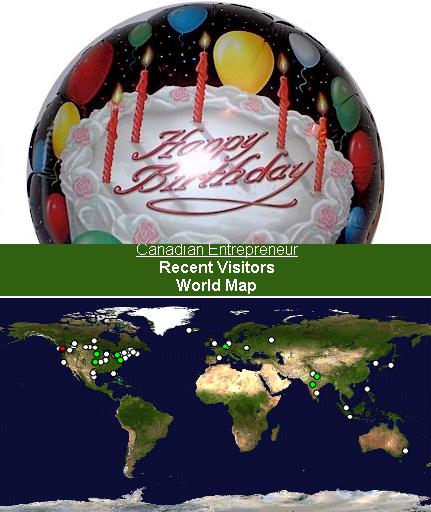
As a birthday present to you, I have renovated the “Most Popular Posts” section in the right-hand column. You can now catch up on the best posts of the past two years with a single click. New entries range from “Are you ready for recession?" to Rick’s advice for better blogging and more powerful writing.
What’s the best part of blogging? Having a reason to sort your thoughts out on paper. Providing people with helpful information that can make a difference in their lives. And being part of a global dialogue. The accompanying map shows the location of the last 100 people to visit this site – from Indonesia and Australia to Iceland and Nizhni Novogrod.
Skol!
New Small Business Statistics
How many Canadian Entrepreneurs are there, anyhow? (about 2.3 million)
Who creates more jobs, small biz or big biz? (pretty much a tie – as of the latest stats, 48% [second quarter of 2006])
How much does small business contribute to Canada’s GDP? (about 22% as of 2005, down from 27% 10 years earlier. The decline is probably to be expected, given the phenomenal growth of big business and mergers & acquisitions in this country - due to the fact that so much more risk capital is available to big businesses than to small ones).
How many small businesses use e-commerce? (about 33% have websites, but only 6% actually sell online).
All this data and much, much more is available from Industry Canada’s “Key Small Business Statistics” report, newly updated for January, 2007. Should be good for winning a few bar bets.
For more information on these and many other trends, see the full report online .
Or download the PDF version here.
Who creates more jobs, small biz or big biz? (pretty much a tie – as of the latest stats, 48% [second quarter of 2006])
How much does small business contribute to Canada’s GDP? (about 22% as of 2005, down from 27% 10 years earlier. The decline is probably to be expected, given the phenomenal growth of big business and mergers & acquisitions in this country - due to the fact that so much more risk capital is available to big businesses than to small ones).
How many small businesses use e-commerce? (about 33% have websites, but only 6% actually sell online).
All this data and much, much more is available from Industry Canada’s “Key Small Business Statistics” report, newly updated for January, 2007. Should be good for winning a few bar bets.
For more information on these and many other trends, see the full report online .
Or download the PDF version here.
Tuesday, January 30, 2007
Maxime Bernier and the "secret sauce" of entrepreneurship
I just ran across this ridiculous speech from Industry Minister Maxime Bernier. Speaking in Saskatoon last September, he proved that he (or his speechwriter) doesn't really understand entrepreneurship.
I had no problem with this part:
The Beauce is a beautiful, remote region, just north of Maine’s moose country. Everything he says about the entrepreneurial spirit of the region is true. It’s great to have an industry minister (even a lawyer who used to work in insurance) who understands what innovation is all about:
Entrepreneurship is not just innovation. The essence of entrepreneurship is not producing something new – it is taking a risk to work towards a goal that may provide a reward. It is the belief that the goal is more than worth the risk.
Without risk there is no entrepreneurship. When a teacher turns a hard subject into a game, that is good teaching - and it may be innovation. But it is not entrepreneurship, because there is no evident risk. There is no attempt to pursue that innovation to a larger end. There is no conception of the reward for leveraging that game, that lesson, to help other students and teachers in the world.
When that teacher takes a risk and remodels the game into a product, and spends time and money seeking out distributors and retailers, that is when innovation becomes entrepreneurship.
I don't mean to be all haughty about it. But entrepreneurship is a precious thing, a fragile sense of confidence that must be continually reinforced and supported. If our government, our culture and our institutions don't support risk-taking as the fundamental basis of entrepreneurship, they're off course before they've begun.
I had no problem with this part:
"The first thing you should know about me is that I am from the Beauce, the region along the Chaudière River south of Québec. The Beauce is unique in Quebec — it is well known as the most entrepreneurial region of the province…. This is where I learned the values that go with entrepreneurship: individual freedom, integrity, responsibility and self-reliance. When I am defending economic freedom and entrepreneurship, I am defending what to me are “les valeurs beauceronnes” — the values of my native Beauce.”
The Beauce is a beautiful, remote region, just north of Maine’s moose country. Everything he says about the entrepreneurial spirit of the region is true. It’s great to have an industry minister (even a lawyer who used to work in insurance) who understands what innovation is all about:
"I grew up believing that when we are free to create and to innovate, and to reap the benefit of our work, all human beings will tend to exhibit some quality of entrepreneurship. And by embracing these ideals we will make the world better, for ourselves and for everybody else at the same time."But this is going too far:
"You can be an entrepreneur in your own field, since there is always something to improve whatever we do. A hairdresser who develops an ability to match heads with new hairstyles is an entrepreneur. An industrial worker who finds a faster way to assemble a machine is an entrepreneur. A teacher who uses games to keep his students interested in mathematics is an entrepreneur.This is hogwash. The minister here is talking about innovation, not entrepreneurship. I feel strongly about this, because if we are to truly appreciate and encourage entrepreneurship in Canada, we need a precise understanding of what it is.
"All these people create something of a greater value. They do it not only because they can earn more money. They do it because it makes their jobs more interesting, because it gives meaning to their lives, because they believe that they can make a difference."
Entrepreneurship is not just innovation. The essence of entrepreneurship is not producing something new – it is taking a risk to work towards a goal that may provide a reward. It is the belief that the goal is more than worth the risk.
Without risk there is no entrepreneurship. When a teacher turns a hard subject into a game, that is good teaching - and it may be innovation. But it is not entrepreneurship, because there is no evident risk. There is no attempt to pursue that innovation to a larger end. There is no conception of the reward for leveraging that game, that lesson, to help other students and teachers in the world.
When that teacher takes a risk and remodels the game into a product, and spends time and money seeking out distributors and retailers, that is when innovation becomes entrepreneurship.
I don't mean to be all haughty about it. But entrepreneurship is a precious thing, a fragile sense of confidence that must be continually reinforced and supported. If our government, our culture and our institutions don't support risk-taking as the fundamental basis of entrepreneurship, they're off course before they've begun.
Monday, January 29, 2007
A new low in customer service
Here’s today's new low in customer service. I called a communications company in the States today and got this message:
“You have reached the 20th floor of (company name). If you must leave a message, please do so at the tone.”
This is a media company that doesn't hesitate to stuff its opinions down its customers’ throats. But it would rather not hear back from any of them.
Can such arrogance last in today's "you-first" digital-media culture?
“You have reached the 20th floor of (company name). If you must leave a message, please do so at the tone.”
This is a media company that doesn't hesitate to stuff its opinions down its customers’ throats. But it would rather not hear back from any of them.
Can such arrogance last in today's "you-first" digital-media culture?
Best-Ever Entrepreneurship Quotes: Week 17
Continuing our series of powerful motivational quotes personally selected to get your week off to an inspiring start.
This week: how to keep a customer.
“Get to know your clients. Go where they are. Try to meet with them as often as you can without making a pest of yourself. Shake their hands and look them in the eye, and always follow through with what you say.”
- Anonymous Canadian entrepreneur, from the June 1999 issue of PROFIT Magazine
This was from a story called “The Best Startup Advice You’ll Ever Get” – in which we quoted every single entrepreneur on the PROFIT 100 list of Canada’s Fastest-Growing Companies. Sure, some were better than others, and there was some duplication, but every single piece of advice they offered was a gem.
PROFIT’s Kim Shiffman compiled a similar article in June 2006, but I just realized it’s not online. I’ll email them and suggest they post it for all to see.
This week: how to keep a customer.
“Get to know your clients. Go where they are. Try to meet with them as often as you can without making a pest of yourself. Shake their hands and look them in the eye, and always follow through with what you say.”
- Anonymous Canadian entrepreneur, from the June 1999 issue of PROFIT Magazine
This was from a story called “The Best Startup Advice You’ll Ever Get” – in which we quoted every single entrepreneur on the PROFIT 100 list of Canada’s Fastest-Growing Companies. Sure, some were better than others, and there was some duplication, but every single piece of advice they offered was a gem.
PROFIT’s Kim Shiffman compiled a similar article in June 2006, but I just realized it’s not online. I’ll email them and suggest they post it for all to see.
Saturday, January 27, 2007
Four sales lessons from 2006
Warning: Ally Motz, CEO of management-services provider SiriusDecisions Canada, uses a lot of big words. But he’s done some serious thinking about the latest trends in sales and marketing.
In an article in the latest issue of SalesExchange, published by the Canadian Professional Sales Association, he shares four key lessons his firm learned last year, and looks at how these findings could shake out in 2007. Here's my edited version.
“Productivity” is now the in word. Since the dawn of time, sales productivity has meant one word – revenue. Now that’s changing.
Motz defines sales productivity as the measure of time and effort expended by salespeople to create the high-quality, customer-relevant interactions required to advance and eventually close an opportunity. Organizations that track salespeople’s ability to be efficient and effective with these interactions, and then consistently help them to improve, will have many options to drive better performance.
Shared metrics are becoming all the rage. More b-to-b organizations are creating funnels that depict the end-to-end demand process, and measuring the ability of sales and marketing to convert at five key junctures: response, marketing-qualified lead, sales-accepted lead, sales-qualified lead and closed business.
Next-generation funnels must consider the reputation activities that are seeding demand programs at the top of the funnel, building out the link between what Motz calls reputation and demand creation.
The technology is beginning to catch up to aspirations. Disappointed by traditional technologies such as CRM and SFA, SiriusDecisions’ clients have moved forward in three distinct areas: communications measurement, marketing platforms and customized sales communications.
Still, many organizations continue to hope that the implementation of these technologies will solve their sales and marketing-integration issues – only to find that their functionality is limited due to a lack of shared vision and co--operation from either sales or marketing.
Operations isn’t just for number-crunchers any more. Progressive sales organizations have shifted the focus of sales operations to that of sales effectiveness, including the oversight of tasks such as sales training and development, sales programs (centralized briefings, demos, proposals), and sales technologies (CRM, SFA, etc.).
On the marketing side, operations is being used to standardize processes to facilitate successful marketing decentralization, create joint metrics with sales and drive synergies in programs and communications between product lines. Organizations that continue to view operations as only an administrative function will find that these other tasks will remain unstructured and underused, forcing reps and marketers alike to solve their own problems ad-hoc.
See the full article here.
In an article in the latest issue of SalesExchange, published by the Canadian Professional Sales Association, he shares four key lessons his firm learned last year, and looks at how these findings could shake out in 2007. Here's my edited version.
“Productivity” is now the in word. Since the dawn of time, sales productivity has meant one word – revenue. Now that’s changing.
Motz defines sales productivity as the measure of time and effort expended by salespeople to create the high-quality, customer-relevant interactions required to advance and eventually close an opportunity. Organizations that track salespeople’s ability to be efficient and effective with these interactions, and then consistently help them to improve, will have many options to drive better performance.
Shared metrics are becoming all the rage. More b-to-b organizations are creating funnels that depict the end-to-end demand process, and measuring the ability of sales and marketing to convert at five key junctures: response, marketing-qualified lead, sales-accepted lead, sales-qualified lead and closed business.
Next-generation funnels must consider the reputation activities that are seeding demand programs at the top of the funnel, building out the link between what Motz calls reputation and demand creation.
The technology is beginning to catch up to aspirations. Disappointed by traditional technologies such as CRM and SFA, SiriusDecisions’ clients have moved forward in three distinct areas: communications measurement, marketing platforms and customized sales communications.
Still, many organizations continue to hope that the implementation of these technologies will solve their sales and marketing-integration issues – only to find that their functionality is limited due to a lack of shared vision and co--operation from either sales or marketing.
Operations isn’t just for number-crunchers any more. Progressive sales organizations have shifted the focus of sales operations to that of sales effectiveness, including the oversight of tasks such as sales training and development, sales programs (centralized briefings, demos, proposals), and sales technologies (CRM, SFA, etc.).
On the marketing side, operations is being used to standardize processes to facilitate successful marketing decentralization, create joint metrics with sales and drive synergies in programs and communications between product lines. Organizations that continue to view operations as only an administrative function will find that these other tasks will remain unstructured and underused, forcing reps and marketers alike to solve their own problems ad-hoc.
See the full article here.
Friday, January 26, 2007
Pitch for Profit!
If you think your business could benefit from a dose of venture capital, but don't know whom to pitch – PROFIT Magazine has a contest for you!
“Pitch 4 Profit” is a Web-based contest in which you record a 90–second pitch for funds, and upload it to PROFIT's website. The contestants with the most compelling presentations (as determined by the judges and the public) will win a chance to present in front of a real audience of potential investors:
* The top three winning companies that are trying to raise less than $1 million will receive a chance to audition for the second season of Dragons’ Den, the CBC-TV show that puts real entrepreneurs in front of self-made millionaires looking for angel-investment opportunities;
* Three companies looking for $1 million or more will win a chance to pitch in front of the assembled venture capitalists at the Canadian Venture Forum, held March 4-6 in Toronto.
Entries will be judged by a three-man investment panel consisting of VC consultant Sean Wise, Rick Segal of JL Albright Venture Partners, and Salim Teja, vice-president of Brightspark Ventures.
While all three are best known for their tech expertise, I am assured that they will consider all entries, including the “boardgames and salad dressing” types of ventures that were so prevalent this season on Dragons’ Den.
So go for it! For more information, to read up on the guidelines for a perfect pitch (remember: Pain Statement + Value Proposition = Elevator Pitch), or to submit your video, click here.
Click here too to watch (and vote on) other people’s video pitches. (They should start coming in soon.)
But move fast: Contest closes Feb. 15, and public voting closes Feb. 19!
Wednesday, January 24, 2007
This is what marketing is all about
Kodak - Winds of Change
This is a brilliant video from YouTube. It's a 3-minute Kodak commercial produced for internal use that proved so popular they've released it publicly.
Click the screen once or twice to see what could be the best Web 2.0 marketing move of the year.
It takes what was great about Kodak, shakes it up and down, admits the company's faults, and then throws down the gauntlet for the future. Masterful stuff.
(Turn your volume down. The announcer may get a little excited. )
"They've got things in their research labs that will make biometrics look like a Happy Meal toy!"
This is a brilliant video from YouTube. It's a 3-minute Kodak commercial produced for internal use that proved so popular they've released it publicly.
Click the screen once or twice to see what could be the best Web 2.0 marketing move of the year.
It takes what was great about Kodak, shakes it up and down, admits the company's faults, and then throws down the gauntlet for the future. Masterful stuff.
(Turn your volume down. The announcer may get a little excited. )
"They've got things in their research labs that will make biometrics look like a Happy Meal toy!"
Monday, January 22, 2007
Surviving the minefield of venture capital
My latest (i.e., my second) Financial Post column is up on the Post’s website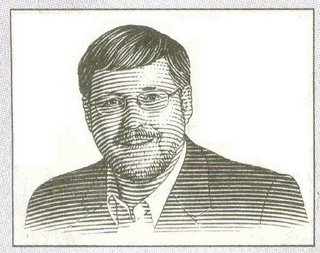 . To learn about some of the deadliest landmines facing entrepreneurs who think they want to attract venture-capital investment, click here.
I've always admired the little engraved headshots used to decorate the columns of various writers at the Financial Post – so I am delighted to now have one of my own. I think it’s kinda cute.
 . To learn about some of the deadliest landmines facing entrepreneurs who think they want to attract venture-capital investment, click here.
I've always admired the little engraved headshots used to decorate the columns of various writers at the Financial Post – so I am delighted to now have one of my own. I think it’s kinda cute.
Best-Ever Entrepreneurship Quotes: Week 16
Continuing our series of powerful motivational quotes personally selected to get your week off to an inspiring start.
For all the marketers in the house:
"If people around you will not hear you, fall down before them and beg their forgiveness, for in truth you are to blame.”
Fyodor Dostoyevsky
You can't go blaming the market for not cozying up to your product. Communication is YOUR job.
For all the marketers in the house:
"If people around you will not hear you, fall down before them and beg their forgiveness, for in truth you are to blame.”
Fyodor Dostoyevsky
You can't go blaming the market for not cozying up to your product. Communication is YOUR job.
Thursday, January 18, 2007
Don't Bore Your Team: The Leadership Wisdom of Craig MacTavish
It’s a shame more Canadians don't get to read Alberta Venture magazine*. AV provides blanket coverage of business (big and small) in Canada’s fastest-growing province, with wit and style.
And sometime it’s got great information anyone can benefit from.

The November issue, for instance, offered an incisive great interview with Craig MacTavish, the former journeyman hockey player who emerged as a creative and winning coach last spring when he led his Edmonton Oilers to the Stanley Cup finals.
“Craig’s List” of top ten leadership tips should be required reading for anyone in business:
1. Treat players equally. Put no one on a pedestal above the others.
2. Be tolerant of mistakes; otherwise players won’t take necessary risks.
3. Don’t expect players to perform beyond their capability.
4. Be patient with players’ shortcomings.
5. Let players know that you care about them as human beings.
6. Give support to a player in a slump.
7. Involve players in your thoughts and beliefs.
8. Don’t bore your players with too-long and poorly prepared meetings.
9. Present your game plan in a way that players get confident that your ideas are solid.
10. Instill in your team a belief in success.
You can read the full article here.
And sometime it’s got great information anyone can benefit from.

The November issue, for instance, offered an incisive great interview with Craig MacTavish, the former journeyman hockey player who emerged as a creative and winning coach last spring when he led his Edmonton Oilers to the Stanley Cup finals.
“Craig’s List” of top ten leadership tips should be required reading for anyone in business:
1. Treat players equally. Put no one on a pedestal above the others.
2. Be tolerant of mistakes; otherwise players won’t take necessary risks.
3. Don’t expect players to perform beyond their capability.
4. Be patient with players’ shortcomings.
5. Let players know that you care about them as human beings.
6. Give support to a player in a slump.
7. Involve players in your thoughts and beliefs.
8. Don’t bore your players with too-long and poorly prepared meetings.
9. Present your game plan in a way that players get confident that your ideas are solid.
10. Instill in your team a belief in success.
You can read the full article here.
Wednesday, January 17, 2007
No teeth, no glory
A while back I was asked to participate in a “graduation day” ceremony for prospective entrepreneurs who had just finished business startup training through the Toronto Business Development Centre.
The grads presented their business plans to a panel consisting of their instructors and me.
It was sort of like Dragons’ Den, the TV show pitting investors against entrepreneurs. Except the mood here was one of graduation-day celebration, rather than the merciless interrogation that the pitchers on Dragons’ Den went through.
Which of course left me in a quandary. When the “students” presented what I thought was faulty logic, or were missing some key connections, what was my role? To keep the mood light and say, “good job,” or go all serious on them? *
My recent column in PROFIT Magazine tells the whole story. Click here.
Excerpt, for those too busy to click:
“I've argued before that marketing is the glass jaw of Canadian entrepreneurs. But there is no excuse for someone coming out of a business startup program not to put marketing front and centre. I thought Google's targeted AdSense messages (online ads you pay for only when someone clicks through to your website) would be perfect for one of these businesses, but the entrepreneurs had never even heard of them.
"And the basic idea of guerrilla marketing — saving your money by piggybacking on other people's contacts and sales efforts — seemed to be a concept they hadn't heard before.”
(Last chance: click here for the full article.)
* You can probably guess how I resolved the dilemma. I feel that sending entrepreneurs out into the world without testing their knowledge and pushing them to the limit is insane. The harder you push them, the more they will be thankful for it later, when the world is pushing back harder than they ever expected.
Monday, January 15, 2007
"Gasoline you pour on a smouldering flame"
I had a great chat last week with Suzie Dingwall Williams, a lawyer and former venture capitalist now with Venutre Law in Toronto. She works with growth-oriented entrepreneurs to help their businesses make the right decisions, especially about venture capital.
She agreed with me that too many companies think they deserve venture capital money when they don't. VC money, after all, has traditionally been reserved for a very tiny group of growth-oriented companies with huge (usually worldwide) potential and defensible niches.
“A true VC kind of risk investment has such a disruptive business model or technology that there’s no real model for it yet,” says Suzy. “Nobody is going to back it unless they're willing to risk all their [investment] for a 1,000% return.”
“VC money is gasoline you pour on a smouldering flame.”
Canadian entrepreneurs with more modest growth ambitions often wonder why they can't get venture capital. Here’s your answer: unless you're a smoldering flame waiting to be sparked into a forest fire, you just ain’t their type.
The same conundrum, of course, afflicted the CBC’s Dragons' Den last fall. The entrepreneurs promoting their businesses thought they were pitching a small business investment opportunity.
Nobody told them that the investors (the dragons) were looking to invest in big businesses that are just temporarily small.
You can read more about Suzie in my Financial Post column next week. Or check out her blog here.
She agreed with me that too many companies think they deserve venture capital money when they don't. VC money, after all, has traditionally been reserved for a very tiny group of growth-oriented companies with huge (usually worldwide) potential and defensible niches.
“A true VC kind of risk investment has such a disruptive business model or technology that there’s no real model for it yet,” says Suzy. “Nobody is going to back it unless they're willing to risk all their [investment] for a 1,000% return.”
“VC money is gasoline you pour on a smouldering flame.”
Canadian entrepreneurs with more modest growth ambitions often wonder why they can't get venture capital. Here’s your answer: unless you're a smoldering flame waiting to be sparked into a forest fire, you just ain’t their type.
The same conundrum, of course, afflicted the CBC’s Dragons' Den last fall. The entrepreneurs promoting their businesses thought they were pitching a small business investment opportunity.
Nobody told them that the investors (the dragons) were looking to invest in big businesses that are just temporarily small.
You can read more about Suzie in my Financial Post column next week. Or check out her blog here.
Best-Ever Entrepreneurship Quotes: Week 15
Continuing our series of powerful motivational quotes personally selected to get your week off to an inspiring start.
"Character consists of what you do on the third and fourth tries."
~John Albert Michener
My take: Experience tells me there is a very thin line between failure and business success. Even the top salespeople will tell you that customers tend to buy on the seventh call.
Our instant-win, short-attention-span society doesn't do much to promote third and fourth tries. But that’s where success breeds best.
"Character consists of what you do on the third and fourth tries."
~John Albert Michener
My take: Experience tells me there is a very thin line between failure and business success. Even the top salespeople will tell you that customers tend to buy on the seventh call.
Our instant-win, short-attention-span society doesn't do much to promote third and fourth tries. But that’s where success breeds best.
Tuesday, January 09, 2007
Advantage: Small Business
I just noticed a great post by Toronto venture capitalist Rick Segal on his Post-Money Valuation blog last month that aptly demonstrates just why small business beats big business in the long run.
I’ll do my best to summarize the post, entitled Expenses - Doing Right vs. "The Policy."
Segal says a CFO recently asked him to review the expense-reimbursement section of his new employee handbook. While it was well written and detailed, Segal says it was also much too formal and corporate.
He suggested scrapping the whole thing and telling people to use common sense.
Read the full post here.
I’ll do my best to summarize the post, entitled Expenses - Doing Right vs. "The Policy."
Segal says a CFO recently asked him to review the expense-reimbursement section of his new employee handbook. While it was well written and detailed, Segal says it was also much too formal and corporate.
He suggested scrapping the whole thing and telling people to use common sense.
- "We need to work as a team to make sure we can hit the home run (grand slam) with the capital we’ve been given. It means watching the nickels cuz they add up to dollars.
"Coach airfare, duh, smallest car, duh, share cars, duh, cheap meals, duh, best western, duh, skype vs. cell, duh.And that’s just the warm-up.
"Everybody needs to look at every single expense and reduce it."
Read the full post here.
Monday, January 08, 2007
Canadian Entrepreneurship Test
In the early days of this blog (nearly two years ago!), I wrote a post about PROFIT Magazine's National Entrepreneurship Test, which we produced while I was at the magazine back in the '90s.
The test still holds up as a fun and insightful way to test your ability to think and act in an entrepreneurial manner. But the link went dead when PROFIT's website was restructured into Canadian Business Online last year, and I can't find it on their site any more.
Fortunately, I made sure when we published the test that we let people know it was freely available for reprinting and reuse by anyone in a non-commercial, educational context. So a quick search found that the test still exists online - or at least the revised shorter version, geared to Internet attention spans with 12 questions instead of 40.
So here's to the Entrepreneurship Centre of Sault Ste. Marie, Ont., which took PROFIT up on its offer and republished the test.
Find out if you have what it takes by clicking here.
The test still holds up as a fun and insightful way to test your ability to think and act in an entrepreneurial manner. But the link went dead when PROFIT's website was restructured into Canadian Business Online last year, and I can't find it on their site any more.
Fortunately, I made sure when we published the test that we let people know it was freely available for reprinting and reuse by anyone in a non-commercial, educational context. So a quick search found that the test still exists online - or at least the revised shorter version, geared to Internet attention spans with 12 questions instead of 40.
So here's to the Entrepreneurship Centre of Sault Ste. Marie, Ont., which took PROFIT up on its offer and republished the test.
Find out if you have what it takes by clicking here.
"Year of the Canadian Entrepreneur"
A new year has begun.
Today, January 8, RoyNat officially launches "The Year of the Canadian Entrepreneur," a multi-sponsor promotional project designed to celebrate Canadian entrepreneurs. The official website is www.yoce.ca.
The project includes a renewed, 12-page Entrepreneur section weekly in the Financial Post, as well as a series of 20-page inserts, the Essential Guide for Entrepreneurs, to run throughout the year in Canadian Business and PROFIT magazines.
There are also plans for a travelling entrepreneurship exhibition to tour the country this spring.
While not an official part of the consortium that bears its name, Canadian Entrepreneur (i.e., this blog) will be taking part. My new column for the Financial Post will run in the newly expanded Entrepreneur section every other Monday.
Today's column looks at the seven reasons why Canadian entrepreneurship is alive, and well, and growing. Click here to read it.
Plus, if they want to use the URL "CanadianEntrepreneur.net," they can just give me a call. In true entrepreneurial fashion, we'll work something out.
Today, January 8, RoyNat officially launches "The Year of the Canadian Entrepreneur," a multi-sponsor promotional project designed to celebrate Canadian entrepreneurs. The official website is www.yoce.ca.
The project includes a renewed, 12-page Entrepreneur section weekly in the Financial Post, as well as a series of 20-page inserts, the Essential Guide for Entrepreneurs, to run throughout the year in Canadian Business and PROFIT magazines.
There are also plans for a travelling entrepreneurship exhibition to tour the country this spring.
While not an official part of the consortium that bears its name, Canadian Entrepreneur (i.e., this blog) will be taking part. My new column for the Financial Post will run in the newly expanded Entrepreneur section every other Monday.
Today's column looks at the seven reasons why Canadian entrepreneurship is alive, and well, and growing. Click here to read it.
Plus, if they want to use the URL "CanadianEntrepreneur.net," they can just give me a call. In true entrepreneurial fashion, we'll work something out.
Best-Ever Entrepreneurship Quotes: Week 14
Continuing our series of powerful motivational quotes personally selected to get your week off to an inspiring start. This week we hear from a real Canadian entrepreneur.
“Had the men who undertook any great enterprise since time began realized half the obstacles and discouragements they would meet, they would never have started. But fortunately they didn't – and don't.”
Sir William Van Horne (1843-1915). (American-born taskmaster who completed the Canadian Pacific Railway, Canada’s greatest megaproject; he later served as president of the CPR, where he oversaw much of the industrialization of Canada)
My take on it: I’ve talked to countless successful Canadian entrepreneurs who have said that if they had the chance to do it over again, they wouldn't. It was just too hard, they say, took too long, cost too much (financially and personally).
I’ve never known whether to believe them or not. Their very natures usually dictate they do something impossible every day.
But the real takeaway for Canadian entrepreneurs is this: Do your planning. Plan some more. Revise the budget to account for all the obstacles and delays you can imagine.
Prepare for the worst, and no setback will break you.
“Had the men who undertook any great enterprise since time began realized half the obstacles and discouragements they would meet, they would never have started. But fortunately they didn't – and don't.”
Sir William Van Horne (1843-1915). (American-born taskmaster who completed the Canadian Pacific Railway, Canada’s greatest megaproject; he later served as president of the CPR, where he oversaw much of the industrialization of Canada)
My take on it: I’ve talked to countless successful Canadian entrepreneurs who have said that if they had the chance to do it over again, they wouldn't. It was just too hard, they say, took too long, cost too much (financially and personally).
I’ve never known whether to believe them or not. Their very natures usually dictate they do something impossible every day.
But the real takeaway for Canadian entrepreneurs is this: Do your planning. Plan some more. Revise the budget to account for all the obstacles and delays you can imagine.
Prepare for the worst, and no setback will break you.
Thursday, January 04, 2007
Clear the Track - Here comes Kaboose!

Toronto online photo-sharing company BubbleShare, a Web 2.0 technology in search of a business, has just been snapped up by Toronto-based Kaboose Inc., a collection of advertising-driven portals targeting kids and parents.
You can read about the $2.25-million deal in Mark Evans' Maple Leaf 2.0 blog here.
Kaboose is a pretty fascinating company with a worldwide growth plan. If you want to know more, you can read my Kaboose profile from the latest issue of PROFIT Magazine. Just click here.
Small Business: Stronger than you think!
Over on our sister blog, Selling to Small Business, I've just posted the results from a Statistics Canada study that reports that Canadian small businesses are actually healthier and last longer quite a bit longer than many people believed.
It's a 2005 study, but this is the first time I've seen it.
The main point: "Of all firms that were created during the 1990s, roughly one-quarter ceased to operate within the first two years. "
"Just over one-third of these firms survived five years or more, and only one-fifth were still in operation after 10 years.”
Although StatsCan's tone is pretty sombre, this result is much better than the statistic most people quote: the fallacy that 80% of all small businesses fail within five years. In fact, 20% last ten years!
For more, click here to see the post at Selling to Small Business.
Or click here to go straight to the StatsCan report.
It's a 2005 study, but this is the first time I've seen it.
The main point: "Of all firms that were created during the 1990s, roughly one-quarter ceased to operate within the first two years. "
"Just over one-third of these firms survived five years or more, and only one-fifth were still in operation after 10 years.”
Although StatsCan's tone is pretty sombre, this result is much better than the statistic most people quote: the fallacy that 80% of all small businesses fail within five years. In fact, 20% last ten years!
For more, click here to see the post at Selling to Small Business.
Or click here to go straight to the StatsCan report.
Stayin' Alive in 2007
A new story on OhMyNews International (a Korea-based site devoted to user-created content) offers five useful tips for thriving in 2007.
Then it boils the key messages down to three - in a gem of compression that's worth repeating here.
Exercise.
Save.
Be more social.
Click here to read the whole story by Nicolas van der Leek. But really, those five words are all you need.
Then it boils the key messages down to three - in a gem of compression that's worth repeating here.
Exercise.
Save.
Be more social.
Click here to read the whole story by Nicolas van der Leek. But really, those five words are all you need.
Monday, January 01, 2007
Best Ever Entrepreneurship Quotes, Week 13
Let's start the year off right with an inspiring yet intimidating quote that sums up the most challenging business task you face.
"To succeed in business it is necessary to make others see things as you see them."
- John H. Patterson
John Henry Patterson (1844-1922) founded the National Cash Register Company. Wikipedia decribes him as a "business innovator, sales genius, social progressive, patriot, and benevolent tyrant."
Patterson was one of the most influential business leaders of his time. In the period 1910-1930 it was estimated that one-sixth of U. S. business executives were former NCR executives. (Probably the most famous person hired and fired by Patterson was Thomas Watson Sr, who went on to found IBM.)
In writing my book, Secrets of Success from Canada's Fastest-Growing Companies, I decided that the final "secret" of top Canadian entrepreneurs was their ability to communicate - to influence customers, employees, financial backers, suppliers and other interest groups to share their own excitement about the mission and future of their business.
I didn't realize that John H. Patterson had said the same thing - better - a century earlier.
"To succeed in business it is necessary to make others see things as you see them."
- John H. Patterson
John Henry Patterson (1844-1922) founded the National Cash Register Company. Wikipedia decribes him as a "business innovator, sales genius, social progressive, patriot, and benevolent tyrant."
Patterson was one of the most influential business leaders of his time. In the period 1910-1930 it was estimated that one-sixth of U. S. business executives were former NCR executives. (Probably the most famous person hired and fired by Patterson was Thomas Watson Sr, who went on to found IBM.)
In writing my book, Secrets of Success from Canada's Fastest-Growing Companies, I decided that the final "secret" of top Canadian entrepreneurs was their ability to communicate - to influence customers, employees, financial backers, suppliers and other interest groups to share their own excitement about the mission and future of their business.
I didn't realize that John H. Patterson had said the same thing - better - a century earlier.
Your M&A advisory for 2007
My buddy Grant McMillen of McMillen & Associates Inc. reports that this is a wonderful time to consider selling your business.
In his recent yearend report he noted that M&A activity on a worldwide basis continues to boom. In the first nine months in 2006, transactions passed the $3-trillion mark!
More importantly, he says, values for mid market and smaller companies continue to improve. “This is partly driven by the financial buyers – private equity groups or high net worth individuals – who are looking for opportunities to invest their money. Many transaction values, expressed as a multiple of EBITDA, have been in the 6 to 8 range. One recent one, the acquisition of a mid-sized Canadian company by a multinational, was reportedly at a 14 times multiple.”
For 2007, “the pipeline continues to be strong for both buy and sell mandates,” says Grant. But never think that deals are easy to pull off.
McMillen characterizes 2006 as the year where “close didn't count.” He says he was involved in one transaction that “imploded” the day before closing, and another deal that was put on hold after the Letter of Intent was negotiated.
To ensure your deals don't implode, have the best legal advice possible. Maintain open communication at all times. Anticipate potential problems and head them off.
And listen to your instincts – if you sense your partners in the deal are concerned about something, approach them openly and try to get it fixed. They’re probably as afraid of surprises as you are.
In his recent yearend report he noted that M&A activity on a worldwide basis continues to boom. In the first nine months in 2006, transactions passed the $3-trillion mark!
More importantly, he says, values for mid market and smaller companies continue to improve. “This is partly driven by the financial buyers – private equity groups or high net worth individuals – who are looking for opportunities to invest their money. Many transaction values, expressed as a multiple of EBITDA, have been in the 6 to 8 range. One recent one, the acquisition of a mid-sized Canadian company by a multinational, was reportedly at a 14 times multiple.”
For 2007, “the pipeline continues to be strong for both buy and sell mandates,” says Grant. But never think that deals are easy to pull off.
McMillen characterizes 2006 as the year where “close didn't count.” He says he was involved in one transaction that “imploded” the day before closing, and another deal that was put on hold after the Letter of Intent was negotiated.
To ensure your deals don't implode, have the best legal advice possible. Maintain open communication at all times. Anticipate potential problems and head them off.
And listen to your instincts – if you sense your partners in the deal are concerned about something, approach them openly and try to get it fixed. They’re probably as afraid of surprises as you are.
Thursday, December 28, 2006
Best Ever Entrepreneurship Quotes, Week 12
Continuing our quest to find motivation and ideas in the experience of others.
"The best way to destroy an enemy is to make him a friend."
- Abraham Lincoln
Who better than Lincoln, who presided over a massive Civil War, knew what an enemy was - and the need to turn them into former enemies? This is obviously a skill demanded on all levels - personal, business, political. More importantly, it's also an attitude - a vision of what could be if you look beyond day-to-day grievances.
Some of the most powerful business deals I know have been forged by companies that are (or were) competitors. Who knows you better? Who else knows your market? Who has more resources you can leverage than the businesses that are most like yours?
In this week of (relative) peace, think about how you could make your life easier by making today's "enemies" tomorrow's friends.
"The best way to destroy an enemy is to make him a friend."
- Abraham Lincoln
Who better than Lincoln, who presided over a massive Civil War, knew what an enemy was - and the need to turn them into former enemies? This is obviously a skill demanded on all levels - personal, business, political. More importantly, it's also an attitude - a vision of what could be if you look beyond day-to-day grievances.
Some of the most powerful business deals I know have been forged by companies that are (or were) competitors. Who knows you better? Who else knows your market? Who has more resources you can leverage than the businesses that are most like yours?
In this week of (relative) peace, think about how you could make your life easier by making today's "enemies" tomorrow's friends.
Friday, December 22, 2006
Two more milestones on the road to wherever

This was a busy week for me, which could be why I just wrote my first post of the week - late Friday afternoon.

And suddenly I find we've hit two milestones.
My previous post (Burn Your Treehouse) was the 400th post in this blog's history - which means I've written more articles for Canadian Entrepreneur than I ever did for PROFIT Magazine, the Financial Times or Equinox Magazine, my three previously-most-prolific outlets.
Plus, today (or very early Saturday morning) we will hit our 15,000th visitor. A drop in the bucket for some websites, of course, but a milestone for Canadian Entrepreneur. It took us 14 months to get our first 5,000 visitors, six months to get the next five thousand, and less than three months to land the latest 5Gs - so we're still on a growth trajectory.
Thanks to all who visit. Thanks for all your comments and support.
Please accept my best wishes for a great Christmas holiday season.
And thanks to Carly for decorating the cookies above.
Burn Your Treehouse!
Check out the blog of Calgary-based CambrianHouse.com, a developer of crowdsource-produced software*, for some great insights into entrepreneurship. If you click here, they’ve collected the best five entrepreneurship/startup related posts into one handy file.
My favourite post (so far) is “Burn Your Treehouse.” In this article, the authors suggest that when many people start companies, the first thing they do is turn their back on the customer – just like the little boys who build a treehouse and hang out a sign saying “No girlz allowed.”
The author (presumably Cambrian House founder Michael Sikorsky) recalls doing exactly that when he started his previous, company, Servidium. “We bunkered ourselves in and built the best web development framework in the world…. It had database abstractions, security and templating mechanisms for separating presentation and business logic. It made tea and buttered your toast and even gave us a patent. It did everything - except sell.”
He admits his company was un-customer focused. “We got so caught up in the genius of our very own framework that we forgot to include the customer as part of the process.”
The price paid for this was a product nobody wanted. “By the time we realized the error of our ways, it was too late. The product never sold and we were never more than a wannabe product company kept afloat by professional services.”
So how do you stay out of the treehouse and engage customers early? “You force it,” says Sikorsky. “Build the most compelling feature of your product and get it out there. Just build it and see if you’re meeting an unmet demand. If no one is willing to spend any credits on your product or service, you’ve got your answer.”
Bottom line: Make the gap between product development and revenue as small as possible.
Click here for the full post (there's lots more). It’ll make you laugh, cry and smarter.
*If you want to know what that means, the next issue of PROFIT may help.)
My favourite post (so far) is “Burn Your Treehouse.” In this article, the authors suggest that when many people start companies, the first thing they do is turn their back on the customer – just like the little boys who build a treehouse and hang out a sign saying “No girlz allowed.”
The author (presumably Cambrian House founder Michael Sikorsky) recalls doing exactly that when he started his previous, company, Servidium. “We bunkered ourselves in and built the best web development framework in the world…. It had database abstractions, security and templating mechanisms for separating presentation and business logic. It made tea and buttered your toast and even gave us a patent. It did everything - except sell.”
He admits his company was un-customer focused. “We got so caught up in the genius of our very own framework that we forgot to include the customer as part of the process.”
The price paid for this was a product nobody wanted. “By the time we realized the error of our ways, it was too late. The product never sold and we were never more than a wannabe product company kept afloat by professional services.”
So how do you stay out of the treehouse and engage customers early? “You force it,” says Sikorsky. “Build the most compelling feature of your product and get it out there. Just build it and see if you’re meeting an unmet demand. If no one is willing to spend any credits on your product or service, you’ve got your answer.”
Bottom line: Make the gap between product development and revenue as small as possible.
Click here for the full post (there's lots more). It’ll make you laugh, cry and smarter.
*If you want to know what that means, the next issue of PROFIT may help.)
Monday, December 18, 2006
Best-Ever Entrepreneurship Quotes: Week 11
Continuing our weekly series of powerful motivational quotes personally selected to start your week on an inspiring note:
“I honestly think it's better to be a failure at something you love than to be a success at something you hate."
George Burns, American comedian, 1896-1996
This is not so much prescriptive advice in an entrepreneurial sense, but a pretty accurate description of the way many entrepreneurs view the world. Like artists, they tend to be driven by visions and personal ambitions that provide emotional rewards that more than make up for the risk and sacrifices that are often involved in taking "the road less travelled."
Although, George Burns was not above offering advice. His singular secret of success: "First of all, you've got to have talent. And then you've got to marry her like I did."
“I honestly think it's better to be a failure at something you love than to be a success at something you hate."
George Burns, American comedian, 1896-1996
This is not so much prescriptive advice in an entrepreneurial sense, but a pretty accurate description of the way many entrepreneurs view the world. Like artists, they tend to be driven by visions and personal ambitions that provide emotional rewards that more than make up for the risk and sacrifices that are often involved in taking "the road less travelled."
Although, George Burns was not above offering advice. His singular secret of success: "First of all, you've got to have talent. And then you've got to marry her like I did."
Thursday, December 14, 2006
Five Things You Wouldn't Know About Me
I got tagged.
Andy Nulman with his Montreal-based Pow! Right Between the Eyes blog caved in and revealed “Five Things You Wouldn't Know About Me,” in response to a meme challenge from fellow bloggers Mitch Joel and Michael Wagner. Then he tagged me to do the same – along with other blogging buddies Tim Sanders, Austin Hill, Roger Von Oech and someone mamed Shardy.
So, since this is the first time I’ve been memed, I’ll give it a shot. But I don't intend to make a habit of it.
Five Things Most Readers of this Blog Don't Know About Me:
1. I still call my best friend from Grade 2 Robbie. And his parents are the only people in the world who still call me Ricky.
2. I got into journalism because I was lonely. In my first and only year at the freshman factory that is York University, I got tired of going all day without talking to anyone. So I looked around to see if there was some club I could join and actually hang with some human beings between classes. Most of the clubs were ethnic-based, like the Armenian Students’ Association, and tempting as that sounded, I kept looking. Finally I dropped in at the student newspaper to see if they would have me. They were so happy to see me they asked if I wanted to be sports editor. I was never lonely again.
3. I was once almost sued by Conrad Black. I had written a story about him and his corporate domino-shuffling while I was at the Financial Times, and he took objection to my comment that he “xxx xxxx xxx as if they were xx xx xxxxx.” He demanded an apology. I wanted to fight, but I was also due to leave for Europe on a leave of absence in a few weeks, so I agreed to negotiate. His lawyers demanded a correction, but we held out for a “clarification.”
4. It was on that trip to Europe that I decided to ask my girlfriend to marry me. Eventually, she did.
5. Here's some actual news. Next month I start writing a twice-monthly column on entrepreneurship issues for the National Post. Better hope I don't tag you!
Andy Nulman with his Montreal-based Pow! Right Between the Eyes blog caved in and revealed “Five Things You Wouldn't Know About Me,” in response to a meme challenge from fellow bloggers Mitch Joel and Michael Wagner. Then he tagged me to do the same – along with other blogging buddies Tim Sanders, Austin Hill, Roger Von Oech and someone mamed Shardy.
So, since this is the first time I’ve been memed, I’ll give it a shot. But I don't intend to make a habit of it.
Five Things Most Readers of this Blog Don't Know About Me:
1. I still call my best friend from Grade 2 Robbie. And his parents are the only people in the world who still call me Ricky.
2. I got into journalism because I was lonely. In my first and only year at the freshman factory that is York University, I got tired of going all day without talking to anyone. So I looked around to see if there was some club I could join and actually hang with some human beings between classes. Most of the clubs were ethnic-based, like the Armenian Students’ Association, and tempting as that sounded, I kept looking. Finally I dropped in at the student newspaper to see if they would have me. They were so happy to see me they asked if I wanted to be sports editor. I was never lonely again.
3. I was once almost sued by Conrad Black. I had written a story about him and his corporate domino-shuffling while I was at the Financial Times, and he took objection to my comment that he “xxx xxxx xxx as if they were xx xx xxxxx.” He demanded an apology. I wanted to fight, but I was also due to leave for Europe on a leave of absence in a few weeks, so I agreed to negotiate. His lawyers demanded a correction, but we held out for a “clarification.”
4. It was on that trip to Europe that I decided to ask my girlfriend to marry me. Eventually, she did.
5. Here's some actual news. Next month I start writing a twice-monthly column on entrepreneurship issues for the National Post. Better hope I don't tag you!
Bank Mergers, again
So now the Bank of Canada is weighing in on the side of promoting bank mergers.
I can’t help but wonder what virtue these people see in bigness. Economies of scale did not help General Motors compete with Japanese and other upstarts. Size did not help Enron succeed (it just made the damage greater when everything fell apart). Digital Equipment sat by and watched the microcomputer revolution happen.
And closer to home, the Canadian banks’ market dominance did nothing to fend off a creative, resolutely customer-focussed campaign by ING Bank. (Imagine, helping clients save money!)
My take: only innovation and customer responsiveness will save the banks as they venture into the unregulated outside world. And where are those characteristics more likely to be found?
In a group of archly competitive, fast-moving, entrepreneurial firms, weaned on competition and the need to satisfy fast-changing clients needs? Or in a few giant, monopolistic firms with less reason than ever to listen to customers, innovate or do things differently?
Years ago, I wrote an editorial saying the banks should be allowed to merge – because forcing companies to stay in business when they no longer have the will to live simply makes no sense.
But that doesn't mean that bank mergers will be good for Canadians – or, long-term, for our banks.
Your comments are welcome.
I can’t help but wonder what virtue these people see in bigness. Economies of scale did not help General Motors compete with Japanese and other upstarts. Size did not help Enron succeed (it just made the damage greater when everything fell apart). Digital Equipment sat by and watched the microcomputer revolution happen.
And closer to home, the Canadian banks’ market dominance did nothing to fend off a creative, resolutely customer-focussed campaign by ING Bank. (Imagine, helping clients save money!)
My take: only innovation and customer responsiveness will save the banks as they venture into the unregulated outside world. And where are those characteristics more likely to be found?
In a group of archly competitive, fast-moving, entrepreneurial firms, weaned on competition and the need to satisfy fast-changing clients needs? Or in a few giant, monopolistic firms with less reason than ever to listen to customers, innovate or do things differently?
Years ago, I wrote an editorial saying the banks should be allowed to merge – because forcing companies to stay in business when they no longer have the will to live simply makes no sense.
But that doesn't mean that bank mergers will be good for Canadians – or, long-term, for our banks.
Your comments are welcome.
Wednesday, December 13, 2006
Breaking through your Blind Spots
I had lunch the other day with a marketing consultant whom I admire very much. But one thing has always concerned me about her own marketing: she hides her light.
In her monthly newsletter, she expounds on high-falutin’ issues of the day and tells us stories about her encounters with bad customer service, lousy advertising, and other marketing miscues.
It’s entertaining reading, but there’s nothing there that speaks to her personal expertise. Any idiot with a typewriter and the time to shop or read could produce a newsletter like that (and many of them do!).
But Margie (not her real name) is a senior profesional who solves real problems for Grade A business clients. Her marketing never cites the work she’s doing – which to my mind is much more interesting than her opinions on mistakes made by big, impersonal companies that should know better but never do.
So halfway through the lunch I went for it. I asked why she never writes about the situations she encounters with clients, and how she helps solve them. Why not share the practical, road-tested solutions that she comes up with for her clients – many of which will apply to every reader of her newsletter?
I'd figured she had a reason. So imagine my surprise when Margie said she’d never thought of it.
To her credit, she saw the opportunity right away. Deal with typical problems faced by her readers, and share the solutions she’s been involved with. That’s solid information for her readers/prospects – and perfect positioning for her.
We discussed ways to tell these stories without compromising client confidentiality, which is paramount, and she left our lunch determined to make a breakthrough.
Think how simple this is to do. Break away from doing what you've been doing and ask yourself: what would my clients really like from me? What would constitute real value to them?
The point is that all of us have to keep learning. We have to push ourselves. And we have to be open to feedback and criticism.
And then, of course, we have to be prepared to use that information to create positive change.
The moral: Seek out more feedback. It could be the secret weapon that moves you ahead.
In her monthly newsletter, she expounds on high-falutin’ issues of the day and tells us stories about her encounters with bad customer service, lousy advertising, and other marketing miscues.
It’s entertaining reading, but there’s nothing there that speaks to her personal expertise. Any idiot with a typewriter and the time to shop or read could produce a newsletter like that (and many of them do!).
But Margie (not her real name) is a senior profesional who solves real problems for Grade A business clients. Her marketing never cites the work she’s doing – which to my mind is much more interesting than her opinions on mistakes made by big, impersonal companies that should know better but never do.
So halfway through the lunch I went for it. I asked why she never writes about the situations she encounters with clients, and how she helps solve them. Why not share the practical, road-tested solutions that she comes up with for her clients – many of which will apply to every reader of her newsletter?
I'd figured she had a reason. So imagine my surprise when Margie said she’d never thought of it.
To her credit, she saw the opportunity right away. Deal with typical problems faced by her readers, and share the solutions she’s been involved with. That’s solid information for her readers/prospects – and perfect positioning for her.
We discussed ways to tell these stories without compromising client confidentiality, which is paramount, and she left our lunch determined to make a breakthrough.
Think how simple this is to do. Break away from doing what you've been doing and ask yourself: what would my clients really like from me? What would constitute real value to them?
The point is that all of us have to keep learning. We have to push ourselves. And we have to be open to feedback and criticism.
And then, of course, we have to be prepared to use that information to create positive change.
The moral: Seek out more feedback. It could be the secret weapon that moves you ahead.
Tuesday, December 12, 2006
Anatomy of a Startup
Last month I wrote a profile of a promising new startup company, Toronto-based Novajet, for PROFIT Magazine.
It’s the first story in a new regular feature called Startup Scan, in which PROFIT commissions a profile of a young company just starting out, and then submits the story to a jury of experienced entrepreneurs for their comments. Does the company have a credible plan? Are they going about it the right way? Are there additional, related markets the company should be pursuing?
It makes for a fun piece, and good insights into what makes for business success.
You can read the story - and the related critiques – by clicking here.
For those too busy to click through, here are a few excerpts:
-- Why CEO Chuck Buchanan walked away from his previous company after a partnership dispute, and decided to found another jet-charter company:
Having found his business-building instincts blunted in a company that had grown to 100 employees, Buchanan agreed to leave. "It was disturbing at first," he admits. "But the more I looked at it, the more I saw this as an entrepreneurial opportunity — a chance to grow something." By selling his half of Flightexec, Buchanan admits, he really didn't have to work again. "But you can't just sit around and grow petunias," he says. "You're not supposed to be a lump in life."
It’s the first story in a new regular feature called Startup Scan, in which PROFIT commissions a profile of a young company just starting out, and then submits the story to a jury of experienced entrepreneurs for their comments. Does the company have a credible plan? Are they going about it the right way? Are there additional, related markets the company should be pursuing?
It makes for a fun piece, and good insights into what makes for business success.
You can read the story - and the related critiques – by clicking here.
For those too busy to click through, here are a few excerpts:
-- Why CEO Chuck Buchanan walked away from his previous company after a partnership dispute, and decided to found another jet-charter company:
Having found his business-building instincts blunted in a company that had grown to 100 employees, Buchanan agreed to leave. "It was disturbing at first," he admits. "But the more I looked at it, the more I saw this as an entrepreneurial opportunity — a chance to grow something." By selling his half of Flightexec, Buchanan admits, he really didn't have to work again. "But you can't just sit around and grow petunias," he says. "You're not supposed to be a lump in life."
The Launch:
On November 2, NovaJet launched its first flight — a business jaunt for five people to Chicago's Palwaukee Municipal Airport, aboard a plane subcontracted from another charter company. Sitting on the tarmac just outside NovaJet's office abutting Hangar 9 at Pearson International Airport, the airline's sole jet, a seven-seat, 480-nautical-miles-an-hour Dassault Falcon 10 (call letters: C-JET) was still waiting for its permit to fly paid passengers. In the meantime, NovaJet had already launched its marketing campaign, featuring ads in the Globe and Mail and pay-per-click ads through Google AdSense targeting business clients who have never used chartered planes and consider executive jets a perk for the wealthy and self-indulgent.
Not true, Buchanan insists. His target market is mid-sized businesses that may have four or five people who need to fly 900 km to 1,600 km, often there and back in a single day. It might be a sales team making a presentation in the U.S. Midwest, a management team reporting to head office on the East Coast or an engineering team headed for a mine in northern Quebec. Once you add up airfares, take into account the time required to negotiate airports and change planes, and add hotel and meal costs, executive charter rates start to look good.
Monday, December 11, 2006
Canada's Best Blogs
Which are Canada's Best Blogs?
Click here to see the winners of the 2006 Canadian Blog Awards. You can click from this page through to all the winners and runners-up.
Congrats to Vancouver Housing Market Blog, which handily won two categories: "Best Business Blog" and "Best Local Blog." It rates a phenomenal 3,000 hits a day (about 30 times the traffic that this blog gets). Here's the power of blogs: It grew from 15,000 hits a month in January to 100,000 in October.
Sadly, Canadian Entrepreneur did not make the cut. For next year, clearly I have to get ALL my relatives onside. :-)
Click here to see the winners of the 2006 Canadian Blog Awards. You can click from this page through to all the winners and runners-up.
Congrats to Vancouver Housing Market Blog, which handily won two categories: "Best Business Blog" and "Best Local Blog." It rates a phenomenal 3,000 hits a day (about 30 times the traffic that this blog gets). Here's the power of blogs: It grew from 15,000 hits a month in January to 100,000 in October.
Sadly, Canadian Entrepreneur did not make the cut. For next year, clearly I have to get ALL my relatives onside. :-)
Best-Ever Entrepreneurship Quotes: Week 10
Continuing our weekly series of powerful motivational quotes personally selected to start your week on an inspiring note:
“You will never 'find' time for anything. If you want time you must take it.”
Charles Buxton – UK-based lawyer, academic and Labour Party MP
Okay, so he wasn’t exactly a business leader.
But this is surely the most powerful time-management quote ever. It speaks to the necessity of combining initiative, purpose and urgency – and what could be more entrepreneurial than that?
How might this insight help you prioritize this week?
“You will never 'find' time for anything. If you want time you must take it.”
Charles Buxton – UK-based lawyer, academic and Labour Party MP
Okay, so he wasn’t exactly a business leader.
But this is surely the most powerful time-management quote ever. It speaks to the necessity of combining initiative, purpose and urgency – and what could be more entrepreneurial than that?
How might this insight help you prioritize this week?
Friday, December 08, 2006
Who will be The Canadian Entrepreneur of 2006?
The end-of-the-year countdown is underway, and I would like YOU to help me choose the first-ever “Canadian Entrepreneur of 2006” Award.
Let me know who you think has been this year’s most inspiring, successful or impactful Canadian entrepreneur. (“Canadian” being broadly defined as any Canadian-born entrepreneur, any Canadian-resident entrepreneur, or any entrepreneur operating mainly in Canada.)
You can submit as many nominations as you'd like. You can just submit their name(s), or you can tell us in your own words why you think this person should be recognized by this blog. (To submit, leave a comment below or email me at rick (at) rickspence.ca.)
The prize? We’ll salute all the nominees, and then choose a winner who will be profiled in this blog and – perhaps – in a portion of the mainstream media where I have some influence. (That influence is growing, too – watch for an announcement soon!)
Criteria? Winners will be chosen based on their initiative, success, obstacles overcome, and overall impact. Since this blog has readers from sea to sea, I hope we will receive submissions from across the country.
A few examples to get you going: Why not Balsillie and Laziridis of RiM, for their vision, persistence and success in the Blackberry department? Or Kevin O’Leary, the former tech entrepreneur turned angel investor/prince of darkness who made a huge impact this year on TV’s Dragons’ Den?
How about Teresa Cascioli of Lakeport Brewing, for crashing the exclusive beer club with her buck-a-beer brands? Or John Sleeman, who sold the family brewery that he revived single-handedly for big bucks this year?
These are all Ontario examples of the top of my head. I’m hoping outraged readers will send in their own nominations from across this land.
Entry deadline: Dec. 23.
(All nominees will be entered into a draw for the only other Canadian Entrepreneur mug in existence. It’s a priceless prize, so don't forget to check back after Christmas to see if you've won!)
Let me know who you think has been this year’s most inspiring, successful or impactful Canadian entrepreneur. (“Canadian” being broadly defined as any Canadian-born entrepreneur, any Canadian-resident entrepreneur, or any entrepreneur operating mainly in Canada.)
You can submit as many nominations as you'd like. You can just submit their name(s), or you can tell us in your own words why you think this person should be recognized by this blog. (To submit, leave a comment below or email me at rick (at) rickspence.ca.)
The prize? We’ll salute all the nominees, and then choose a winner who will be profiled in this blog and – perhaps – in a portion of the mainstream media where I have some influence. (That influence is growing, too – watch for an announcement soon!)
Criteria? Winners will be chosen based on their initiative, success, obstacles overcome, and overall impact. Since this blog has readers from sea to sea, I hope we will receive submissions from across the country.
A few examples to get you going: Why not Balsillie and Laziridis of RiM, for their vision, persistence and success in the Blackberry department? Or Kevin O’Leary, the former tech entrepreneur turned angel investor/prince of darkness who made a huge impact this year on TV’s Dragons’ Den?
How about Teresa Cascioli of Lakeport Brewing, for crashing the exclusive beer club with her buck-a-beer brands? Or John Sleeman, who sold the family brewery that he revived single-handedly for big bucks this year?
These are all Ontario examples of the top of my head. I’m hoping outraged readers will send in their own nominations from across this land.
Entry deadline: Dec. 23.
(All nominees will be entered into a draw for the only other Canadian Entrepreneur mug in existence. It’s a priceless prize, so don't forget to check back after Christmas to see if you've won!)
Thursday, December 07, 2006
11 Ways to Improve Your Writing and Your Business
In compiling the secrets of success from some of Canada’s best entrepreneurs for my 1997 book, Secrets of Success from Canada’s Fastest-Growing Companies, I realized that many of the attributes of great entrepreneurs – from great marketing skills to planning and HR smarts – stem from old-fashioned communication skills. I’ve been a proponent of strong writing and communication skills ever since.
So I was delighted to find the following article from the Minnesota-based Roberts Group: 11 Ways to Improve Your Writing and Your Business.
Here are the 11 points: feel free to click here for the whole story.
1. Begin with one grain of sand.
2. Give the who, what, when, where, and why.
3. Step up to bat and take a few swings.
4. Adopt a plain writing style.
5. Keep it short.
6. Give the reader a map.
7. Be active.
8. Cut unneeded words and prune windy phrases.
9. Watch out for these four commonly misused words.
10. Stress benefits, not features.
11. Give your writing the conversation test.
Why does simple, clear writing matter? Because your employees spend more time trying to decipher poorly written reports and memos than they spend reading well-written documents. Because employers and customers shun job-seekers and marketers who don't communicate clearly. And, as author Sherry Roberts says, because “People won't buy what they don't understand.”
Here’s how you get started.
1. Begin with one grain of sand: Before you start to write any business document, identify the single idea you're trying to get across. Jot it down in one sentence on a note pad next to your keyboard. If you were writing a news story, this would be the headline.
Here are some examples:
You want an appointment to explain your new product. (sales letter)
Using computers to track inventory will save thousands of dollars. (report)
The janitorial crew will be working new hours. (memo)
Your one-line synopsis is a grain of sand; it will help you begin. Large projects can be built from it, but the grain of sand itself is neither overwhelming nor intimidating.
As you write, reread your one-line reminder. It will keep you grounded, focused, on target. Know what you want before you begin to write, and the writing will come more easily.
Get the whole story at http://www.editorialservice.com/11ways.html
So I was delighted to find the following article from the Minnesota-based Roberts Group: 11 Ways to Improve Your Writing and Your Business.
Here are the 11 points: feel free to click here for the whole story.
1. Begin with one grain of sand.
2. Give the who, what, when, where, and why.
3. Step up to bat and take a few swings.
4. Adopt a plain writing style.
5. Keep it short.
6. Give the reader a map.
7. Be active.
8. Cut unneeded words and prune windy phrases.
9. Watch out for these four commonly misused words.
10. Stress benefits, not features.
11. Give your writing the conversation test.
Why does simple, clear writing matter? Because your employees spend more time trying to decipher poorly written reports and memos than they spend reading well-written documents. Because employers and customers shun job-seekers and marketers who don't communicate clearly. And, as author Sherry Roberts says, because “People won't buy what they don't understand.”
Here’s how you get started.
1. Begin with one grain of sand: Before you start to write any business document, identify the single idea you're trying to get across. Jot it down in one sentence on a note pad next to your keyboard. If you were writing a news story, this would be the headline.
Here are some examples:
You want an appointment to explain your new product. (sales letter)
Using computers to track inventory will save thousands of dollars. (report)
The janitorial crew will be working new hours. (memo)
Your one-line synopsis is a grain of sand; it will help you begin. Large projects can be built from it, but the grain of sand itself is neither overwhelming nor intimidating.
As you write, reread your one-line reminder. It will keep you grounded, focused, on target. Know what you want before you begin to write, and the writing will come more easily.
Get the whole story at http://www.editorialservice.com/11ways.html
Tuesday, December 05, 2006
The Four Ts of Blogging
I gave a presentation last week on the new interactive online media that are changing the marketing equation: blogs, search, wikis, video, and other digital phenomena you need to know.
It should surprise no one here that I favour blogs as a big marketing play. Blogs are flexible, powerful, they add life to websites, they are loved by search engines, they serve niche markets in intimate ways, they deepen relationships – and some even drive sales. It’s a versatile tool you need to understand.
BUT – blogs aren't for everyone. I count four problems with blogging - four ways that blogging strikes Terror into the hearts of many businesses. Coincidentally, they all start with T.
Time: Blogs require time. Usually, executive (or key employee) time. Sadly, no one cares what your office temp or promotions assistant thinks – they want to hear from your top person or people. And that means you have to take time to think up subjects, to write, and to post.
Talent: To blog successfully, someone in your shop has to know how to write – or you have to hire someone to do it for them. Vague, unclear, ungrammatical and other bad writing will do you no favours.
Topics: Someone, somewhere, has to keep thinking up topics to blog about. In an ideal world, you would get so much feedback and so many comments from your readers that you would never be at a loss for content. But in the real world, you have to post two or three times a week – and you need to have something to say.
Thick Skin: Sometimes people will object to what you write. Some will use your blog as a forum for criticizing you or your company. You have to get comfortable with inviting critics into the tent. As Shel Israel and Robert Scobie say in their book Naked Conversations, you may be surprised to find other customers coming to your defence, which is a wonderful outcome. At any rate, you can certainly defend yourself. But bloggers have to be prepared for pushback.
Business is full of systems and processes and shortcuts that are designed to prevent important, time-pressed employees from committing to regular, ongoing obligations such as blogging. Blogging goes against all common sense in that it asks you to sit down, think and create.
Of course, that’s why blogs are so powerful in the right hands – and useless in the wrong ones.
(There is always the possibility of delegating blogging to trained professionals, such as PR people or outside writers. Purists scoff at letting other people blog for you, but I think it can be done. But you have to agree to work closely with your PR people – and you need the same commitment, the same ability to think and analyze, and the same risk-tolerance as if you were doing it all yourself.)
Make no mistake: the product is worth it - as an archive of company knowledge and experience, a search engine attractor, a relationship-building tool, and as an interactive mechanism for engaging customers and stakeholders in ongoing dialogue. But blogging's freshness and walk-on-the-wild-side creativity will create problems for many firms before they begin to see the light.
Your comments?
It should surprise no one here that I favour blogs as a big marketing play. Blogs are flexible, powerful, they add life to websites, they are loved by search engines, they serve niche markets in intimate ways, they deepen relationships – and some even drive sales. It’s a versatile tool you need to understand.
BUT – blogs aren't for everyone. I count four problems with blogging - four ways that blogging strikes Terror into the hearts of many businesses. Coincidentally, they all start with T.
Time: Blogs require time. Usually, executive (or key employee) time. Sadly, no one cares what your office temp or promotions assistant thinks – they want to hear from your top person or people. And that means you have to take time to think up subjects, to write, and to post.
Talent: To blog successfully, someone in your shop has to know how to write – or you have to hire someone to do it for them. Vague, unclear, ungrammatical and other bad writing will do you no favours.
Topics: Someone, somewhere, has to keep thinking up topics to blog about. In an ideal world, you would get so much feedback and so many comments from your readers that you would never be at a loss for content. But in the real world, you have to post two or three times a week – and you need to have something to say.
Thick Skin: Sometimes people will object to what you write. Some will use your blog as a forum for criticizing you or your company. You have to get comfortable with inviting critics into the tent. As Shel Israel and Robert Scobie say in their book Naked Conversations, you may be surprised to find other customers coming to your defence, which is a wonderful outcome. At any rate, you can certainly defend yourself. But bloggers have to be prepared for pushback.
Business is full of systems and processes and shortcuts that are designed to prevent important, time-pressed employees from committing to regular, ongoing obligations such as blogging. Blogging goes against all common sense in that it asks you to sit down, think and create.
Of course, that’s why blogs are so powerful in the right hands – and useless in the wrong ones.
(There is always the possibility of delegating blogging to trained professionals, such as PR people or outside writers. Purists scoff at letting other people blog for you, but I think it can be done. But you have to agree to work closely with your PR people – and you need the same commitment, the same ability to think and analyze, and the same risk-tolerance as if you were doing it all yourself.)
Make no mistake: the product is worth it - as an archive of company knowledge and experience, a search engine attractor, a relationship-building tool, and as an interactive mechanism for engaging customers and stakeholders in ongoing dialogue. But blogging's freshness and walk-on-the-wild-side creativity will create problems for many firms before they begin to see the light.
Your comments?
Monday, December 04, 2006
Best-Ever Entrepreneurship Quotes: Week 9
Continuing our weekly series of powerful motivational quotes personally selected to get your week off to an inspiring start:
"A wise man will make more opportunities than he finds."
Francis Bacon
English author, courtier, & philosopher (1561 - 1626)
"A wise man will make more opportunities than he finds."
Francis Bacon
English author, courtier, & philosopher (1561 - 1626)
Saturday, December 02, 2006
Project-Management Tips - for entrepreneurs and astronauts
Project management is one of those skills that successful entrepreneurs seem to be born with - and the rest of us have to learn. I’m sure some managers believe studying the top online MBA programs will give them a stellar skill set. In reality, that's not true at all.
Here's a quick course in project management: 100 Rules for Project Managers, as developed by Jerry Madden, Associate Director of the Flight Projects Directorate at NASA's Goddard Space Flight Center.
Within 10 years, NASA went from shooting dogs into space (one-way) to sending three men to the moon and bringing them safely back home again. So obviously they learned a thing or two about building effective teams, creating consensus and getting things done.
Here are some of my favourite maxims as collected by Jerry Madden. (You can view and download the whole list here.)
Rule #1: A project manager should visit everyone who is building anything for his project at least once, should know all the managers on his project (both government and contractor), and know the integration team members. People like to know that the project manager is interested in their work, and the best proof is for the manager to visit them and see first hand what they are doing.
Rule #5: Vicious, despicable, or thoroughly disliked persons, gentlemen, and ladies can be project managers. Lost souls, procrastinators, and wishy-washies cannot.
Rule #6: A comfortable project manager is one waiting for his next assignment or one on the verge of failure. Security is not normal to project management.
Rule #10: Not all successful managers are competent and not all failed managers are incompetent. Luck still plays a part in success or failure, but luck favors the competent, hard-working manager.
Rule #15: The seeds of problems are laid down early. Initial planning is the most vital part of a project. The review of most failed projects or project problems indicate the disasters were well planned to happen from the start.
Rule #24: Pay close attention to workaholics—if they get going in the wrong direction, they can do a lot of damage in a short time.
Rule #28: People who monitor work and don't help get it done never seem to know exactly what is going on. (Being involved is the key to excellence.)
Rule #55: Over-engineering is common. Engineers like puzzles and mazes. Try to make them keep their designs simple.
Rule #68: Remember the boss has the right to make decisions. Even if you think they are wrong, tell the boss what you think but if he still wants it done his way; do it his way and do your best to make sure the outcome is successful.
And my favourite:
Rule #83: Sometimes the best thing to do is nothing. It is also occasionally the best help you can give. Just listening is all that is needed on many occasions. You may be the boss, but if you constantly have to solve someone's problems, you are working for him.
Check out the whole list here.
Here's a quick course in project management: 100 Rules for Project Managers, as developed by Jerry Madden, Associate Director of the Flight Projects Directorate at NASA's Goddard Space Flight Center.
Within 10 years, NASA went from shooting dogs into space (one-way) to sending three men to the moon and bringing them safely back home again. So obviously they learned a thing or two about building effective teams, creating consensus and getting things done.
Here are some of my favourite maxims as collected by Jerry Madden. (You can view and download the whole list here.)
Rule #1: A project manager should visit everyone who is building anything for his project at least once, should know all the managers on his project (both government and contractor), and know the integration team members. People like to know that the project manager is interested in their work, and the best proof is for the manager to visit them and see first hand what they are doing.
Rule #5: Vicious, despicable, or thoroughly disliked persons, gentlemen, and ladies can be project managers. Lost souls, procrastinators, and wishy-washies cannot.
Rule #6: A comfortable project manager is one waiting for his next assignment or one on the verge of failure. Security is not normal to project management.
Rule #10: Not all successful managers are competent and not all failed managers are incompetent. Luck still plays a part in success or failure, but luck favors the competent, hard-working manager.
Rule #15: The seeds of problems are laid down early. Initial planning is the most vital part of a project. The review of most failed projects or project problems indicate the disasters were well planned to happen from the start.
Rule #24: Pay close attention to workaholics—if they get going in the wrong direction, they can do a lot of damage in a short time.
Rule #28: People who monitor work and don't help get it done never seem to know exactly what is going on. (Being involved is the key to excellence.)
Rule #55: Over-engineering is common. Engineers like puzzles and mazes. Try to make them keep their designs simple.
Rule #68: Remember the boss has the right to make decisions. Even if you think they are wrong, tell the boss what you think but if he still wants it done his way; do it his way and do your best to make sure the outcome is successful.
And my favourite:
Rule #83: Sometimes the best thing to do is nothing. It is also occasionally the best help you can give. Just listening is all that is needed on many occasions. You may be the boss, but if you constantly have to solve someone's problems, you are working for him.
Check out the whole list here.
Subscribe to:
Posts (Atom)