Forgive the jingoism. That’s the title of an article at Inc.com (and in the October issue of Inc. magazine) by Michael S. Hopkins. It takes a contemporary and slightly pop-culture look at why entrepreneurship is such a popular and powerful concept right now.
And most of it applies equally to Canadians, eh (not to mention just about everybody else.)
Some of it’s just plain silly, but many of these reasons are important – and even inspiring. Here are some of my favorites:
1. Because things are changing, still and again. But now the changes are incremental and diverse, not overnight and obvious. Start adding the changes up and themes emerge.
5. Jim Collins's website (www.jimcollins.com).
6. Better coffee. Easier to find. Now available in every American hamlet (thanks to Starbucks and its spawn) in time for that next all nighter you swore you wouldn't pull.
9. Because English is, more than ever, the language of international business. There are more Chinese learning English than Americans speaking it.
17. Moore's Law--despite anyone who says it no longer applies. We guarantee that tomorrow the computer your company needs will again be faster, better, and cheaper than it is today.
18. Peer groups. More of them. Less formal. Simpler to start (not least because there are simply more peers). The counsel, empathy, and bracing inspiration of veteran fellow travelers can be as close as you decide to arrange it.
19. Because not just your business problems but our social problems, too, are being attacked more and more frequently with entrepreneurship.
21. Because corporate America's burden of satisfying shortest-term financial performance expectations has never been more crippling.
23. Because big companies still keep Dilbert in fresh material.
It goes on and on, but it’s worth it. Click here for the full story.

Saturday, November 12, 2005

Friday, November 11, 2005
"...And then she saw the Spitfire"
A remarkable letter in today's Toronto Star: "I am here because of him."
Happy Remembrance Day.
Never forget.
Happy Remembrance Day.
Never forget.
Wednesday, November 09, 2005
Building better business relationships
I recently overheard a very successful entrepreneur advise a less experienced employee on how to build great customer relations.
The employee was just about to fly to the U.S. to meet a new marketing partner and seal a promotional deal that could prove huge for the company. In a gentle, low-key way, the entrepreneur shared some hard-won advice that will probably stay with the employee forever.
“Like always, concentrate on relationship first,” he said. “Make sure you ask her a lot of questions. What’s your agenda? What are you trying to do? What are your objectives?”
Details of the deal - and a valuable new relationship - come later.
The Four Wins in Business
Much like you, I was too busy to attend last month’s Future Leaders event in Toronto with Thomas Caldwell, chairman of Caldwell Financial Ltd. (My excuse was better than yours, though, 'cuz it was my daughter’s birthday.)
We both missed a great session. Fortunately, Future Leaders writes up summaries of its meetings, so here are a few highlights from Caldwell’s provocative presentation, A Barbarian at the Gate.
Caldwell, now one of the largest seat holders on the New York Stock Exchange, says many successful people were not great achievers early on (think high school). What drives many leaders, he says, is some form of unfinished business.
Caldwell has experienced many setbacks in his career, at one time losing everything. But he considers this the best thing that ever happened to him. He changed his life and his work habits to ensure it never happened again. “Success is great,” he said, “but you only grow in adversity.”
Caldwell identified four wins in business:
1. Win for the customer: a valuable product at a competitive price; keeping the customer satisfied, especially after the sale.
2. Win for the employees: encourage employees to keep going; give them another chance when they screw up; energize your team.
3. Win for the owners: share what you are doing and don’t be greedy.
4. Win for suppliers: pay accounts right away, and pay fair prices; don’t be like the big companies and banks that abuse the system with their payment practices.
For more on Future Leaders, click here.
Monday, November 07, 2005
Women helping women
Today I moderated a roundtable discussion among seven distinguished women entrepreneurs. They all rank on PROFIT’s 2005 list of Canada’s Top Women Entrepreneurs, and were tremendously successful and articulate.
Nonetheless, the goal at the W100 Idea Exchange, held at the Vaughan Estate in Toronto, was to discuss the challenges these entrepreneurs are currently facing. Graciously, they each came up with one or two.
Here’s a sampling of the issues they are facing, and the solutions offered by their peers.
1. One business owner asked for help improving the margins in her business. Suggestions included raising prices, hiring consultants to cut costs, and selling the company’s real-estate assets. When the entrepreneur said she was reluctant to raise prices, another participant said her company raised prices 15% last year. When it received no complaints, it raised them again.
2. One participant complained about the high cost of buying custom end-to-end management software. Several entrepreneurs said they had found it cheaper to hire their own IT staff to produce home-made solutions where the mass-market packages leave off. Another said she actually asks competitors for advice on topics like this, as they understand her needs best.
3. “I need help finding, contracting and keeping sales people,” said another entrepreneur. “’Good sales people’ is becoming an oxymoron.”
Among the suggestions from the table: Ask more process-oriented questions in the interview to better understand a sales candidate’s abilities and experience; revise commission structures to better reward desired behaviour; offer better training to encourage good people to stay; hire two or three salespeople at a time to reduce training costs and hope that at least one makes the grade.
4. One entrepreneur said her business is ‘plateauing,’ and competitors are eating into her margins. What should she do? Did she need an exit strategy?
One peer picked up on the real problem: “Are you bored with the business?” The table offered several solutions, such as delegating the parts of her job she doesn’t like, or investing in new startups to give her the growth fix she seems to crave. She seemed pretty happy with the feedback.
For more on PROFIT’s W100 list, click here.
Friday, November 04, 2005
Circle the date, save your pennies
On Wednesday evening, November 23, I will be speaking as part of the Future Leaders Entrepreneurs Forum at the National Club in Toronto.
Update Nov. 8: For various reasons, the organizers have put off this event till February. I will let you know the new date when it's finalized.
My topic will be all-new: Lessons from Canada’s Newest Growth Companies, based on my work this year with the PROFIT 100, Hot 50 emerging growth companies, small-biz clients, and other businesses I have been spending time with and learning from.
I did many presentations on this topic during my years at PROFIT Magazine, culminating in my book, Secrets of Success from Canada's Fastest-Growing Companies. But that was then, this is now, and my content will be all new and updated for 2005 - and beyond.
Here's the promo blurb:
"Far below the radar of the mainstream media, Canada is home to thousands of exciting, successful growth companies. How do they succeed in the face of powerful competition, both at home and abroad? Through a canny combination of vision, strategy and systems – and a bias for execution that is bold, yet measured.
In this exclusive presentation, Rick will introduce you to some of Canada’s top growth companies and share the secrets of their success!"
How can you miss it? For more information or tickets, e-mail info@futureleaders.ca
Bad Bosses mean so much
I believe entrepreneurship is the source of Canada's future jobs, innovation, and economic security.
That's why one of Canada’s greatest natural resources is its near-infinite supply of bad bosses. Bad Bosses inspire talented employees to quit and start their own businesses, to do things smarter/faster/more independently. Their hostility and ineptitude have inspired many great companies and family fortunes.
So it is with pride and relief that I saw a recent Monster.ca poll in which more than 100,000 Canadians rated their bosses on seven factors. They used a scale ranging from -50 to +50, with zero representing fair performance, +50 representing the perfect boss and -50 a clear failure.
Responses to all seven statements produced an overall score of -3, indicating that Canadian bosses rank just below the middle point. In other words, most of them are bad.
Though Monster puts a positive spin on the results, saying “Canadians are sending a clear message: their bosses are halfway to being perfect - with room for improvement."
The poll says bosses have the most room for improvement in the following areas: - Acknowledging their mistakes -7.1; - Being a born leader -6.2; - Helping employees reach their potential -4.3; and - Taking employees' viewpoints into consideration -3.5.
Our bosses performed best (if you can call it that – look how low these scores are) on: - Letting employees know what is expected +3.6; - Taking employees' well-being into consideration +0.7; and, - Making work challenging and stimulating -0.4.
Monster’s press release concluded that “A good boss can make all the difference, and we hope these results will encourage bosses out there to take a look at how to raise their game every day."
If not, don’t worry about it. Canada needs Bad Bosses, too.
Best Reasons to be an Entrepreneur, part 1
(First in an occasional series)
From a 2004 story in Strategy magazine, Chris Staples, partner of Rethink in Vancouver, talks about why he left a big agency to form his own company:
"Someone once said, 'When you're independent, the accountants work for you. When you're part of a network, you work for the accountants.'"
From a 2004 story in Strategy magazine, Chris Staples, partner of Rethink in Vancouver, talks about why he left a big agency to form his own company:
"Someone once said, 'When you're independent, the accountants work for you. When you're part of a network, you work for the accountants.'"
Wednesday, November 02, 2005
Free! Glossary of Business Terms
Even veteran business people are stumped regularly by unclear technical terms or impenetrable acronyms.
But entrepreneurs are practically defined by their ability (and eagerness) to access needed resources.
So here's one to bookmark. (Or "Add to Favorites," as Bill Gates would put it.)
VISA Canada offers an online glossary of small business terms to help you wade through the jargon and balderdash.
From "abstracts" to "WBT" (Web-based training), you can find help here.
The word list also offers a lot of Internet-related technical terms, although they could use an update. It includes "ListServ", but not Google, permission marketing, or search engine optimization.
On the plus side, it doesn't cover "rightsizing," "going forward," or "Crackberry."
Tuesday, November 01, 2005
The Young and the Restless
Entrepreneurship, says Business Week, “is no longer a dirty word.”
Well, better late than never, I guess. Thanks for getting on the bus 20 YEARS LATE.
B-Week Online is celebrating entrepreneurship this week because it’s running a stunt to identify America’s Best Entrepreneurs Under 25. It’s a pretty impressive list of ventures for folks so young: software companies, video services, telecom, publishing, even hazardous waste transport.
You can read all about these disgustingly young, smart and accomplished people here. At the end of your tour, you can even vote for your favorite.
BusinessWeek: last on the entrepreneurship bandwagon, but first in Web interactivity.
By the way, cynical readers may notice that only two of the 20 nominated entrepreneurs are women.
The stats, as we have noted before, show that women are now starting more businesses than men. But the fact remains that most of those firms are personal-services business – not the fast-growth tech businesses, manufacturers or B-to-B services that tend to impress (or even interest) journalists and VCs.
If you want to read a list of impressive women entrepreneurs, PROFIT magazine published its list this month of Canada’s Top 100 Women-Owned Businesses. Check it out at http://www.profitguide.com/w100/index.asp.
By the way, when I left PROFIT a few years ago, I advised my successor, Ian Portsmouth, that three ambitious lists a year (the PROFIT 100, the Hot 50 emerging growth companies, and the Women 100) were too many for a magazine with limited resources.
Ian didn’t listen. He thinks all three lists are essential to our understanding of today’s economy and to the promotion of Canada’s best entrepreneurs, and he’s exactly right.
(Though overworked.)
Sunday, October 30, 2005
Why Jack Welch loves small business
When he was the visionary, no-prisoners CEO at General Electric, Jack Welch tried hard to make his behemoth of a company more focused, effective and efficient. In other words, he wanted GE to be like the best small businesses.
Why does Welch admire smaller businessess? "For one, they communicate better," he says. "Without the din and prattle of bureaucracy, people listen as well as talk; and since there are fewer of them they generally know and understand each other.
"Second, small companies move faster. They know the penalties for hesitation in the marketplace.
"Third, in small companies, with fewer layers and less camouflage, the leaders show up very clearly on the screen. Their performance and its impact are clear to everyone.
"And, finally, smaller companies waste less. They spend less time in endless reviews and approvals and politics and paper drills. They have fewer people; therefore they can only do the important things. Their people are free to direct their energy and attention toward the marketplace rather than fighting bureaucracy."
That's one for your bulletin board. An indictment of modern business and a guide to success - all in 125 words.
Saturday, October 29, 2005
7 Deadly Business Mistakes
Courtesy of B.C. entrepreneur Cherilyn Lester, here are 7 mistakes entrepreneurs make before they even start their business:
Mistake # 1: Selling themselves as just another commodity supplier. There nay be a million carpenters in the world, but the most successful ones have a specialty: wood carving, house renovation, specialized pieces.
Mistake # 2: Failing to plan. An idea is not a business plan, a marketing plan, or even just a goal. Although planning may seem tedious, the process will benefit you more than you can imagine: when you are seeking funding, for example, or when your indstry changes.
Mistake # 3: Spending too much on brochures and business cards. Most startup businesses change too quickly for these materials to be effective for very long. Don’t waste time or money on brochures and cards until you can keep your sales presentation the same for six months.
Mistake # 4: Creating a domain name and arranging website hosting before you've completed the marketing plan.
Mistake # 5: Selling yourself instead of your product. Don’t promote your experience or qualifications: promote your solutions.
Mistake # 6: Stopping marketing. If you stop marketing when you run out of new ideas, your new business will peter out too. The key to successful marketing is repetition.
Mistake # 7: When nothing happened, you didn’t try again. Nothing says failure like someone who quits. Motivate yourself! Get up in the morning and say “I’m going to get hits to my website.” Or “I’m going to get a client this week!” You have to try, make mistakes, learn, and try again.
Wednesday, October 26, 2005
Have no fear, BMO's here
Every business goes through rough spots. And not acknowledging tough times only makes bad situations worse.
What can you do about it? Here are some useful tips from Bank of Montreal.
(Don’t be so surprised. Years ago, the banks pledged to significantly raise their support for small business. Now if you go to BMO’s site, they have maybe two dozen stories with tips and ideas for small businesses. It’s a pretty sad effort, but you’ll probably find something of value by clicking here.)
So what do you do in tough times? BMO’s article, “Eight Tips and Steps That Can Help,” offers, umm, eight tips.
1. Face the facts
Be realistic about your company's situation.
2. Identify and address the root cause of your problem
Make sure you know exactly how your company makes money. Which activities are the most profitable? Which are the most expensive?
3. Seek help
Look to others within and outside your business for their expertise and assistance.
4. Generate cash quickly
Can you sell some assets that you are not currently using? Can you sell and lease back key assets that are tying up working capital? Can you collect receivables faster?
5. Keep your key business partners fully informed
Inform business partners of your situation well before breaking any commitments with them.
6. Negotiate extended terms with your creditors
Can your banker live with interest-only payments until you get your new plan in order? Did you have an aggressive repayment plan on your loan that can be amended? Will key suppliers accept a partial payment prior to shipping goods?
7. Restructure your debts
Can you restructure your operating debt and obtain a term loan to free working capital? Can you convert some debt into equity? Can you inject personal funds into the company?
8. Formulate a turnaround business plan
Have you got a plan in place to address your root problems? Will you be able to measure the success of your plan in a short time?
Bravo BMO.
Later on we'll check in with some of the other banks to see if they have any better ideas.
Tuesday, October 25, 2005
Focus on Winners (or, Managing Expectations)
That's the gist of the following press release we received here this morning (our first!). It was personally e-mailed to us by the PR guy at Babson College - which suggests an interesting blurring between blogs and mainstream media.
But it's right up our alley here at Canadian Entrepreneur, because it's all about growth companies. So here's my version, edited and annotated.
FIRST GLOBAL STUDY OF HIGH EXPECTATION ENTREPRENEURSHIP (note: you know their story is weak when there's no verb in the headline!)
Wellesley, MA -- The first global study of high-expectation entrepreneurship has found that just 9.8% of the world’s entrepreneurs expect to create almost 75% of the jobs generated by new business ventures.
(What's high-expectation entrepreneurship? It's defined as all start-ups and newly formed businesses which expect to employ at least 20 employees within five years.)
A research consortium co-directed by Babson College and London Business School analyzed 505,000 survey responses across 44 countries over a five-year period to study high-expectation entrepreneurship.
These ventures have far-reaching impacts, because of their contribution to job creation and innovation. The report’s key findings include:
* More high-expectation entrepreneurial activity occurs in North America (U.S. and Canada) and Oceania (Australia and New Zealand) than in other country groups. For these groups, high expectation entrepreneurial activity ranges from 0.1% to 1.6% of the adult population;
* High-expectation activity is highest in the U.S. (1.6% of adult population), roughly twice the rate in the UK and Germany;
* High-expectation ventures are most prevalent among well-educated men aged 25-34, with high incomes;
* Worldwide, 9.8% of entrepreneurs expect to create 74.1% of all jobs born out of new business ventures;
* Governments should encourage high-expectation entrepreneurial activity through selective support measures, such as removing disincentives for entrepreneurial growth, and facilitating spin-offs from knowledge-intensive organizations (in high-income countries), and improving elementary and secondary education (in lower-income countries).
Lead researcher Erkko Autio concludes: “This study shows that it is only a small fraction of all new firms that really matter for job creation. Therefore, selective policy measures by governments targeted at high-potential ventures are likely to prove more effective for job-creation purposes."
[Note from me: Ontario, thank goodness, has been targeting its growth-business assistance for years (see here and here and here). The feds, not so much.]
For a copy of the report, click here.
Monday, October 24, 2005
The Lucky Entrepreneur
“Being a successful entrepreneur is 50% luck,” says Greg Kiessling, one of Toronto’s most accomplished yet least known entrepreneurs.
Greg co-founded software developer Sitraka, which had about 250 employees when he and his partner sold to a U.S. software company in 2002. While he worked hard to grow the company, and planned the sale with the detail of a military operation, Kiessling knows entrepreneurship is always a crapshoot –with a thin line separating the winners from the losers.
That’s one reason so many entrepreneurs, having made their money early, go on to tackle socially responsible projects. Greg could be sitting on a beach now, but instead he is investing in high-risk small businesses, and pushing green energy in Ontario though his newest company, Bullfrog Power.
(If you buy your power from Bullfrog, 100% of your bill goes to support renewable wind, solar and hydro power – not the nuclear and coal industries. Costs a little more, but as they say, it’s worth it.)
Why would a comfortably affluent entrepreneur work full-out on public interest projects? Greg says it’s only natural. Entrepreneurs who have made it, he said, often feel a need to give back – and they are fortunate to have the means to try to do so. He notes he has met several other Canadian software entrepreneurs – Mike Green of Visual Systems and Ron Dembo of Algorithmics – who are tackling similar environmental projects.
And Greg stated his belief that the Bill and Melinda Gates Foundation will someday have a bigger impact on the world than Microsoft.
As part of a project to explore the problems facing growth companies, I did a Q&A with Greg today in Toronto. He offered some telling insights into the business-building process.
* On the two biggest challenges he faced: “An entrepreneur’s two biggest problems are: Do you have a strategy that makes sense, and do you have the skills to execute that strategy?” He says he invested a lot of time in putting the right people in place, with the right motivation to succeed. As for the strategy, well, software was changing all the time. The key, he says, was to continually re-evaluate Sitraka’s strategy, because what worked one year was never going to work two years later.
* Asked to name the biggest problem he never solved, Greg replied: adequately financing the company. “We were two software geeks – we know nothing about finance,” he says. Greg calls Sitraka Canada’s biggest self-financed software company at the time, but adds, “I say that as if it were something to be proud of.” He suggests Sitraka might have grown bigger and seized more opportunities had the partners taken advantage of some of the financing offers presented to them over the years.
* Greg also had an eloquent explanation for why marketers find the entrepreneurial market so price-sensitive: As the boss, he says, “You’re spending every dollar like it’s your own – because it actually is your own.”
For more on Bullfrog Power, click here.
Thursday, October 20, 2005
Maybe I’m dumber than a sack of hammers...
... but today was the first time I used that Bell Canada service where, when the line I call is busy, they offer to monitor the line and let me know when it is free. Whether it is the 95-cent charge or the frightening Big Brotherness of it, I had never tried this service before.
Well, it really works! When my target hung up, my phone rang. I picked up the phone and it immediately dialed his number. Five seconds later, we are talking. We exchange the info we need to exchange before he had to hang up to join a conference call that was just about to start.
So this service enabled me to jump into the tiniest of 15-second windows between when my target hung up on one call and when he dialed the next.
O Brave New World! Are there any other similarly valuable services I’ve been missing?
(Of course, if the guy just got voice mail, I wouldn’t have had that problem at all…)
Tuesday, October 18, 2005
In a hell all their own
I blogged a few days ago about my column this month in PROFIT Magazine. It’s a personal look at some of the frustrations and disappointments of life as an entrepreneur, but kinda funny and kinda hopeful.
As I mentioned in the post “Nine hard truths,” (click here), that column has received an unusually high number of positive responses. I find that interesting, because journalists tend to value the reporting we do (objective, formally researched stories) much more highly than the “lighter,” more personal essays. The readers’ responses are a nice reminder that there is more than one way to serve an audience.
That post was written before I finally got into my previously locked-out PROFIT e-mailbox, where last week I discovered more letters from readers. It was fascinating to see how much other entrepreneurs identified with the problems I wrote about: phones not ringing, customers crying for innovation but having no budget, or “At any given time, everyone you want to contact is in a meeting.”
As I learned long ago, entrepreneurs often feel they are in a hell all their own - that nobody understands what they go through. That’s one of the things that kept me at PROFIT magazine for 13 years – helping entrepreneurs connect with each other.
For insight into entrepreneur isolation, here are excerpts from some of the e-mails I received:
“Hi Rick: As an entrepreneur and a consultant I sometimes feel that my experiences are mine alone. Then I read your Frontlines article; I could have written it myself. Most of the wisdom in the article I have seen first-hand…”
“Good article! You speak the truth and I know the pain of it all too well; I’ve been at this a long time and I still live with it regularly.”
“I wanted to just pass on my endorsement of your lessons and rules and encourage you to keep ‘passing it on’ so that we can successfully grow the entrepreneurial community in Canada!”
“Hello. I enjoyed finding out I am not the only one. Thanks.”
“Mr. Spence: Upon reading your article about entrepreneurship, I immediately searched my home office for hidden cameras and transmitters; you have perfectly described the realities of an entrepreneur. ”
Nonetheless, that last writer adds, “ it is still better to be an entrepreneur than to not be one. We're part of the contrarian subset of culture, like musicians or farmers, who marvel at the throngs of people drinking hot coffee in barely creeping cars on their way to go work for someone else's ideas.”
I couldn’t have said it better. Thanks to all who wrote.
Sunday, October 16, 2005
Marketing Tip No.212, or “Hulk Hanging Up Now”
I love this business! Hollywood is Calling is a tacky little company that will someday be huge. It lets ordinary people buy a phone call or message from real Hollywood stars ... well, assuming you consider Ron Palillo (Welcome Back Kotter’s Arnold Horshack), boxer Leon Spinks or Russell Johnson (the Professor from Gilligan’s Island) to be Hollywood stars.
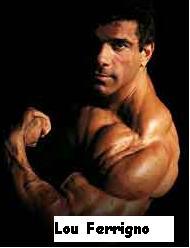
The service works. I paid $40 a few years ago to have Lou Ferrigno (The Incredible Hulk) call a business acquaintance to say Thank You for appearing at a conference. When I talked to the recipient later, she was pleased as punch – even though Lou wasn’t in the mood for a conversation. As soon as he read his little spiel, he hung up. (The company says it is up to the stars whether or not to continue the conversation beyond the script they contract to do.)
It’s a wonderfully sick business: Its latest promotion is to suggest you hire horror stars to call your friends on Hallowe’en. Their top suggestion: Kane Hodder, who played Jason in the Friday the 13th movies. (I personally think the guy who played Horshack would also qualify.)
Other celebrity callers include James Drury (The Virginian), two actors wh o played the killer Leatherface in various Texas Chainsaw Massacre movies, former Bond girl Lana Wood (Natalie Wood’s sister), Lorenzo Lamas from Falcon Crest, former Blue Jay pitcher Tom Candiotti, Diff'rent Strokes’ Todd Bridges, and notorious housesitter Kato Kaelin.
The whole thing may be cheesy, but the price point is right. And a strategically contrived call from the right person might just impress certain clients. Check out the complete list of former stars here.
Four reasons why I think this business is a fabulous entrepreneurial venture:
* It plays into people’s growing obsession with celebrity;
* It offers a unique interactive experience at a time when bored consumers are looking for one-of-a-kind experiences they can brag about;
* It has both business and consumer applications (celebrate a friend’s birthday in a memorable way, or use it to cut through the clutter in communicating with a client or prospect);
* It uses communications technology to create the illusion of a relationship.
Homework: How could you exploit these trends in your business?

The service works. I paid $40 a few years ago to have Lou Ferrigno (The Incredible Hulk) call a business acquaintance to say Thank You for appearing at a conference. When I talked to the recipient later, she was pleased as punch – even though Lou wasn’t in the mood for a conversation. As soon as he read his little spiel, he hung up. (The company says it is up to the stars whether or not to continue the conversation beyond the script they contract to do.)
It’s a wonderfully sick business: Its latest promotion is to suggest you hire horror stars to call your friends on Hallowe’en. Their top suggestion: Kane Hodder, who played Jason in the Friday the 13th movies. (I personally think the guy who played Horshack would also qualify.)
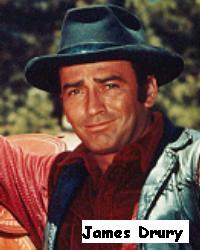
Other celebrity callers include James Drury (The Virginian), two actors wh
 o played the killer Leatherface in various Texas Chainsaw Massacre movies, former Bond girl Lana Wood (Natalie Wood’s sister), Lorenzo Lamas from Falcon Crest, former Blue Jay pitcher Tom Candiotti, Diff'rent Strokes’ Todd Bridges, and notorious housesitter Kato Kaelin.
The whole thing may be cheesy, but the price point is right. And a strategically contrived call from the right person might just impress certain clients. Check out the complete list of former stars here.
Four reasons why I think this business is a fabulous entrepreneurial venture:
* It plays into people’s growing obsession with celebrity;
* It offers a unique interactive experience at a time when bored consumers are looking for one-of-a-kind experiences they can brag about;
* It has both business and consumer applications (celebrate a friend’s birthday in a memorable way, or use it to cut through the clutter in communicating with a client or prospect);
* It uses communications technology to create the illusion of a relationship.
Homework: How could you exploit these trends in your business?
Friday, October 14, 2005
SOHO Report: Love what you do, hire those you hate
I attended the Soho Business Conference in Toronto today, and was privileged to moderate the opening panel featuring three wildly successful entrepreneurs: Andrea Slingsby of Flight Centre North America, Franc Nemanic of Hostopia (No. 1 on the PROFIT 100 list of Canada’s Fastest-Growing Companies), and Bruce Poon Tip of Gap Adventures.
I have known Bruce for a while (since his company made the PROFIT 100 seven times), but he really impressed me today (and the audience) with the news that his adventure travel company has just bought its first icebreaker. How cool is that? The M/V Explorer is 300 feet long and used for touring the Arctic ocean in summer and the Antarctic Ocean in winter (although I guess that would be their summer, wouldn’t it?). Bruce said it costs $30,000 a day to run. But its trips are sold out till 2008, so he’s not worried.
The panelists’ job was to offer the audience inspiration and ideas for succeeding in their own businesses. A few highlights:
Frank Nemanic on vision and strategy: “I believe that everything is created twice: once in your head, once in reality. To succeed, you have to know what you want to accomplish.”
Asked which are more important to pursue, new customers or existing ones, Andrea Slingsby acknowledged a common business failing: “We don’t spend enough time taking care of our [existing] customers. It’s a mistake we’ve made, that we’re making up for now. It really should be 50-50.”
“I can’t invest enough in HR,” said Bruce Poon Tip in response to a question on the importance of employees and motivation. “Most companies have physical assets. My assets leave every day, and I want them to come back.” While admitting that HR remains an undervalued function in most companies, he said employee excellence also stems from having a unifying vision in your organization. “You need to focus on something more than just selling what you’re selling.”
A little later, Bruce tossed in a zinger that had attendees buzzing afterward: “Hire people you don’t like.” He believes entrepreneurs tend to hire people they like – which usually means people with backgrounds and skills very much like their own. But entrepreneurs need to ensure they hire people with complementary skills, he says: “So I hire people I hate.”
One attendee later asked me if I thought Bruce was serious. I hope not, but I believe he was pointing out a basic truth: the need to hire people who will challenge you. As Franc noted: “If two people agree on everything, one is not necessary.”
At the close, I asked each panelist for the best advice they’d offer other entrepreneurs.
Bruce Poon Tip: “Love what you do and be passionate about it. If you’re not passionate about your product, no one’s going to buy it.”
Andrea Slingsby: “Surround yourself with the best people – which is not necessarily people you hate.”
Franc Nemanic: “Be bold. And take more risks.”
I hope to report soon on the other conference speakers, including Michael Gerber.
Wisdom for Winners
What makes a business person successful? John S. McCallum, professor of finance at the University of Manitoba, has taught MBA students for 32 years – and given a lot of thought to this question as he's watched his students make their mark (or not) on the business world.
He put down his thoughts on this subject in a column in the Ivey Business Journal in October 2004. If you missed it, click here to link to a very engaging and thoughtful article.
If your clicker isn’t working, here is McCallum’s top 10 list of characteristics that he believes play into executive success.
1. CONFIDENCE: If you don’t believe you can lead, then it will show and hurt your progress, says McCallum, “especially under pressure when the stakes are highest.” And why is it, he asks, “that those with the fewest legitimate reasons to be confident are so often the most confident, while those with real talent struggle with insecurity?"
2. BE ETHICAL: “Ethics is not only honesty, justice and fairness but also treating people with dignity and respect.” If doing the right thing for its own sake doesn’t inspire you, he adds, do it because unethical players will always be caught out.
3. THINK: “So often I have seen things go wrong because those responsible did not think things through.” The key, he says, is self-discipline and taking your time.
4. WORK HARD: “Working hard is not sufficient to get you to the executive suite and keep you there, but it certainly is necessary.”
5. GET OVER IT: Everyone experiences setbacks. In McCallum’s experience, those who do not let disappointments distract them enjoy the most career success.
6. LISTEN: Most communications training focuses on writing and speaking, says McCallum – not listening. Yet it is through listening that we gain most of the information we need to succeed.
7. GET HELP: McCallum says he’s seen many executives stubbornly fight their way through problems when they should have asked for help. “A reputation for not getting help when you clearly need it is no help to those who appoint and promote.”
8. READ: Books (fiction and non-fiction), professional and technical material, magazines and newspapers, short stories and poems can all help you gain business knowledge and, more importantly, wisdom, people smarts, and judgement. (No mention of blogs, though.)
9. BE BOLD: In talking to business people on their retirement, McCallum says many expressed regrets they had not been bolder in their careers. Not only because it might have brought more rewards, “but also because it might have been more fun and satisfying.”
10. NEVER GIVE YOUR HEART AND SOUL TO AN ENTERPRISE: “Hearts and souls belong to family and friends.”
Tuesday, October 11, 2005
Let's All Work with Google!
A few years back, everyone was talking about the new economy. Then the bubble popped, and we all went back to sleep.
But business continues to change. And in a recent blog by Chris Sacca, who is one of Google’s Principals for New Business Development, I found a masterful summary of the new improved rules of doing business.
Google is a relentlessly innovative company. Sacca’s job is to find new ideas and new people to partner with – even though 90% of the people he meets will never be appropriate partners. Many of us could learn from Sacca's proactive attitude. Our chances of meeting people who can help us are probably much better than his. So how open are we to new ideas?
Sacca's guidelines (he politely calls them “hints”) for proposing deals make rewarding reading. You can click here, or read my summary below.
Email rules - Phones are very yesterday. Voicemail is so broken. Email allows me to ensure that I get back to you. It also helps me bring in all the folks whose input would matter on your topic.
Thesis Statements - Lead with what you want [from Google]. Put it in the first sentence or two. Please don't make me go too far. This is particularly tough when I have to forward your message to a lot of other execs who are also looking for a thesis statement.
What problem are you solving? - Many times I have conversations with folks who can't answer that question.
Differentiate - Tell me right away why you guys are different and what comparative advantage you have on the market. Why are you the best to help us?
Follow-up - Following up by repeat email is perfectly fine with me and may often help if I have fallen behind. When doing so, please propose a concrete next step. That said, what doesn't help is when you go over our heads to other execs.
Meetings aren't always necessary - Often, vendors are in a rush to meet in person. Start with email. Send us a deck. Maybe next we can do a brief call. There is no need to hold a meeting with me to build a relationship. I swear I have done business over instant messaging networks.
Lead with engineering - I would rather have a meeting with technical people in the room than just business people any day.
Threats don't work - A surprising number of people write to me saying "If you do not act in 5 days I am taking this to Microsoft . . . " I am very inclined to let those proposals go. To me, partnerships are as much about the partner as they are about the technology.
Don't assume we have thought about X already - [People] presume we have a big honking master plan document somewhere and have the next few years set forth step by step. Truth is, we are constantly learning. You have a killer idea for us? Fire away!
Bottom line is that I/we want to work with you and your company! Partnerships are an essential part of our strategy and have been the impetus for massive value creation at Google. So, send those proposals and let's do some cool deals! Thanks.”
Thanks?!
If I were a smarter man, I would kill to do business with this guy.
But business continues to change. And in a recent blog by Chris Sacca, who is one of Google’s Principals for New Business Development, I found a masterful summary of the new improved rules of doing business.
Google is a relentlessly innovative company. Sacca’s job is to find new ideas and
 new people to partner with – even though 90% of the people he meets will never be appropriate partners. Many of us could learn from Sacca's proactive attitude. Our chances of meeting people who can help us are probably much better than his. So how open are we to new ideas?
Sacca's guidelines (he politely calls them “hints”) for proposing deals make rewarding reading. You can click here, or read my summary below.
Email rules - Phones are very yesterday. Voicemail is so broken. Email allows me to ensure that I get back to you. It also helps me bring in all the folks whose input would matter on your topic.
Thesis Statements - Lead with what you want [from Google]. Put it in the first sentence or two. Please don't make me go too far. This is particularly tough when I have to forward your message to a lot of other execs who are also looking for a thesis statement.
What problem are you solving? - Many times I have conversations with folks who can't answer that question.
Differentiate - Tell me right away why you guys are different and what comparative advantage you have on the market. Why are you the best to help us?
Follow-up - Following up by repeat email is perfectly fine with me and may often help if I have fallen behind. When doing so, please propose a concrete next step. That said, what doesn't help is when you go over our heads to other execs.
Meetings aren't always necessary - Often, vendors are in a rush to meet in person. Start with email. Send us a deck. Maybe next we can do a brief call. There is no need to hold a meeting with me to build a relationship. I swear I have done business over instant messaging networks.
Lead with engineering - I would rather have a meeting with technical people in the room than just business people any day.
Threats don't work - A surprising number of people write to me saying "If you do not act in 5 days I am taking this to Microsoft . . . " I am very inclined to let those proposals go. To me, partnerships are as much about the partner as they are about the technology.
Don't assume we have thought about X already - [People] presume we have a big honking master plan document somewhere and have the next few years set forth step by step. Truth is, we are constantly learning. You have a killer idea for us? Fire away!
Bottom line is that I/we want to work with you and your company! Partnerships are an essential part of our strategy and have been the impetus for massive value creation at Google. So, send those proposals and let's do some cool deals! Thanks.”
Thanks?!
If I were a smarter man, I would kill to do business with this guy.
Monday, October 10, 2005
Nine hard truths
I’ve received an unusual number of positive comments about my most recent “Frontlines” column in PROFIT Magazine.
It’s called “Nine hard truths: The immutable laws of being your own boss, and five ways to transcend them all.” Basically, I just tried to set down a few thoughts about some of the lessons I’ve learned in two years of being an entrepreneur instead of a wage slave.
For those who don’t want to click, here’s an excerpt:
“Lesson 1: The 40-hour workweek is not your friend. There is no way to do everything you need to get done between 9 and 5-especially since most of the people you deal with in big corporations only work from 10 to 4 (and take a lunch, too). Fortunately, the entrepreneur has two secret weapons that competitors in big business usually shun: Saturday and Sunday.”
To read more, click here:
And have a great Thanksgiving!
Friday, October 07, 2005
Free Ticket Giveaway!
I have just been given a free ticket to the SOHO-SME Business Show in Toronto on Oct. 14 (see just a few posts down, or click here).
Even the discounted value of this ticket is $159.
The conference features special guests such as authors Michael Gerber and T. Harv Ecker, along with many other notables. I myself will be moderating the panel of leading entrepreneurs, consisting of Franc Nemanic, Andrea Slinsby and Bruce Poon Tip, at 9 in the morning.
To get your free ticket, you must be the first email I receive that says FREE TICKET in the subject line. Plus (since Ontario law requires a skill-testing question), you must tell me: What is your favourite post here on Canadian Entrepreneur?
Note: You must let me know where you live. I reserve the right not to send you the ticket if you are not from the Toronto area or otherwise unlikely to use it.
Email me at rick@rickspence.ca
Good luck!
Eight measures of a winning business
When you're assessing a company, how do you know it is a healthy business that is going to grow?
If you're a banker of venture capitalist, you look at all sort of measurements, mainly financial. But what if you're not privy to the balance sheet?
Here's a handy list of non-financial indicators that often I use to divine the prospects for entrepreneurial businesses. Take a look to see if I'm missing anything:
Eight indicators that a business will thrive and grow
1) Written business plan, reviewed and updated at least once a year
2) The company exists at the convergence of two or more compelling trends (e.g. iPod: storage technology, great design, miniaturization, digital-music management);
3) Management is a partnership of experienced people with complementary skills (i.e., finance and technical)
4) The company targets niche business-to-business markets that have money to pay for innovative products
5) The company’s product offers a clear solution and a unique selling proposition (i.e., we can help you manage your geophysical data faster than anyone else)
6) The company is well capitalized in anticipation of future financial needs
7) Management is constantly (and willingly) developing new administrative processes to help the firm “keep its edge” as it grows
8) Presence of a paid board of directors (consisting mainly of outsiders) or a board of advisors
If I left out any other essential factors, feel free to leave a comment here.
Thursday, October 06, 2005
A Week to Remember
My idea of Small Business Week is the week that oil prices drop 30%, the feds roll back business taxes, the prime rate falls 50 basis points, customers pay in 10 days instead of 60 and Microsoft offers free software to everyone using bootleg programs who promises not to do it again.
Until then, we’ll have to settle for the real Small Business Week, founded by the Business Development Bank and coming your way Oct. 16-22. (Regional dates may vary.) The theme this year: "YOU'RE THE POWER behind the Canadian economy, let's share the energy!"
(No, I am not making this up. That really is the theme. If you’re so smart, come up with something better.)
SB Week is an opportunity for local communities to put on awards dinners, business conferences, speaker breakfasts and other events to aid and celebrate local business. You wouldn’t think they would need a Crown corporation to get them to do this, but this is Canada, after all.
If you want to locate an event in your area, visit http://www.bdc.ca/en/no_navigation/prov_events.htm
If you’re in southern Ontario, click here
http://www.bdc.ca/en/branches/ontario/barrie/calendar.htm
I am surprised to see no big Toronto events. Guess you will have to settle for the SOHO SME Business Conference (put on by a bunch of entrepreneurs from British Columbia) on Oct. 14. It is cited in my previous post (below).
Let's share the energy, darn it.
Wednesday, October 05, 2005
Upcoming conference alert (and discount!)
Michael E. Gerber has been writing (and rewriting) the entrepreneurial rulebook for three decades. As author of The E-Myth: Why Most Small Businesses Don’t Work, and What to Do About It, he was instrumental in helping thousands of business owners discover the secret of success: "working ON the business, not IN it."
Just a reminder that Michael Gerber is coming to Toronto on October 14, at the Soho Business Conference and Expo at the Metro Convention Centre. (He will also be in Vancouver on Oct. 20, if you’re that way inclined.) A lot of people I know are really looking forward to this.
In preparation, I am currently reading Gerber’s latest sequel, E-Myth Mastery. Cleverly, the book is divided into two parts: overcoming your personal limitations to achieve success, followed by “seven essential disciplines for building a world-class company.”
Do you know what the seven disciplines are? Give it a guess.
Ok, here they are:
* Leadership
* Marketing
* Money
* Management
* Fulfillment
* Lead Conversion (maybe he’s an alchemist)
* Lead Generation
Fulfillment, by the way, refers to how well you fulfill your customers' needs. Some businesses use the term to refer to merely delivering a product or service, but Gerber’s definition actually incorporates the imperative of delivering well.
For mroe info on Gerber, visit http://www.e-myth.com/
For more info on the conference, click here.
If you want to register, I can get you an $80 discount off the $249 price. Click here. And don’t forget to quote your SOHOSavings Code, soho-RISP, to claim your discount.
See you there. I’ll be moderating a panel of three dynamic entrepreneurs at 9 am.
Tuesday, October 04, 2005
Motivation spelled backwards is noitavitom
You know all those plaques with the beautiful nature photographs and the meaningful, motivational statements that make you feel like you're doing something important and worthwhile...?
Well, http://www.despair.com doesn't sell those.

Well, http://www.despair.com doesn't sell those.

Move ’em up, clear ’em out
Next Wednesday (Oct. 12), the Toronto Venture Group is holding a breakfast meeting featuring a speaker on Topgrading – the title of a book with a revolutionary approach to HR development. It might be worth attending.
The book is Topgrading: How Leading Companies Win by Hiring, Coaching and Keeping the Best People, by industrial psychologist Bradford D. Smart. It came out in 1999, but its principles seem to be gaining traction now. The idea basically is for companies to rank their employees as A, B or C players – A being those in the top 10% in their field. Then companies must learn to develop and attract more A players – and clear out the C players.
Sounds like a plan to me. As an employee, journalist and consultant, I have constantly been frustrated by companies’ unwillingness to cull staff for poor performance, potential or attitude (It’s not just the right thing to do for the organization – I believe it’s the decent thing to do in the long run.)
And most companies have no clue about training and developing their best people, beyond “You’re doing a good job. Keep it up.” So bringing some discipline and sense of process to both these neglected management functions is long overdue.
This technique probably works best with growth companies whose needs are always changing and growing, which is probably why the TVG is getting involved. Should be a good session.
Click here for more on the Toronto Venture Group
Click here for reviews and excerpts from the book
Google vs the Universe
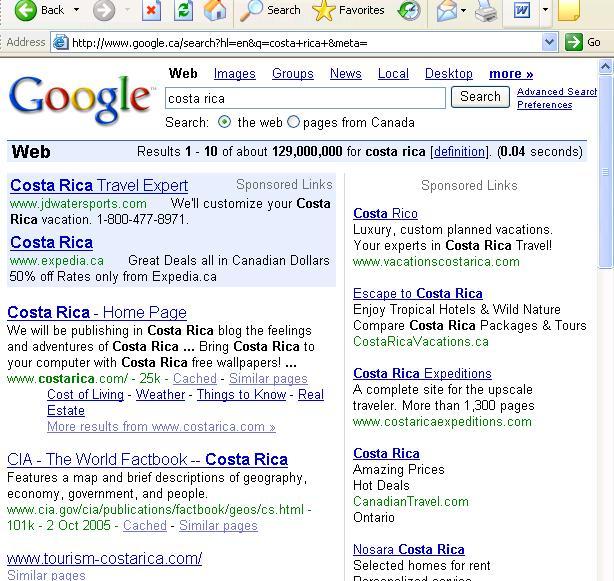
“Search Engine Optimization” has become the tactic of choice for many marketers, and the most powerful example of it is Google’s AdWords service. AdWords is so simple, it terrifies many companies.
AdWords allows marketers to place ads on search results pages when web surfers use specific key words. If you were Burger King, you could make sure your ad popped up under "Sponsored Links"(see example at right) every time someone did a search for McDonald’s. (Yes, I know how expensive that would be. It’s just an example!)
The question is: is this legal? Or does trademark protection mean that other companies have no right to buy or sell ad space on pages that include your trademarks?
The answer is: no one knows. For the first time, one U.S. court (in Virginia) has ruled that what Google is doing is okay. But it drew the line on allowing companies to use competitors’ trademarked names in their own ads. (A lot of people have been running ads that say things like, “Looking for Coca-Cola? Try Pepsi instead.”) And Google has apparently not been very consistent about shutting these offending ads down.
But similar cases are heading toward other U.S. courts, and the experts aren’t sure the AdWords business model can survive them all. Here’s a link to a recent story by Bob Heyman that says the whole thing could end up in the Supreme Court.
Heyman’s conclusion: Marketers shouldn’t worry – yet. In the meantime, “Do be sure that client search ads don't include third party trademarks...
"While lawsuits so far have only named Google as a Defendant, no agency would want to be responsible for having a client be sued as a party to yet another Google lawsuit. And good search practice needs to include policing competitor's ads to be sure they don't infringe your clients' marks. Don't rely on Google to enforce this...
“But nothing about the Geico rulings changes the fact that buying competitors’ trademarked keywords remains a best practice for SEM. Indeed, anecdotal evidence indicates it may well be the most successful of all search tactics.
"However, the wise Search marketer will prepare for the day when a Federal District Court may rule against Google and backup strategies will be needed.”
My take? AdWords is a powerful medium that levels the playing field between entrepreneurs and giant marketing organizations. Expect big business to fight it all the way.
Monday, October 03, 2005
The news story you thought you'd never see
Scientists are now talking seriously about: Teleportation.
According to today's Globe & Mail, "the U.S. military recently spent $25,000 for a report on teleportation by U.S. theoretical physicist Eric W. Davis. He identified several possible types of teleportation, including "psychic teleportation," moving objects through space-time deformities called wormholes, and manipulating empty space or "the cold vacuum."
Apparently, even Einstein is in on this action. Transport yourself here for the full story.
(And guess how the story starts.
If you guessed "Beam me up, Scotty" you too can get a job with The Globe and Mail.)
Thursday, September 29, 2005
The Coming Succession Crisis
More and more entrepreneurs I talk to are looking at ways to exit their businesses – not necessarily now, but over time, and with the highest possible price and the maximum possible control (over both their company and the transition process) right up till the end.
But you can't always get what you want. The demographics of the baby-boom bulge dictate that there will more sellers than buyers – and you know what happens when that happens.
Last month I wrote a feature for PROFIT Magazine on the upcoming succession crisis. It’s worth your attention, not just because of the problem it creates for retiring owners, but also for the opportunities it will generate for anyone on the buy side.
You can access the story, “The trillion dollar trap,” here.
For those who hate clicking through, here are the first few paragraphs:
“It's September 2012. You wake up one morning, drink your Starbucks energy juice, and check the digital news on your iPod. When you see that the price of oil has just passed US$100 a barrel, you decide that's enough. It's time you enjoyed the fruits of building your business. You message your accountant and tell her you want to sell. Then you call up an ad for an around-the-world cruise.
But your accountant throws cold water on your dream of worry-free years in the sun. You've left it too late, she says. Your staff are not ready to run the business without you—and at the shape your books are in, you'll never get top dollar. Even worse: tens of thousands of entrepreneurs—most of whom are baby boomers seeking retirement—are trying to sell their businesses at the exact same time. If you had started planning for this back in 2005, you might be able to afford something better than a time-share in Moose Jaw.”
For more guilt-ridden crisis-mongering, click here.
(By the way: when I wrote that in early August, $100-a-barrel oil seemed quite science fictionous. Funny how the future catches up.)
Wednesday, September 28, 2005
5 characteristics of winning entrepreneurs
A reader of this blog sent me this note recently asking for help:
"I just started small business management and entrepreneurship at Mohawk College and I would like to hear some of your ideas and experience on owners of small businesses, entrepreneurs and the top people you have guided that have been successful. I am very interested in any advice you may have."
My reply suggested that her query was rather too open-ended fr me to deal with well. But that sounded harsh, so I added the following to try to sum up what I've learned about entrepreneurs in the past 20 years. It turned out okay, so I decided to share it with you:
"For what it's worth, here are the five most important characteristics I think most entrepreneurs can have:
1) Vision. The ability to see a goal or objective, and then make it clear enough so that others (employees, bankers, customers, etc.) can make that vision their own.
2) Passion. This gives them the courage to begin and the strength to persist.
3) Genuine interest in people. Others will be more likely to help you when you show interest in them.
4) Relentless curiosity. Entrepreneurs must always ask themselves, how does this work? How could it work better? How did they do it? How can I learn more about this? And they must feed this curiosity by reading and absorbing all the knowledge and information they can.
5) Self-Awareness. This tells them when to talk and when to shut up and listen."
And then of course I directed her to my book, which is available still in some libraries: Secrets of Success from Canada's Fastest-Growing Companies. Also available here.
(Surely "asking for the sale" is another admirable entrepreneurial attribute.)
Monday, September 26, 2005
Why do entrepreneurs do what they do?
You'll never find a better explanation than that delivered by Shasha Navazesh of ShaSha Bread Co. at our Entrepreneurs' Panel at Enterprise Toronto's Small Business Forum today. A professional pastry chef who started his own artisan bakery to produce nutritious, organic sourdough breads, Shasha is remarkably passionate - and eloquent - about what he does.
As moderator, I asked the three panelists to tell us the worst business advice they ever received. Shasha recalled that most of his friends and family told him not to start his business - it was just too hard, they said. Someone in the audience asked how he found the courage to ignore all those warnings. Taking the risk was just part of his lifelong dream, said Shasha:
"In the depths of our personal being is that drive to experience and learn in this life. So it’s beyond just having a business – it’s about how you conduct your life...
"Are you going to sit on the wayside, or are you going to get your toes wet or go in the water and swim? Some of us sit and watch from the wayside, some of us dip our toes, some of us just dive right in."
Shasha had another bon mot, about how entrepreneurs learn. “We learn more from our mistakes than anything else. When you go the bank, if you have already been bankrupt once, they give you a loan much quicker. Because the second time it’s personal. This time they know you know what you shouldn’t be doing.”
More highlights when I have more time.
Sunday, September 25, 2005
Can YOU read my handwriting?
At PROFIT Magazine’s GrowthCamp conference this morning, the first session I attended was a hands-on demo of mobility technology from Hewlett-Packard, one of the sponsors. The GPS technology was fun, 'though the Bluetooth demonstration and the iPaq phone seemed ho-hum.
But what everyone loved was the tablet computer we each got to play with. These are sub-notebook computers in which the screen can be detached from the keyboard – and you just use the screen! You can cradle the thing in your arm and type using a “virtual keyboard” on-screen, or draw or write the messages you want using the attached stylus.
These computers have been around for a while, but they’re still rare at retail – sold mainly through bulk and “reseller” channels. Tablets cost twice as much as a comparable laptop, but they’re tremendously functional, and I think they will take off soon.
The key is the MS handwriting-recognition software, which seems much improved since I first tried out a version two years ago. Most human beings have trouble reading my writing, but Windows Journal figured it out immediately.
Here’s an example. The pic below is a typical sample of my messy handwriting as scrawled on HP’s TC 1100 (the black text is the “marker” font, the red is often used for correcting text). See if you can read my writing, before reading down to see the computer’s translation.
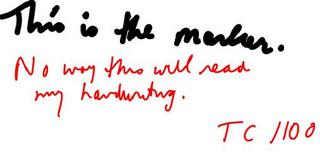
this is the marker.
No way this will read
my handwriting.
TC 1100
The computer made just one mistake – it missed the capital T!
As our session leader said, taking notes in a meeting by typing on a laptop is unfriendly and distracting. But writing on the screen, just like in a real (paper) notebook – that’s accepted, and easy! Very cool stuff.
One attendee at the demo had just bought a laptop. But the 30-day return period hasn’t expired yet, so she’s thinking of trading hers in for a tablet. Wicked cool, as the kids would say.
(You can read more about tablet PCs here.)
But what everyone loved was the tablet computer we each got to play with. These are sub-notebook computers in which the screen can be detached from the keyboard – and you just use the screen! You can cradle the thing in your arm and type using a “virtual keyboard” on-screen, or draw or write the messages you want using the attached stylus.
These computers have been around for a while, but they’re still rare at retail – sold mainly through bulk and “reseller” channels. Tablets cost twice as much as a comparable laptop, but they’re tremendously functional, and I think they will take off soon.
The key is the MS handwriting-recognition software, which seems much improved since I first tried out a version two years ago. Most human beings have trouble reading my writing, but Windows Journal figured it out immediately.
Here’s an example. The pic below is a typical sample of my messy handwriting as scrawled on HP’s TC 1100 (the black text is the “marker” font, the red is often used for correcting text). See if you can read my writing, before reading down to see the computer’s translation.

this is the marker.
No way this will read
my handwriting.
TC 1100
The computer made just one mistake – it missed the capital T!
As our session leader said, taking notes in a meeting by typing on a laptop is unfriendly and distracting. But writing on the screen, just like in a real (paper) notebook – that’s accepted, and easy! Very cool stuff.
One attendee at the demo had just bought a laptop. But the 30-day return period hasn’t expired yet, so she’s thinking of trading hers in for a tablet. Wicked cool, as the kids would say.
(You can read more about tablet PCs here.)
Saturday, September 24, 2005
Letter from GrowthCamp
I’m writing this from the Nottawasaga Inn in Alliston, Ont., site of this year’s annual GrowthCamp conference for the CEOs of PROFIT’s Hot 50 list of emerging growth companies.

This event bring together amazing entrepreneurs and dynamic speakers for a unique, intense and fun learning experience. In the six years GrowthCamp has been going, it has become a huge hit, and literally changed some people’s lives.
Here are a few highlights from today:
* Magician (or master illusionist) David Ben revealed the secrets of creative problem solving – whether it’s for magic or business. The best psychics don’t predict the future, he says, “they make the future happen.” Savvy entrepreneurs do the same, by creating pictures in other people’s minds, setting expectations, relentless preparation, hard work and confidence. The power of suggestion is key.
* Donald Cooper, whom I consider Canada’s best professional speaker and business guru, talked about “the power of committing to a clear purpose.” Lots of great stories and examples, which I will blog more fully another time.
Here are the questions he says you must ask in order to achieve your profit commitments (not targets – commitments!):
- Are we good enough to get the top price in our specific market?
- Are we efficient enough to be price-competitive, service-competitive, and profitable?
- Does everyone on our team know how their job impacts the bottom line? And how we’re doing compared to where we’ve committed to be?
- Do we hold people accountable for their commitments to growth and profitability?
* Bill Tatham, multi-millionaire founder of Janna Systems, revealed the strategic thinking that transformed Janna from a struggling service company to a highly targeted software developer that sold in 2000 for $1.7 billion. Aim to sell to industry leaders, he advised, and the bigger the better: “Strive for the largest possible average transaction size.”
I chaired one of the six “Idea Exchange” roundtables, where entrepreneurs swapped their successful tactics on marketing and employee motivation. Two great ideas that emerged:
- Do what it takes to keep your key sales people and other top performers, even if it means treating them very differently from the majority of people n your company (e.g. profit-sharing, big raises, phantom equity);
- Survey employees on their satisfaction with the company and its management, but make sure you act on the findings. (One entrepreneur at our table even bonuses his managers based on the scores achieved in their department.)
More to come.

This event bring together amazing entrepreneurs and dynamic speakers for a unique, intense and fun learning experience. In the six years GrowthCamp has been going, it has become a huge hit, and literally changed some people’s lives.
Here are a few highlights from today:
* Magician (or master illusionist) David Ben revealed the secrets of creative problem solving – whether it’s for magic or business. The best psychics don’t predict the future, he says, “they make the future happen.” Savvy entrepreneurs do the same, by creating pictures in other people’s minds, setting expectations, relentless preparation, hard work and confidence. The power of suggestion is key.
* Donald Cooper, whom I consider Canada’s best professional speaker and business guru, talked about “the power of committing to a clear purpose.” Lots of great stories and examples, which I will blog more fully another time.
Here are the questions he says you must ask in order to achieve your profit commitments (not targets – commitments!):

- Are we good enough to get the top price in our specific market?
- Are we efficient enough to be price-competitive, service-competitive, and profitable?
- Does everyone on our team know how their job impacts the bottom line? And how we’re doing compared to where we’ve committed to be?
- Do we hold people accountable for their commitments to growth and profitability?
* Bill Tatham, multi-millionaire founder of Janna Systems, revealed the strategic thinking that transformed Janna from a struggling service company to a highly targeted software developer that sold in 2000 for $1.7 billion. Aim to sell to industry leaders, he advised, and the bigger the better: “Strive for the largest possible average transaction size.”
I chaired one of the six “Idea Exchange” roundtables, where entrepreneurs swapped their successful tactics on marketing and employee motivation. Two great ideas that emerged:
- Do what it takes to keep your key sales people and other top performers, even if it means treating them very differently from the majority of people n your company (e.g. profit-sharing, big raises, phantom equity);
- Survey employees on their satisfaction with the company and its management, but make sure you act on the findings. (One entrepreneur at our table even bonuses his managers based on the scores achieved in their department.)
More to come.
Thursday, September 22, 2005
Leadership and the failure to act
(Warning: long post. But worth every word.)
I was in Boston with a good friend from Baton Rouge the day Hurricane Katrina blasted New Orleans and the Gulf Coast, so I followed the horrific developments with great interest. There is blame all around, but I haven’t seen much thoughtful discussion of the mistakes leading up to this mess.
But check out this post from the Wharton Business School’s Knowledge at Wharton newsletter. It names names and blames games – all from a sober, rational management-school point of view. It's chilling stuff.
Interesting excerpts:
Robert E. Mittelstaedt Jr., dean of the W.P. Carey School of Business: Despite all the laws about what a president can or can't do… when the chips are down, leaders step up and take action and worry about the consequences later.
Bush should have declared martial law on Tuesday [August 30, one day after Katrina swept through the city], sent troops in there and started to marshal resources… I have never seen him as a leader. He's just a politician managed by his handlers. And I'm a Republican.
… Leaders don't worry about consequences. Leaders are born, not made. He [Bush] has amazing power but inherently doesn't have much leadership ability. There is no leadership test to be elected.
… Where did leadership show up? The Coast Guard. They had deployed helicopters to the area, so they were able to move resources in right behind the storm... People at the middle level in the Coast Guard knew it was their responsibility and they just did it.
[New Orleans] is a place with a long history of political corruption and a lack of concern for the broader public good... It's still far down on the list of cities that have things under control. The poverty level is horrible. Crime is terrible. The public school system is terrible... All of that contributes to an environment where there are no leaders who can effectively deal with the bulk of the problems.
Management professor Lawrence G. Hrebiniak: It seems the government has an aversion to good planning… FEMA has been swallowed up by the Department of Homeland Security whose emphasis is on terrorism… Third, there were leadership failures, like Brown's appointment by Bush as FEMA director. He's a buddy. We see a pattern of cronyism in politics, placing inexperienced and unqualified people in important positions. So the leader who appoints them is acting poorly, and then he appoints people who can't do the work. [Mistakes] feed off each other. It's a disastrous situation.
Morris A. Cohen, professor of operations and information management: I do a lot of work in support of mission-critical problems and systems prone to random and infrequent failure that lead to catastrophic results… What my work teaches me is the need for 'event management.' ...When events occur you find yourself in real-time management. You have to bring resources to play at the right time and manage the process of repair or replacement.
One's ability to do that is almost completely determined by the decisions and systems in place prior to the event… You can only do them by investing in advance. …It looks like a lot of this was a failure to execute rather than a failure to plan.
Hrebiniak: I've been studying some government agencies from a management perspective… Structurally, these agencies are a mess. If you tell someone to do something, size and bureaucracy inhibit functionality. We are not efficient and not effective.
I am becoming afraid of what might happen in the future, especially if we have an unannounced terrorist attack. The government is very complex... I see a need for change. I hope we start appointing qualified people to important positions. But I'm afraid there will be a flurry of activity [in the wake of Katrina] where we will help rebuild the city, but then go back to the normal way of doing things.
Wednesday, September 21, 2005
Entrepreneurs for all Seasons
Busy, interesting week coming up.
On Saturday and Sunday I will be attending GrowthCamp, PROFIT Magazine’s weekend retreat for the CEOs of the Hot 50 Growth Companies (see previous posts). I’m looking forward to seeing friends from last year and meeting some of the new winners I’ve interviewed on the phone.
On Monday I will be at the Enterprise Toronto Small Business Forum, where I am moderating the noontime Entrepreneur Panel. (Admission free. Click here.) My panelists are:
• Margaret Sarrasin, who started MJ's Fine Foods Inc. in 2000. Within 10 months, the distribution of Margaret's Artisan and Santa Fe Flatbreads expanded from local specialty shops to national grocery chains.
• Henrique (Henry) Sia of Golden Valley's Food Outlet Inc., a wholesale and retail outlet of specialty food products imported from the Philippines, China, Indonesia, Malaysia and Thailand.
• Shasha Navazesh of ShaSha Bread Co., an Organic Artisan bakery that combines ancient techniques with innovative methods to produce nutritious, organic sourdough products. (Shasha was very generous about sending us free samples when I was at PROFIT magazine, so I am looking forward to thanking him. His flatbreads got us through a lot of late production nights.)
I’ll be asking my characteristically impertinent questions:
* Did you have a business plan when you started out? How much does your business resemble that plan?
* What’s the worst business advice you ever received?
* What has been your worst moment in business? What got you through it?
* As an entrepreneur in Toronto, what are your impressions of:
* the business climate in this city?
* the banks?
* City Hall?
* our transportation infrastructure?
Shasha himself suggested a few interesting questions I will try to include:
• what was the most effective way you promote your products into the market?
• what do you think consumers are basing their buying decision on these days?
And on Tuesday I am moderating a private seminar for a client featuring Brian Luborsky, CEO of Premier Salons, which was Canada’s Fastest-Growing Company in 1997. He’s a great business strategist who has gone from success to success, so I am looking forward to hearing about his latest adventures and lessons learned.
I’ll blog all I can.
Tuesday, September 20, 2005
Learning from the Hottest
The other day I wrote about the new PROFIT magazine list of the "Hot 50" companies - Canada's fastest-growing early-stage companies. (Scroll down for the full list.)
I also wrote a story for PROFIT on three of these Hot 50 companies: what do they do, where do they come from, and what do they know that lesser mortals don't? Click here for the story.
Too busy to click? Here are some highlights.
Move fast, bid low: At Voda Computer Systems Ltd. in Kamloops, B.C., president Andrew Watson reveals his techniques for making two strategic acquisitions while the company was less than two years old. His philosophy: do your homework, bid low, take two years to pay.
Today, lots of companies are approaching Watson to buy them out, but he prefers to wait. "What I would rather do is hit hard, decimate them and then buy them out for less."
Innovation opportunities are everywhere: Poptech Ltd. of Toronto creates near-life-sized cardboard point-of-purchase displays such as you see dispensing gum, chocolate bars and DVDs at your local supermarket or video store. The key, though, is that they used innovative design to come up with displays that are easy to assemble (most just pop into place), saving retailers valuable time. "Our competition has been asleep at the wheel for 50 years," declares president Geoff Moss. "We were the first company to take the blinkers off."
Why was the point-of-purchase industry sleeping so long? "They never thought anything was broken," says Moss. Buyers weren't demanding better products, so it took motivated newcomers to devise them. As his partner David Minister admits, "They weren't buying our stuff, so we had to change it."
Make service measurable: At Carlu Corp. in Toronto, Jeffry Roick and Mark Robert have turned an abandoned department-store floor (the Seventh Floor of the old Eaton's College Street) into the city's premier location for society weddings, formal dinners and other posh events. To succeed, they had to create a service ethic as special as the art moderne landmark itself.
The pair developed a 100-page policy manual that covers every aspect of operations, from the look of sales proposals to the right way to answer the phone. "It's the most comprehensive in the industry," says Robert. "And we continuously fine-tune it so we have the best practices nailed down."
"We wanted to put ourselves in an international league, and have trained our staff accordingly," adds Roick. "We give our people a lot of freedom, but they also have to accept accountability."
As I said, the rest is here.
Monday, September 19, 2005
Canada’s Hottest New Companies
The 2005 Hotlist is out! PROFIT Magazine has just released its list of the PROFIT Hot 50, the fastest-growing new companies (under five years old) in Canada.
Click here to see the rankings of the Hot 50.
To save you time, here are the top 5 companies on the list:
1. Multi-Channel Communications Inc., Toronto (operates call centres for telcos): Two-year sales growth: 35,824% (whew!)
2. Kids & Company Ltd.., Toronto (child care for corporate employees): 1621%
3. Maximum Fence Inc., Hamilton (high-end fencing): 1316%
4. Pearson Software Recruiting Specialists, Toronto (recruitment agency): 892%
5. RIFCO Inc., Red Deer, Alta. (finances vehicle repairs and purchases): 860%.
My first impression: all five are niche service companies, mainly for business and high-end consumer markets. What’s happened to manufacturing? Where are the tech companies?
A glance at the overview story accompanying the list confirms my initial impression. 62% of the companies (i.e., 31 of the 50) are engaged in business services – and only 20% of those are IT-related. In all, 12% of Hot 50 firms are involved in consumer services, 8% in software development, 6% in manufacturing, and 4% in each of retail, construction and distribution.
I bet this is the lowest “manufacturing” percentage in any PROFIT growth company list published in the past 20 years.
I read the other day that Canada has lost more than 100,000 manufacturing jobs this year. Check out this Hot 50 package if you want to see what Canada’s economy of the future may look like.
You can also read about the No. 1 company, MCC Inc., here.
Friday, September 16, 2005
Communicating for Success
One of the things I do is speak on communication skills to business managers and entrepreneurs.
Why communication? Because being able to communicate your visions, expectations, requests and feedback - consistently, honestly and clearly - is a fundamental business-building skill.
And as business guru Peter Drucker says, “60% of all management problems result from faulty communication.”
So I was delighted to talk to a senior manager in a huge, successful IT company today about the biggest challenges he faces. It turns out it’s communicating: making sure he represents his company properly to outsiders, and that he and his team can communicate clearly, quickly and strategically with superiors and peers throughout the company.
“Being able to get a point across or develop a thought is the key to being successful,” he says. “Communication skills are ultimately what separate people who are successful in business from people who aren’t.”
Look for upcoming posts from me on some of the biggest communications challenges that business people face.
We've all heard the cliché, “a failure to communicate.” Let’s re-focus on communicating for success.
Thursday, September 15, 2005
"Hang on a minute while I cut off this station wagon..."
Here's a link to a Globe & Mail story about new evidence corroborating what many people secretly know, but don't wish to acknowledge: talking on a cellphone while driving increases your chances of causing an accident.
And don't think those hands-free devices help. According to writer Richard Russell, "The oft-repeated answer of using a hands-free device is nothing more than an extension of that distraction, one that creates an opportunity to talk more often and for longer periods -- heightening the risk, and the length of time at risk."
I've always looked at any attempt to ban cellphone use while driving (as they do in New York State, among others) as a direct assault on entrepreneurs.
I believe the entrepreneurial revolution of the 1980s owes much to the simultaneous development of the cellphone, which allowed entrepreneurs to multiply their effectiveness by exerting greater control over operations while they were physically absent (i.e., in the car). And entrepreneurs spend a lot of time in their cars.
Would bans on phoning while driving affect your business? Given the evidence, would such a ban be fair?
Let me know what you think by clicking on "Comment", below...
Goal Setting and Organizational Failure
I'm affilliated with a group called TEC (The Executive Committee), an entrepreneurs' self-help group designed to help people improve their businesses and the quality of their lives. If you are an entrepreneur looking for a peer program that can enhance both halves of your life, drop me a line. I can hook you up with a TEC chair in your region.
To assist its members, TEC has produced a number of useful "executive summaries" of issues that plague entrepreneurs. Today's link is to a publication on Goal-Setting.
It's just four pages long, but it's a terrific summary of advice, checklists and tips to make you a more productive planner. And thanks to entrepreneurial Toronto accountant Ed Scheck, it's available for your free perusal here.
As you probably know, goal-setting is not for the faint of heart. It takes passion, purpose and commitment. Here's an excerpt from the TEC document that lists 10 common organizational roadblocks that get in the way of achieving objectives:
1. Lack of clear-cut responsibilities around the goals
2. Lack of a tracking system
3. Lack of an accountability system
4. Lack of commitment
5. Lack of buy-in from people who are expected to fulfill the goals
6. Ineffective communication
7. Lack of time or resources
8. Too many goals are financially driven
9. Focusing on too many or too few goals
10. Goals aren't tied to a longer-term vision
To score more goals, read more here.
Wednesday, September 14, 2005
Customer Service Diatribe
I just fielded another "courtesy call" from a company that wanted me to know how much they value my business. And by the way, did I know about this month's incredible deal ...?
I personally think it's okay for suppliers to inform me from time to time about new products and promotions. But please don't insult me by calling it a courtesy call.
It's a good lesson for all marketers. When you're trying to build a relationship, start by not lying.
I personally think it's okay for suppliers to inform me from time to time about new products and promotions. But please don't insult me by calling it a courtesy call.
It's a good lesson for all marketers. When you're trying to build a relationship, start by not lying.
How To Get Results
I just got off the phone with an entrepreneur at a fast-growth company who has been particularly successful at getting results by setting basic daily operating targets for all of his employees (eg, number of sales calls made, number of customer contacts per day, speed of processing mail, etc.)
He says that if you look after the daily inputs, the important quarterly performance quotas and targets look after themselves. Few businesses have the discipline to look at things this way, but it makes a lot of sense.
I asked if it was mainly a function of the old saying. "What gets measured gets done." That's partly it, he agreed, but he then quoted a more appropriate adage I hadn't heard before, which takes that one step further: "People will do not what you expect - but what you inspect."
Tuesday, September 13, 2005
Technology in the Service of Mankind
 Just to give you an idea of the power of free Internet services today, the "SiteMeter" at the bottom of this page offers incredible functionality.
Here is its map of where the last 100 visits to this site came from, within North America. You can also map the whole world or other continents, but other than a few folks in Europe and Singapore, they are mostly dark.
If you're from Monterrey, Mexico or Nunavut, you may recognize your own visit. Thanks to all for coming.
And sleep soundly tonight, knowing what kind of trail you are leaving whenever you visit a website...
Canadian entrepreneurs kick ---
I'm not one for the A-- word myself, but I like this article from PROFITguide.com, "Canadian entrepreneurs kick ass."
Jim McElgunn interviews Leonard Brody, a sometime entrepreneur turned author (Everything I Needed to Know About Business...I Learned from a Canadian), about why Canadians are really global entrepreneurial leaders. I don't agree with all of Leonard's analysis (a more realistic explanation for Canada's high level of self-employed people is our sprawling and inefficient farming and fishing industries), but his enthusiasm is welcome.
But not everything is rosy, even on a book tour. When asked how Canadian entrepreneurs could improve, Brody has some good ideas.
"* We need to overcome our risk aversion. Canadians are not yet of the school of thought that failure is a badge of honour, not of shame. Entrepreneurs do not become great until they fail. Rupert Murdoch went bankrupt seven times... If we don't start accepting the importance of failure as a lesson rather than a badge of shame, we are going to lose out on opportunities.
* "Second, we need to work on our marketing prowess. We are not good marketers. We need to get better. The very fact that we need to have a conversation about whether Canadians are good entrepreneurs says something—we wouldn't need to have that in the U.S.
* "Finally, we need to become more venturesome...We need to start taking some serious swings for the fences. If we match that with a greater tolerance for risk, we'll have a great mix for future growth for this country."
Read the whole thing here.
(Ironically, PROFIT chose to follow this story with a link to a classic 2001 cover story, "Why Canadians Can't Market.")
Friday, September 09, 2005
The Next Level of Laziness
In the past I have posted about some of the weird and wacky search terms that have led people to this site. I am preparing a similar post for next week, but in the meantime, I had to tell you about this one.
Here is an assignment that some kid in Ontario got today in school: "Look up Entrepreneur on the internet. Looks through some of the hits and find an interesting article. Cut and paste the item on the next page."
So what did the kid do? He cut n' pasted the entire text of that assignment into Yahoo's search engine. And somehow it led him to this site.
I don't think the inventors of search engines ever imagined such laziness. But hey, I guess it worked.
Your $100 discount is here!
In my last post (conveniently located just below this one), I mentioned an exciting upc oming event: the Soho Business Conference and Expo coming to Toronto on October 14. The main reason for my enthusiasm: keynote speaker Michael Gerber, best-selling author of The E-Myth and a genuine pioneer in entrepreneurial thinking and growth.
Since I posted that, I’ve learned a little more about the conference, and it’s even cooler than I thought. And then I made a deal with them.
If you want to attend, you click on the link below, use my special discount code (below), and you’ll get $100 off the $249 ticket price. (Full disclosure: I then get $49 of the rest. But that’s not why I recommended this conference in the first place. And you still get a great deal.)
Three more reasons why the conference is cool:
* T. Harv Eker is also speaking. He’s a successful U.S. entrepreneur and the best-selling author of Secrets of a Millionaire Mind, a NY Times No. 1 best-selling book.
* My friend Franc Nemanic is on the agenda. He’s the founder of Hostopia, PROFIT Magazine’s No. 1 fastest-growing company for 2005. I interviewed him in the June issue of PROFIT, and his story is fantastic – in fact, the profile I wrote is about to be reprinted in a university business textbook. You can read that story here – but trust me, Franc is cool.
* Another keynoter is Andrea Slingsby, president of Flight Centre North America, a huge international success story. Flight Centre is also been ranked as the fourth-best company to work for in Canada, so this should be a dynamite presentation.
For more information on the conference, click here.
To register and receive your special rate, click here.
Don’t forget to quote your SOHOSavings Code, soho-RISP, to claim your $100 discount.
If you'er coming, leave a comment. Maybe we can arrange to meet up.
 oming event: the Soho Business Conference and Expo coming to Toronto on October 14. The main reason for my enthusiasm: keynote speaker Michael Gerber, best-selling author of The E-Myth and a genuine pioneer in entrepreneurial thinking and growth.
Since I posted that, I’ve learned a little more about the conference, and it’s even cooler than I thought. And then I made a deal with them.
If you want to attend, you click on the link below, use my special discount code (below), and you’ll get $100 off the $249 ticket price. (Full disclosure: I then get $49 of the rest. But that’s not why I recommended this conference in the first place. And you still get a great deal.)
Three more reasons why the conference is cool:
* T. Harv Eker is also speaking. He’s a successful U.S. entrepreneur and the best-selling author of Secrets of a Millionaire Mind, a NY Times No. 1 best-selling book.
* My friend Franc Nemanic is on the agenda. He’s the founder of Hostopia, PROFIT Magazine’s No. 1 fastest-growing company for 2005. I interviewed him in the June issue of PROFIT, and his story is fantastic – in fact, the profile I wrote is about to be reprinted in a university business textbook. You can read that story here – but trust me, Franc is cool.
* Another keynoter is Andrea Slingsby, president of Flight Centre North America, a huge international success story. Flight Centre is also been ranked as the fourth-best company to work for in Canada, so this should be a dynamite presentation.
For more information on the conference, click here.
To register and receive your special rate, click here.
Don’t forget to quote your SOHOSavings Code, soho-RISP, to claim your $100 discount.
If you'er coming, leave a comment. Maybe we can arrange to meet up.
Michael Gerber, Superstar
Here's a heads-up on a very cool event coming to Toronto on Oct. 14 (and to Vancouver on Oct. 20, for those who prefer to live by the sea among majestic mountanis):
On Oct. 14, the Metro Toronto Convention Centre will hold a "Kick-off to Small Business Week" featuring Michael Gerber, author of The E-Myth: Why Most Small Businesses Don't Work and What to Do About It.
Gerber is the guru of growth entrepreneurs. In The E-Myth, he was the first to push the idea that an entrepreneur who wants to build his or her business must "work ON the business, not IN it." That is, good entrepreneurs must evolve from running day-to-day operations to become leaders, visionaries and strategic thinkers.
That notion has inspired and assisted more successful entrepreneurs than any other I know (although Jim Collins' Good to Great is starting to give Gerber a run for his money).
There will also be lots of other events, including a CEO/Entrepreneur Spotlight Panel, how-to presentations, industry expert keynotes, exhibits and displays, and an Ask-The-Expert Advice Centre. The evening also includes "THE ULTIMATE NETWORKING RECEPTION!" (Featuring live entertainment and great opportunity to meet and network with many business professionals, executives, entrepreneurs and industry leaders. Or so they say.)
More details on the SOHO conference...
http://www.soho.ca/2005sohosme/Toronto/main_toronto.htm
If you want to register, though, hold on a day or two. I have met the organizer before, and I might be able to swing you a discount. Stay tuned.
Thursday, September 08, 2005
How to be a Better Business Person
A couple of useful quotes I’ve run across today....
* Chet Holmes, a U.S. sales and management consultant, says every business owner needs the Three Ps. “It’s what made every Fortune 500 company: Planning, procedures and policies.” In most companies, he says, managers run around doing whatever they think is best, rather than agreeing on uniform and productive operational policies.
I buy that, because all the growth companies I have known have been racing against time in their fight to survive and succeed: Can they develop the policies and procedures they need to hang together as a company before their fast growth spins out of control?
* “Create Mental Pictures” in your marketing, says online sales expert Wes Blaylock.
“Create mental pictures in the readers mind through your ad copy. You can easily do this by telling a story, or putting them in a certain scenario…The point is to try and get them to day-dream about what it would be like to solve the problem that you are selling the solution to.”
* “Replace your clock with a compass,” says Jim Estill, CEO of SYNNEX Canada and a time-management guru too.
“It is better to know the direction you want to go than to try to move quickly. Effectiveness is more important than efficiency. It is more important to work on the right thing than to simply work quickly.”
Click here to read Jim’s blog, Time Leadership.
Cheap ploy to sell books
A number of people have asked recently about my book: a 1997 epic entitled Secrets of Success from Canada's Fastest-Growing Companies. Many of the examples are a little dated now, but the key lessons remain significant, so it's still a good read.
Since it's out of print now, you won't find it in stores. But copies are still available from Amazon.com and some of its used-book affiliates, so check it out. I have just posted a link to my book's page on Amazon. You'll find it at the bottom of the "Links" list, at right, and also at the very bottom of the main page. (It replaces the Google AdSense ads that no one ever clicked on anyway...)
Enjoy!
Subscribe to:
Posts (Atom)