Joe Kraus was a co-founder of Excite.com, one of the first international Web portals. He’s now working on another startup, Palo Alto-based JotSpot, the first application-wiki company. (If you have to ask, you’ll never understand it.)
Joe’s a pretty slack blogger – he hasn’t posted since June 29. But what he has to say in his blog, Bnoopy, is pretty cool. Here’s why he believes “It’s a great time to be an entrepreneur.”
“There’s never been a better time to be an entrepreneur because it’s never been cheaper to be one. Here’s one example.
Excite.com took $3,000,000 to get from idea to launch. JotSpot took $100,000.
Why on earth is there a 30X difference? There’s probably a lot of reasons, but here are my top four.
Hardware is 100X cheaper.
It’s two factors – Moore’s law and the rise of Linux as an operating system designed to run on generic hardware. Back in the Excite days, we had to buy proprietary Sun hardware and Sun hard drive arrays. Today, we buy generic Intel boxes provided by one of a million different suppliers.
Infrastructure software is free
Back in 1993 we had to buy and continue to pay for maintenance on everything we needed just to build our service -- operating systems, compilers, web servers, application servers, databases... Today, free, open source infrastructure is the norm. Get it anytime and anywhere.
Access to Global Labor Markets
Startups today have unprecedented access to global labor markets. Back in 1993, IBM had access to technical people in India, but little Excite.com did not. Today, with rent-a-coder, elance.com and just plain e-mail, we have access to a world-wide talent pool of experts on a temporary or permanent basis.
Search Engine Marketing changes everything
Ten years ago to reach the market, we had to do expensive distribution deals. We advertised on television and radio and print. We spent a crapload of money.
It’s an obvious statement to say that search engine marketing changes everything. But the real revolution is the ability to affordably reach small markets. You can know what works and what doesn’t. "
Joe believes these enduring advantages ensure that more people will become entrepreneurs than ever before. After all, he says, “a lot more people can raise $100,000 than raise $3,000,000.”
It’s also a great time to be an angel investor, he adds, “because there are real possibilities of substantial company progress on so little money.”
For the whole story, click here.

Thursday, September 08, 2005

Wednesday, September 07, 2005
What's happening Sept. 26?
Toronto-area entrepreneurs should be circling Sept. 26 on their calendars. That’s the date of Enterprise Toronto’s Small Business Forum, a one-day celebration of entrepreneurship and a terrific source of information and motivation for all growth-minded entrepreneurs.
The trade show and conference will attract 50 speakers, 80 exhibitors and over 3500 entrepreneurs. And best of all, it's free! The Forum includes:
* Roundtable discussions on marketing, financing, business plans and more
* Breakout sessions on market research, communication, modeling masters and other hot topics
* Special networking opportunities
* Forums tailored to female entrepreneurs and youth entrepreneurs.
Best of all, of course, will be the Entrepreneur Panel, featuring three dynamic Toronto business owners – and a handsome and charming moderator named Spence. My three panelists will be Henry Sia of Golden Valley Foods, Margaret Sarrasin of MJ's Fine Foods, and Shasha Navazesh, the innovator behind ShaSha Bread. Our theme? "The Taste of Success!"
Come on out, learn from inspiring entrepreneurs, and play Stump the Moderator during our Q&A. The panel takes place from 12:00 noon to 1:00 pm in Hall 107 of the Metro Toronto Convention Centre, on Monday Sept. 26.
For more information or to register, visit http://www.enterprisetoronto.com
The trade show and conference will attract 50 speakers, 80 exhibitors and over 3500 entrepreneurs. And best of all, it's free! The Forum includes:
* Roundtable discussions on marketing, financing, business plans and more
* Breakout sessions on market research, communication, modeling masters and other hot topics
* Special networking opportunities
* Forums tailored to female entrepreneurs and youth entrepreneurs.
Best of all, of course, will be the Entrepreneur Panel, featuring three dynamic Toronto business owners – and a handsome and charming moderator named Spence. My three panelists will be Henry Sia of Golden Valley Foods, Margaret Sarrasin of MJ's Fine Foods, and Shasha Navazesh, the innovator behind ShaSha Bread. Our theme? "The Taste of Success!"
Come on out, learn from inspiring entrepreneurs, and play Stump the Moderator during our Q&A. The panel takes place from 12:00 noon to 1:00 pm in Hall 107 of the Metro Toronto Convention Centre, on Monday Sept. 26.
For more information or to register, visit http://www.enterprisetoronto.com
Tuesday, September 06, 2005
The Art of the Deal
Fabulous “insider” story in the September issue of Inc. Magazine on its sale – along with sister magazine Fast Company – to Chicago entrepreneur Joe Mansueto.
The sale was well publicized because of the tremendous difference between the price that former owner Gruner + Jahr AG received for the magazines ($33 million U.S.) and the price G+J paid for them just a few years ago – in the hundreds of millions. (Now that’s value destruction!)
But this story goes into the minutiae of the sale, from valuing the two properties to exploring the different motives of each bidder. It even examines management’s conflicting role: working enthusiastically to attract more bidders while also considering a bid of their own.
One significant takeaway from story is seeing the advantages that an independent entrepreneur enjoyed as the bidding process became more complicated. Only he – free from the oversight and control of higher levels of risk-averse management – could bid from the heart. And only he could respond flexibly and sensitively to the changing (and often absurd) demands of the sellers.
It’s also interesting to follow the rivalry of the two magazines. Fast Company was loud, splashy and hopelessly naïve, a visually exciting magazine that sprang from the hyped-up Internet craze. Inc., 25 years old, was the older, more staid chronicler of the rise of small business in the 1980s, easily overshadowed by brash newcomers like FC. The story makes it clear that Fast Company was seen by almost everyone to be without value – a last smack in the face to the Internet bubble economy.
Sure, it’s 9,000 words. But worth your time, especially with writing like this…
[Fast Company editor John] Byrne, meanwhile, was looking through the deal book for the first time that morning. [Inc. editor John] Koten had urged him to get a copy as quickly as possible, adding: "You're not going to believe how much it undersells our magazines." Byrne's initial reaction was shock, which quickly gave way to rage. The book did a poor job presenting Inc.'s prospects, he felt, but its discussion of Fast Company was appalling. He later showed the book to an investment banker friend who said, after reading it, "John, I've just read your death warrant."
Read the whole story here.
The sale was well publicized because of the tremendous difference between the price that former owner Gruner + Jahr AG received for the magazines ($33 million U.S.) and the price G+J paid for them just a few years ago – in the hundreds of millions. (Now that’s value destruction!)
But this story goes into the minutiae of the sale, from valuing the two properties to exploring the different motives of each bidder. It even examines management’s conflicting role: working enthusiastically to attract more bidders while also considering a bid of their own.
One significant takeaway from story is seeing the advantages that an independent entrepreneur enjoyed as the bidding process became more complicated. Only he – free from the oversight and control of higher levels of risk-averse management – could bid from the heart. And only he could respond flexibly and sensitively to the changing (and often absurd) demands of the sellers.
It’s also interesting to follow the rivalry of the two magazines. Fast Company was loud, splashy and hopelessly naïve, a visually exciting magazine that sprang from the hyped-up Internet craze. Inc., 25 years old, was the older, more staid chronicler of the rise of small business in the 1980s, easily overshadowed by brash newcomers like FC. The story makes it clear that Fast Company was seen by almost everyone to be without value – a last smack in the face to the Internet bubble economy.
Sure, it’s 9,000 words. But worth your time, especially with writing like this…
[Fast Company editor John] Byrne, meanwhile, was looking through the deal book for the first time that morning. [Inc. editor John] Koten had urged him to get a copy as quickly as possible, adding: "You're not going to believe how much it undersells our magazines." Byrne's initial reaction was shock, which quickly gave way to rage. The book did a poor job presenting Inc.'s prospects, he felt, but its discussion of Fast Company was appalling. He later showed the book to an investment banker friend who said, after reading it, "John, I've just read your death warrant."
Read the whole story here.
Monday, September 05, 2005
10 ways to cut your fuel costs
In times like this, you need to count your pennies.
Here's a timely article from About.com's useful Small Business Canada site, on 10 ways to cut gasoline costs. It's not exactly groundbreaking, but it offers some good ideas for individual motorists as well as for business owners managing fleets.
Here's the gist:
* Ensure that all vehicles are properly maintained.
* Consolidate trips.
* Train your drivers not to idle their engines.
* Use block heaters on cold winter days.
* Have more clients come to you, rather than you going to them.
* Trade in your vehicle(s) for vehicles with better fuel economy. (Example: could you get by with mini-vans instead of trucks?)
* Search out discounts on bulk fuel purchases (they may be available from your local chamber of commerce).
Check out all 10 tips here.
And while we're counting our pennies, here's a similar story from About.Com on saving money on business insurance. Go for it! Because cash is king.
Here's a timely article from About.com's useful Small Business Canada site, on 10 ways to cut gasoline costs. It's not exactly groundbreaking, but it offers some good ideas for individual motorists as well as for business owners managing fleets.
Here's the gist:
* Ensure that all vehicles are properly maintained.
* Consolidate trips.
* Train your drivers not to idle their engines.
* Use block heaters on cold winter days.
* Have more clients come to you, rather than you going to them.
* Trade in your vehicle(s) for vehicles with better fuel economy. (Example: could you get by with mini-vans instead of trucks?)
* Search out discounts on bulk fuel purchases (they may be available from your local chamber of commerce).
Check out all 10 tips here.
And while we're counting our pennies, here's a similar story from About.Com on saving money on business insurance. Go for it! Because cash is king.
Wednesday, August 31, 2005
Notes from Nantucket
Just returned yesterday from a road trip to Nantucket with three friends. Great fun, wonderful island (14 miles by three, 20 miles south Cape Cod), and a delightful, shabby cottage by the sea.
Nantucket is one of America's most exclusive playgrounds: the sort of place where multimillionaires buy the home next door to house their staff, or tear it down just to improve the view. John Kerry's wife Teresa Heinz Kerry has a summer home there, surrounded by a 12-foot hedge. And apparently one of the founders of Google just put down $16 million for a house that's not even on the water.
A few economic observations from Nantucket:
* There are no limits to prices. Just when you think prices can go no higher, they can. In practice, this is true only of niche markets in which motivated, affluent buyers chase commodities that are rare. Yet many people serve such markets. Certainly that description could be applied to markets in Canada such as cottages in Muskoka, specific neighborhoods of Toronto, recreational property in Alberta and B.C., high-end clubs and restaurants in thriving cities such as Edmonton, Calgary and Vancouver, top-tier art, skilled labour and crafts people, etc.
* Related markets are also price-insensitive. We paid $25 an hour to play tennis (at a public court). Room rates at one hotel top $1,000 a night. One of my friends paid $25 for a quarter-chicken dinner. The good sweatshirts cost $80. (All prices U.S.$, frighteningly enough.)
* Vision pays. I met a few "middle class" people (academics, lawyers) who managed to buy homes or land on Nantucket in the late ‘80s and early ‘90s, when prices were much lower and in fact falling. Now they are sitting pretty. Even in a declining market, these people believed in the island and they followed their hearts.
* Every problem is an opportunity. Two hundred years ago, Nantucket was one of the most prosperous ports in America, its whaling ships circling the globe for precious whale oil. Then the harbour silted up, and petroleum was discovered. In the 1850s and 60s, the island stagnated economically and lost half its population. Then it rediscovered its most precious assets - a wonderful location with beautiful beaches, and a village with by unmatched collection of quaint (but solid) 18th-century buildings, untouched by the Industrial Revolution or the excesses of Victorian architecture. Nantucketers began a concerted effort to lure vacationers to their island - and created an infinitely renewable resource that was not only more lucrative than whaling, but much less smelly.
* Private philanthropy matters. One civic-minded businessman bought up most of the Nantucket waterfront to create a vigorous, attractive tourist area - without the carnival trappings. The Maria Mitchell Association, in memory of one of America's first female scientists, conducts important research and educational programs for tourists and residents alike. To preserve the island's environment, foundations have sprung up to buy land as it comes up for sale - bidding against private developers. (This of course also helps drive up land prices further.)
* Prosperity presents problems, but they can be solved. Few native-born Nantucketers can afford to buy properties of their own on the island, so many are forced to leave. One way Nantucket is trying to stem that problem is by allowing homeowners to build second homes on their lots.
And of course, it's hard to find good retail staff and other lower-skilled labour, due to high housing, food and transportation costs - so Nantucket firms have learned to hire willing workers from all over the word, especially eastern Europe, whose young people love the idea of living in the States. (They also endure crowded housing conditions that most young Americans wouldn't accept).
Supply and demand rules. (If only they taught this in school...)
- Thanks to my friend John B for this photo from our whale watching trip...

Nantucket is one of America's most exclusive playgrounds: the sort of place where multimillionaires buy the home next door to house their staff, or tear it down just to improve the view. John Kerry's wife Teresa Heinz Kerry has a summer home there, surrounded by a 12-foot hedge. And apparently one of the founders of Google just put down $16 million for a house that's not even on the water.
A few economic observations from Nantucket:
* There are no limits to prices. Just when you think prices can go no higher, they can. In practice, this is true only of niche markets in which motivated, affluent buyers chase commodities that are rare. Yet many people serve such markets. Certainly that description could be applied to markets in Canada such as cottages in Muskoka, specific neighborhoods of Toronto, recreational property in Alberta and B.C., high-end clubs and restaurants in thriving cities such as Edmonton, Calgary and Vancouver, top-tier art, skilled labour and crafts people, etc.
* Related markets are also price-insensitive. We paid $25 an hour to play tennis (at a public court). Room rates at one hotel top $1,000 a night. One of my friends paid $25 for a quarter-chicken dinner. The good sweatshirts cost $80. (All prices U.S.$, frighteningly enough.)
* Vision pays. I met a few "middle class" people (academics, lawyers) who managed to buy homes or land on Nantucket in the late ‘80s and early ‘90s, when prices were much lower and in fact falling. Now they are sitting pretty. Even in a declining market, these people believed in the island and they followed their hearts.
* Every problem is an opportunity. Two hundred years ago, Nantucket was one of the most prosperous ports in America, its whaling ships circling the globe for precious whale oil. Then the harbour silted up, and petroleum was discovered. In the 1850s and 60s, the island stagnated economically and lost half its population. Then it rediscovered its most precious assets - a wonderful location with beautiful beaches, and a village with by unmatched collection of quaint (but solid) 18th-century buildings, untouched by the Industrial Revolution or the excesses of Victorian architecture. Nantucketers began a concerted effort to lure vacationers to their island - and created an infinitely renewable resource that was not only more lucrative than whaling, but much less smelly.
* Private philanthropy matters. One civic-minded businessman bought up most of the Nantucket waterfront to create a vigorous, attractive tourist area - without the carnival trappings. The Maria Mitchell Association, in memory of one of America's first female scientists, conducts important research and educational programs for tourists and residents alike. To preserve the island's environment, foundations have sprung up to buy land as it comes up for sale - bidding against private developers. (This of course also helps drive up land prices further.)
* Prosperity presents problems, but they can be solved. Few native-born Nantucketers can afford to buy properties of their own on the island, so many are forced to leave. One way Nantucket is trying to stem that problem is by allowing homeowners to build second homes on their lots.
And of course, it's hard to find good retail staff and other lower-skilled labour, due to high housing, food and transportation costs - so Nantucket firms have learned to hire willing workers from all over the word, especially eastern Europe, whose young people love the idea of living in the States. (They also endure crowded housing conditions that most young Americans wouldn't accept).
Supply and demand rules. (If only they taught this in school...)
- Thanks to my friend John B for this photo from our whale watching trip...

Thursday, August 25, 2005
Off to Nantucket

No posts expected for a week or so - Rick and a few friends have gone off to an enchanted island in the North Atlantic to celebrate our 200th birthday.
Captain Ahab bids you all a fine last week of the summer. See you soon.
Monday, August 22, 2005
10 Recruiting Initiatives You Must Start Immediately
(Don't you love must-read headlines like this?)
That's the title of a recent article by U.S. recruiting consultant Lou Adler. Like me, he believes the talent shortage is here to stay (in fact, I think it will only get worse, but I'll save that for another day).
The solution: you have to get tougher and much more proactive if you are going to get the good people you need for your company. Here are Adler's 10 tips for toughening up your recruiting process:
- Make your hiring processes more potential-employee friendly.
- Break the wall between recruiters and hiring managers.
- Use technology to increase recruiter productivity.
- Implement workforce planning.
- Get more recruiters.
- Get your recruiters off the PC and onto the phone.
- Focus on referrals, referrals, and more referrals.
- Focus your technology efforts to build and nurture your pipelines.
- Train your hiring managers to be better interviewers.
- Don't take no for answer. (Adler says great recruiters recognize "No" as a request for more information.)
You can see his full article here.
That's the title of a recent article by U.S. recruiting consultant Lou Adler. Like me, he believes the talent shortage is here to stay (in fact, I think it will only get worse, but I'll save that for another day).
The solution: you have to get tougher and much more proactive if you are going to get the good people you need for your company. Here are Adler's 10 tips for toughening up your recruiting process:
- Make your hiring processes more potential-employee friendly.
- Break the wall between recruiters and hiring managers.
- Use technology to increase recruiter productivity.
- Implement workforce planning.
- Get more recruiters.
- Get your recruiters off the PC and onto the phone.
- Focus on referrals, referrals, and more referrals.
- Focus your technology efforts to build and nurture your pipelines.
- Train your hiring managers to be better interviewers.
- Don't take no for answer. (Adler says great recruiters recognize "No" as a request for more information.)
You can see his full article here.
Sunday, August 21, 2005
Put a Tiger in your tank

With Tiger Woods tearing up the golf world again, it's time to look back at a story I wrote for PROFIT awaaay back in 1998: Business Lessons from the world's hottest golfer.
Some of the references may be dated, but the messages remain relevant.
A phenomenon since he scored 48 on nine holes -- at the ripe old age of three -- Tiger Woods isn't just the golfer to beat on today's PGA tour. He's an inspiration for achievers in any line of work. PROFIT looks at Tiger's brief career so far to identify six rules of entrepreneurial success:
* As a teenager, Tiger excelled at baseball, basketball and the 400 metres. That shows the importance of getting experience in diverse fields, right? Think again. Tiger eventually gave up his other sports, because they interfered with golf practice. Which shows the overriding importance of focussing your efforts on the activity you most enjoy, or the one that offers the most potential.
* Earl Woods has become notorious for pushing his son to become the world's top golfer, but his lessons were sound. When Tiger was just a cub, he would bang his club on the ground whenever he hit a bad shot. Earl taught him not to blame errors on his club, his lie, or any outside distraction -- but to take responsibility for every shot he made.
* When Tiger won the prestigious Masters title in his pro debut last year in Georgia, his not-so-secret weapon was a long drive that tamed some of the toughest holes in golf: the Augusta National's par 5s. His drives (averaging 323 yards) sailed high over the bunkers that have intimidated most long hitters. Lesson: Make your first shot count.
* Before competing in the Masters, Woods got to know the heart-breaking Augusta course by playing several practice rounds. So this moral must be about preparation, right? Wrong. Preparing smart is the lesson here. Woods didn't just practise with anybody. He teamed with Jack Nicklaus, Arnold Palmer, Ben Crenshaw and other former champions. He watched and listened carefully to the men who knew that course better than anyone. Moral: Preparation is important, but true success comes from seeking out the best teachers -- and paying heed.
* At the Canadian Open in Montreal last September, an errant Woods shot hit a fan in the elbow. Despite bogeying the hole, Tiger walked over to the spectator, apologized, and gave him the ball. The next day, after two subpar rounds, Woods was out of the tournament -- the first time he hadn't made the cut since turning pro. But he bowed out with grace, answering every media question, praising the course and saying how much he looked forward to returning to Canada again this year. The moral: Class counts.
* When arch-rival Ernie Els was preparing for this year's Masters, he summed up the impact of Woods' success. "In the past, I've gone in and shown the course too much respect," Els said. "You've got to freewheel, let it fly and go for every pin. That's what Tiger did last year, and that's what I'm going to do." Lesson: True champions bring out the best in everyone around them.
©1998, PROFIT, The Magazine for Canadian Entrepreneurs
For more Fun With Business Lessons, see:
Business Lessons from Star Trek
Leadership Lessons from Reed Richards
Friday, August 19, 2005
Talk your way out of this one, Conrad
From today's Toronto Star:
Black lieutenant to plead guilty
Fallen media baron's firm, execs indicted
Conrad Black's legal problems appeared to take a serious turn for the worse yesterday when his long-time business partner agreed to co-operate with the U.S. Department of Justice, giving it a crucial ally in its criminal probe of the besieged newspaper baron.
(much omitted here)
...
"Today's indictment charges that insiders at Hollinger, whose job it was to safeguard the shareholders, made it their job to steal and conceal," the U.S. Attorney's Office wrote.
I spent an afternoon interviewing Conrad Black many years ago, for the late, lamented Financial Times of Canada. Like everyone else, I came away vaguely repulsed by his arrogance, but dazzled by his intellectual brilliance.
As a businessman, though, he spent way too much time with lawyers.
Black lieutenant to plead guilty
Fallen media baron's firm, execs indicted
Conrad Black's legal problems appeared to take a serious turn for the worse yesterday when his long-time business partner agreed to co-operate with the U.S. Department of Justice, giving it a crucial ally in its criminal probe of the besieged newspaper baron.
(much omitted here)
...
"Today's indictment charges that insiders at Hollinger, whose job it was to safeguard the shareholders, made it their job to steal and conceal," the U.S. Attorney's Office wrote.
I spent an afternoon interviewing Conrad Black many years ago, for the late, lamented Financial Times of Canada. Like everyone else, I came away vaguely repulsed by his arrogance, but dazzled by his intellectual brilliance.
As a businessman, though, he spent way too much time with lawyers.
On the road again
Quick post while on a short family vacation to Kingston and the Thousand Islands.
Wonderful entrepreneurial story in Reid's Dairy, a local production, wholesale and retail business in lovely Belleville, Ont. Founded by a post-war German refugee, it has become a local legend, and with a people's touch. Its factory outlet store has g reat products at cool prices, and the old-fashioned ice-cream parlour attached to the plant (it's the castle you see in the distance when driving along the 401) has wonderful treats at prices that let families afford to upgrade to waffle cones.
(I had the looney milkshake, thining that anyone selling milkshakes for a buck these days deserves encouragement.) The straw doesn't just stand up straight in a Reid's shake - you need two hands to pull it out.
My kids loved the ice cream, the little zoo, pond and playground - all warm personal touches in a cool world. They want to move to Belleville.
August 21 update: Later on the trip we saw two more Reid's Dairy stores - in Kingston and Whitby. Motivated to do some actual research, I found they have 23 stores now between Kingston and Toronto. Good on 'em! You can view their website here.
You can even print out a handy shopping list!
Wonderful entrepreneurial story in Reid's Dairy, a local production, wholesale and retail business in lovely Belleville, Ont. Founded by a post-war German refugee, it has become a local legend, and with a people's touch. Its factory outlet store has g
 reat products at cool prices, and the old-fashioned ice-cream parlour attached to the plant (it's the castle you see in the distance when driving along the 401) has wonderful treats at prices that let families afford to upgrade to waffle cones.
(I had the looney milkshake, thining that anyone selling milkshakes for a buck these days deserves encouragement.) The straw doesn't just stand up straight in a Reid's shake - you need two hands to pull it out.
My kids loved the ice cream, the little zoo, pond and playground - all warm personal touches in a cool world. They want to move to Belleville.
August 21 update: Later on the trip we saw two more Reid's Dairy stores - in Kingston and Whitby. Motivated to do some actual research, I found they have 23 stores now between Kingston and Toronto. Good on 'em! You can view their website here.
You can even print out a handy shopping list!
Monday, August 15, 2005
E-Mail Your Customers Will Love
Eight out of 10 broadband users delete commercial e-mail without reading it. Six in 10 say most e-mail doesn't offer them anything interesting, anyway. So how do you get through?
E-mail marketing expert Bill Nussey offers his ideas in a new article on Inc.com. “A good marketing e-mail sparks trust in the "from" field, piques interest in the subject line, and follows through with concise, relevant content that is easy to act on,” he writes. Here are his tips for creating e-mail that works.
* Be the friend in the "from" field: Research says the No. 1 factor influencing people to open e-mail is knowing and trusting the sender - followed by an intriguing subject line.
* Place key information above the fold: Your brand, offer and call to action should be viewable on the screen without scrolling.
* Tailor messages to recipients: The key to relevance is personalized content.
* Write in terms of customer benefit: E-mail customers don't want to read about great sales; they want to read about great discounts on items they are interested in.
* Keep content simple: Too many elements or offers can divert reader attention and degrade response.
* Clearly state your call to action: And give reasons to act soon.
You'll find all the details I took out by clicking here
E-mail marketing expert Bill Nussey offers his ideas in a new article on Inc.com. “A good marketing e-mail sparks trust in the "from" field, piques interest in the subject line, and follows through with concise, relevant content that is easy to act on,” he writes. Here are his tips for creating e-mail that works.
* Be the friend in the "from" field: Research says the No. 1 factor influencing people to open e-mail is knowing and trusting the sender - followed by an intriguing subject line.
* Place key information above the fold: Your brand, offer and call to action should be viewable on the screen without scrolling.
* Tailor messages to recipients: The key to relevance is personalized content.
* Write in terms of customer benefit: E-mail customers don't want to read about great sales; they want to read about great discounts on items they are interested in.
* Keep content simple: Too many elements or offers can divert reader attention and degrade response.
* Clearly state your call to action: And give reasons to act soon.
You'll find all the details I took out by clicking here
Thursday, August 11, 2005
To Blog or Not to Blog - that you call a question?
A week ago I penned a response to an item in the AIMS (Association of Internet Marketing and Sales) newsletter in which the writer advised companies not to encourage employee blogging because, basically, employees can't write.
I think that's nonsense. I believe that if companies give employees the right tools, encouragement and support (i.e., editing), then teams of employees can use blogging to engage their customers and contacts in new and powerful ways.
As I wrote, "Yes, good blogs are tough to pull off. But to say that companies should not blog because most of their employees lack the skill or motivation to post coherent thoughts on a regular basis is like saying companies shouldn’t have security guards, since none of their employees wants to walk around the premises at night carrying a flashlight. "
The article got picked up by OneDegree.ca, a cool new Canadian site for Internet professionals founded by Ken Shafer - who also founded AIMS.
If you wish, you can read the whole bloggin' story here:
http://www.onedegree.ca/2005/08/11/to-blog-or-not-to-blog
I think that's nonsense. I believe that if companies give employees the right tools, encouragement and support (i.e., editing), then teams of employees can use blogging to engage their customers and contacts in new and powerful ways.
As I wrote, "Yes, good blogs are tough to pull off. But to say that companies should not blog because most of their employees lack the skill or motivation to post coherent thoughts on a regular basis is like saying companies shouldn’t have security guards, since none of their employees wants to walk around the premises at night carrying a flashlight. "
The article got picked up by OneDegree.ca, a cool new Canadian site for Internet professionals founded by Ken Shafer - who also founded AIMS.
If you wish, you can read the whole bloggin' story here:
http://www.onedegree.ca/2005/08/11/to-blog-or-not-to-blog
Don't Overplan: More good news on strategic planning
Here's another interesting take on strategic planning, to go with the post below this one.
While many entrepreneurs feel intimidated by strategic planning, it doesn't have to be so tough. It's thoughtful consideration of the future of your business, that's all: where do you want to go, and how do you get there?
Verne Harnish, U.S.-based founder and CEO of Gazelles Inc., offers a recipe for a one-page strategic plan. On a single sheet, he says, the owner of a growing business must be able to answer just two questions:
1. In a single measure (revenue, number of closings, active communities, revenue per employee, etc.), where do I want the business to be 10 years from now?
2. What is the most important thing the company must accomplish during the next 90 days?
“If an owner can’t answer the first question, it will be impossible to make the 100-plus other decisions that are required day to day,” Harnish says.
“Secondly, don’t over-plan; do what is most urgent. Because of the pace of change today, the world will be different in 90 days. Stay true to the long vision, but lead in the now.”
In bigger companies, he urges business leaders to "cascade" this same 90-day planning approach to every department in the company so that every individual focuses on “today’s brutal reality, not what’s to come.”
Click here to see more.
While many entrepreneurs feel intimidated by strategic planning, it doesn't have to be so tough. It's thoughtful consideration of the future of your business, that's all: where do you want to go, and how do you get there?
Verne Harnish, U.S.-based founder and CEO of Gazelles Inc., offers a recipe for a one-page strategic plan. On a single sheet, he says, the owner of a growing business must be able to answer just two questions:
1. In a single measure (revenue, number of closings, active communities, revenue per employee, etc.), where do I want the business to be 10 years from now?
2. What is the most important thing the company must accomplish during the next 90 days?
“If an owner can’t answer the first question, it will be impossible to make the 100-plus other decisions that are required day to day,” Harnish says.
“Secondly, don’t over-plan; do what is most urgent. Because of the pace of change today, the world will be different in 90 days. Stay true to the long vision, but lead in the now.”
In bigger companies, he urges business leaders to "cascade" this same 90-day planning approach to every department in the company so that every individual focuses on “today’s brutal reality, not what’s to come.”
Click here to see more.
Strategy and Spamalot
A lot of business people still have trouble with the concept of strategic planning. They wonder who should do it, and what it's for.
I just encountered a great explanation of strategy. It comes from a book, The Power of Strategy by Jacoline Loewen of Strategy International.
"I think that strategy is very similar to the search for the Holy Grail.
"Renowned knights traveled great distances and overcame severe hardship in the struggle to find this sacred relic, the chalice used by Jesus at the Last Supper. Finally, Sir Galahad was the one who discovered that the Holy Grail is, in fact, within us. There is no right or wrong answer -- it is the journey that provides the learning, not the Holy Grail itself.
"In strategy, it is the process of people going through the questioning and thinking that ingrains the strategy into their everyday actions, not the plan itself."
You can read a much longer excerpt from Loewen's book at http://www.strategyinternational.com/index.php?menu=7023&
I just encountered a great explanation of strategy. It comes from a book, The Power of Strategy by Jacoline Loewen of Strategy International.
"I think that strategy is very similar to the search for the Holy Grail.
"Renowned knights traveled great distances and overcame severe hardship in the struggle to find this sacred relic, the chalice used by Jesus at the Last Supper. Finally, Sir Galahad was the one who discovered that the Holy Grail is, in fact, within us. There is no right or wrong answer -- it is the journey that provides the learning, not the Holy Grail itself.
"In strategy, it is the process of people going through the questioning and thinking that ingrains the strategy into their everyday actions, not the plan itself."
You can read a much longer excerpt from Loewen's book at http://www.strategyinternational.com/index.php?menu=7023&
Wednesday, August 10, 2005
Yet Another One-Liner
It’s just been a day for witty comments.
I was talking to an entrepreneur who runs her own accounting practice, and the conversation turned to the future of her business. I asked her if she was working toward selling her business eventually, and she said she’s working on her succession plan every day. She is trying to convince her school-age children that being a CA is the coolest job possible.
But one of her daughters said she had no interest in running the business. “I want a job where I can get to see my children more often,” she said.
Ouch. Talk about a wake-up call.
I was talking to an entrepreneur who runs her own accounting practice, and the conversation turned to the future of her business. I asked her if she was working toward selling her business eventually, and she said she’s working on her succession plan every day. She is trying to convince her school-age children that being a CA is the coolest job possible.
But one of her daughters said she had no interest in running the business. “I want a job where I can get to see my children more often,” she said.
Ouch. Talk about a wake-up call.
So that's the market segment I've been missing!
At a meeting today I was helping a client distill his company's personality, in order to represent it appropriately in words, pictures and design, both online and off.
The president was sure his company was offbeat, laid-back and fun, but we weren't sure what that meant. So the art director asked, "How loose are you, really? I mean, I have clients who don't wear shoes."
Not that loose, we decided.
The president was sure his company was offbeat, laid-back and fun, but we weren't sure what that meant. So the art director asked, "How loose are you, really? I mean, I have clients who don't wear shoes."
Not that loose, we decided.
Tuesday, August 09, 2005
Backstreet's Back
Last week I drove my 15-year old daughter to the Backstreet Boys concert at the Molson Amphitheatre in Toronto. She and her friend had an awesome time.
Why do I mention this?
I am just curious, frankly, to see what mentioning the Backstreet Boys does to the traffic on this weblog in the next day or so.
It will also be interesting to see how the Google ads (click on them and I may get a penny some day) change way down at the bottom of this page.
Scientific discovery are us.
(By the way, you too can observe this experiment. Also way down at the bottom of the page is my SiteCounter, which records how many people come to this site. [Don't worry, it doesn't know who you are.] I left it public for anyone to see. But if you click, prepare not to be amazed. I could have a lot more traffic on this site if I wrote about the Backstreet Boys more often instead of Harold Taylor. But what would be the point?)
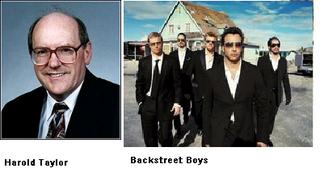
Why do I mention this?
I am just curious, frankly, to see what mentioning the Backstreet Boys does to the traffic on this weblog in the next day or so.
It will also be interesting to see how the Google ads (click on them and I may get a penny some day) change way down at the bottom of this page.
Scientific discovery are us.
(By the way, you too can observe this experiment. Also way down at the bottom of the page is my SiteCounter, which records how many people come to this site. [Don't worry, it doesn't know who you are.] I left it public for anyone to see. But if you click, prepare not to be amazed. I could have a lot more traffic on this site if I wrote about the Backstreet Boys more often instead of Harold Taylor. But what would be the point?)
Who knew people kept stats like these?
Kudos to time management consultant Harold Taylor for digging out cool, often obscure tips and statistics related to productivity.
In his newsletter this week, he includes a little note entitled, “Writing Skills Increase Productivity.” (Actually, what he wrote was “Writing Skills Increases Productivity,” but we know what he meant.)
Here’s Taylor’s item:
A survey of 218 executives by Communispond Inc. revealed that 88% of the respondents rated writing skills between 7 and 10 on a scale of 1 to 10 in terms of importance to productivity.
(Source: Building your Business Writing by Lin Grensing, MW, March/April, 1988)
Okay, so it’s not the most comprehensible statement you ever read. But when you’ve just begun a business-writing training service, and you’re positioning it as a productivity tool, confusing stats are better than no stats at all.
For more on Writing4Results, see http://www.writing4results.com/
For the full Taylor’s Time Tips, click here:
http://www.taylorontime.com/timetips/050808.html
In his newsletter this week, he includes a little note entitled, “Writing Skills Increase Productivity.” (Actually, what he wrote was “Writing Skills Increases Productivity,” but we know what he meant.)
Here’s Taylor’s item:
A survey of 218 executives by Communispond Inc. revealed that 88% of the respondents rated writing skills between 7 and 10 on a scale of 1 to 10 in terms of importance to productivity.
(Source: Building your Business Writing by Lin Grensing, MW, March/April, 1988)
Okay, so it’s not the most comprehensible statement you ever read. But when you’ve just begun a business-writing training service, and you’re positioning it as a productivity tool, confusing stats are better than no stats at all.
For more on Writing4Results, see http://www.writing4results.com/
For the full Taylor’s Time Tips, click here:
http://www.taylorontime.com/timetips/050808.html
Thursday, August 04, 2005
"Got it. Thanks!"
Here is my contribution to world peace and workplace efficiency.
Send more e-mails!
No, I don't want to know what you did last weekend. But I do want more people to acknowledge receipt of key e-mails. It is the courteous thing to do. (What a quaint word "courteous" is, even though the world has more need of courtesy now than ever.)
If you receive a document you've been waiting for, let the sender know you got it - and that you appreciate it. Send a quick e-mail to say Thanks.
If someone sends you an invoice, or any other document that is is important to them, acknowledge receipt. A quick "got it, thanks" will set the sender's mind at ease.
When you receive an e-mail that requires a considered, thoughtful response - and you have no time for that just now (who does?) - do the sender a favor. Let them know you got the e-mail, and give them some idea when you will get back to them. They will appreciate your thoughtfulness and be pleased to know that you are on the case - or at least intending to be.
Feedback is an essential part of communication. In interpersonal communication we rely on continuous feedback - even if it's just a nod, a wink or a smile that says the other person understands what you're saying.
E-mail is still a dodgy technology that can't really be trusted, so it is a medium in which feedback is even more important.
Give your correspondents a break, and let them know where you're at with their e-mails. Best of all, since so few peoople do that, it will help distinguish you from the run-of-the-mill faceless hordes in their Address Books. And that's what business is all about.
Send more e-mails!
No, I don't want to know what you did last weekend. But I do want more people to acknowledge receipt of key e-mails. It is the courteous thing to do. (What a quaint word "courteous" is, even though the world has more need of courtesy now than ever.)
If you receive a document you've been waiting for, let the sender know you got it - and that you appreciate it. Send a quick e-mail to say Thanks.
If someone sends you an invoice, or any other document that is is important to them, acknowledge receipt. A quick "got it, thanks" will set the sender's mind at ease.
When you receive an e-mail that requires a considered, thoughtful response - and you have no time for that just now (who does?) - do the sender a favor. Let them know you got the e-mail, and give them some idea when you will get back to them. They will appreciate your thoughtfulness and be pleased to know that you are on the case - or at least intending to be.
Feedback is an essential part of communication. In interpersonal communication we rely on continuous feedback - even if it's just a nod, a wink or a smile that says the other person understands what you're saying.
E-mail is still a dodgy technology that can't really be trusted, so it is a medium in which feedback is even more important.
Give your correspondents a break, and let them know where you're at with their e-mails. Best of all, since so few peoople do that, it will help distinguish you from the run-of-the-mill faceless hordes in their Address Books. And that's what business is all about.
Thursday, July 28, 2005
How well do you understand people?
Every entrepreneur is in marketing. And I believe every marketer needs to know what makes people tick. What attracts their attention and compels them to action?
It's rare that we actually get a chance to see what interests people most. But here's an interesting opportunity in the Toronto Star's website: its "most e-mailed stories" page.
http://www.thestar.com/NASApp/cs/ContentServer?pagename=thestar/Render&c=Page&cid=1109682110623
On July 27, the day British police arrested a key bombing suspect and NASA revealed more launch problems with the shuttle Discovery, which Toronto Star news stories did readers most e-mail to their friends and colleagues?
You guessed it: the liquor store strike that didn't happen. Furor over a downtown movie studio. Ikea cuts prices. Which gives us lots of clues into why people behave the way they do (hint: self-interest), even if it is Marketing 101.
Here are the Star's Top 10 most-emailed sories of the day, in descending order:
Cheers! LCBO strike averted
July. 27, 2005 04:55 PM
The Liquor Control Board of Ontario and the union representing its 5,400 workers have reached a tentative agreement that will avert a threatened strike at 12:01 a.m. tonight.
Mega-studio deal sparks controversy
July. 27, 2005 06:17 AM
A massive studio complex has become mired in controversy.
Ikea cuts prices on more than 500 items
July. 27, 2005 07:09 AM
Retailer Ikea is slashing prices on its most popular items by 17 per cent.
Rule forces MD to leave her patients
July. 27, 2005 01:00 AM
Dr. Jesse Bhatia is wondering how seriously the Ontario government is taking the shortage of physicians.
Meet the chef of Kimbourne Farm
July. 27, 2005 01:00 AM
Louis-Charles Desjardins pulled up in front of the 1896 farmhouse at the end of a dusty road and knew he had found the perfect place for his country inn.
CSIS angered by imam's campaign
July. 27, 2005 06:19 AM
Canada's spy service is waging a rare public battle against an outspoken Scarborough imam.
Newcomers' skills wasted, group argues
July. 27, 2005 06:41 AM
The provincial and federal governments are doing a terrible job of helping professionally trained immigrants become accredited in Ontario.
Residents shocked as Abitibi closes mills
July. 27, 2005 04:09 PM
STEPHENVILLE, Nfld. — Residents of this community were stunned to learn that the region will lose 300 jobs.
Blackout hits downtown
July. 27, 2005 10:33 AM
A blackout yesterday morning knocked out traffic lights and power for more than 7,000 customers.
Who's taking blame for Christian violence?
July. 26, 2005 01:00 AM
Now that imams are publicly condemning terrorist acts as anti-Muslim and against the teachings in the Qur'an, I wonder if pressure might be put on Christian leaders to take a similar stand.
We'll have another "Understanding People" exercise in a few days. Because people are your target market.
It's rare that we actually get a chance to see what interests people most. But here's an interesting opportunity in the Toronto Star's website: its "most e-mailed stories" page.
http://www.thestar.com/NASApp/cs/ContentServer?pagename=thestar/Render&c=Page&cid=1109682110623
On July 27, the day British police arrested a key bombing suspect and NASA revealed more launch problems with the shuttle Discovery, which Toronto Star news stories did readers most e-mail to their friends and colleagues?
You guessed it: the liquor store strike that didn't happen. Furor over a downtown movie studio. Ikea cuts prices. Which gives us lots of clues into why people behave the way they do (hint: self-interest), even if it is Marketing 101.
Here are the Star's Top 10 most-emailed sories of the day, in descending order:
Cheers! LCBO strike averted
July. 27, 2005 04:55 PM
The Liquor Control Board of Ontario and the union representing its 5,400 workers have reached a tentative agreement that will avert a threatened strike at 12:01 a.m. tonight.
Mega-studio deal sparks controversy
July. 27, 2005 06:17 AM
A massive studio complex has become mired in controversy.
Ikea cuts prices on more than 500 items
July. 27, 2005 07:09 AM
Retailer Ikea is slashing prices on its most popular items by 17 per cent.
Rule forces MD to leave her patients
July. 27, 2005 01:00 AM
Dr. Jesse Bhatia is wondering how seriously the Ontario government is taking the shortage of physicians.
Meet the chef of Kimbourne Farm
July. 27, 2005 01:00 AM
Louis-Charles Desjardins pulled up in front of the 1896 farmhouse at the end of a dusty road and knew he had found the perfect place for his country inn.
CSIS angered by imam's campaign
July. 27, 2005 06:19 AM
Canada's spy service is waging a rare public battle against an outspoken Scarborough imam.
Newcomers' skills wasted, group argues
July. 27, 2005 06:41 AM
The provincial and federal governments are doing a terrible job of helping professionally trained immigrants become accredited in Ontario.
Residents shocked as Abitibi closes mills
July. 27, 2005 04:09 PM
STEPHENVILLE, Nfld. — Residents of this community were stunned to learn that the region will lose 300 jobs.
Blackout hits downtown
July. 27, 2005 10:33 AM
A blackout yesterday morning knocked out traffic lights and power for more than 7,000 customers.
Who's taking blame for Christian violence?
July. 26, 2005 01:00 AM
Now that imams are publicly condemning terrorist acts as anti-Muslim and against the teachings in the Qur'an, I wonder if pressure might be put on Christian leaders to take a similar stand.
We'll have another "Understanding People" exercise in a few days. Because people are your target market.
Tuesday, July 26, 2005
Your Message in the Media
I had a great meeting yesterday with some people who are trying to rebrand their company and raise awareness in their selected market by doing some public relations.
They found it interesting to hear about my take on PR, so I thought I would share an abridged version with you.
1. The media are a great tool for getting coverage and raising awareness. But for most small businesses, you are better to tap into niche media than to go all out expecting TV, radio and big daily newspapers to pick up your story.
2. To do that, you need to know what niche you are targeting. (Fortunately, this company had just figured it out, which makes my job easier. A lot of companies still have no clue.)
3. Then you do some research to find out which media your target markets consume (preferably, when they are in a business frame of mind).
4. Study those media. Figure out what kinds of stories they are looking for. (Studying back issues, for instance, tells you what stories they like to run.)
5. Simply put, use your contacts, knowledge and industry expertise to give them more of the same.
6. Editors and news producers exist mainly to filter out press releases. They rarely see themselevs as searching for hidden gems amid the mountain of media releases they receive every day. So target specific media with personal queries.
7. Press releases are necessary for certain governance processes. From a marketing point of view, however, the best function of a press release is to create a comprehensive archive of controlled information for your website. It answers a lot of people's questions and looks incredibly professional.
But you will need to have a pretty good gimmick going (or there must be millions of lives at stake) if you expect a national newspaper to run your press release.
Pleae let me know if this has been helpful.
if you'd like more info, e-mail me anytime. rick@rickspence.ca
They found it interesting to hear about my take on PR, so I thought I would share an abridged version with you.
1. The media are a great tool for getting coverage and raising awareness. But for most small businesses, you are better to tap into niche media than to go all out expecting TV, radio and big daily newspapers to pick up your story.
2. To do that, you need to know what niche you are targeting. (Fortunately, this company had just figured it out, which makes my job easier. A lot of companies still have no clue.)
3. Then you do some research to find out which media your target markets consume (preferably, when they are in a business frame of mind).
4. Study those media. Figure out what kinds of stories they are looking for. (Studying back issues, for instance, tells you what stories they like to run.)
5. Simply put, use your contacts, knowledge and industry expertise to give them more of the same.
6. Editors and news producers exist mainly to filter out press releases. They rarely see themselevs as searching for hidden gems amid the mountain of media releases they receive every day. So target specific media with personal queries.
7. Press releases are necessary for certain governance processes. From a marketing point of view, however, the best function of a press release is to create a comprehensive archive of controlled information for your website. It answers a lot of people's questions and looks incredibly professional.
But you will need to have a pretty good gimmick going (or there must be millions of lives at stake) if you expect a national newspaper to run your press release.
Pleae let me know if this has been helpful.
if you'd like more info, e-mail me anytime. rick@rickspence.ca
Friday, July 22, 2005
Lessons from a comic-book superhero
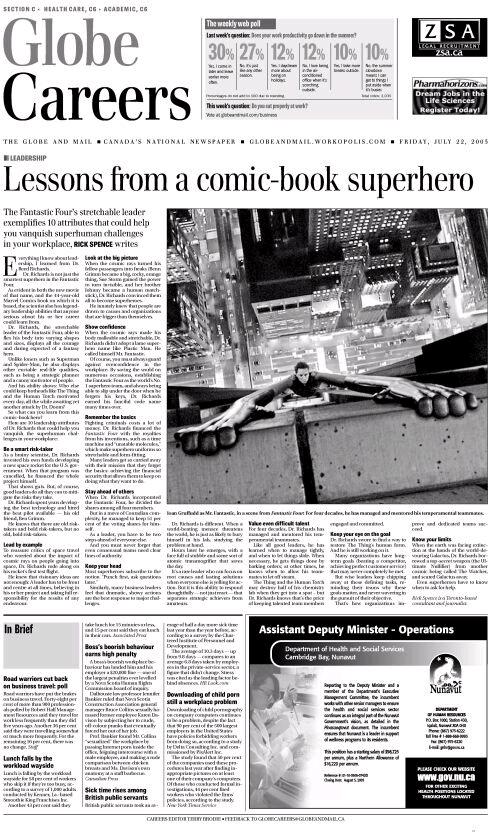
You can turn any experience into a lesson, says my friend, sales trainer Kelley Robertson. In my case, a childhood spent reading too many comic books turned into a story in The Globe and Mail today.
"Lessons from a comic-book superhero" offers 10 leadership lessons from Reed Richards, the stretchable leader of the Fantastic Four.
I wrote it up at the cottage and sent it to the The Globe's Careers page almost as a lark. To my surprise, they liked it. Mind you, they did a good editing job; they asked me to punch up some of the lessons to make it more focused and useful.
You can judge the results by clicking HERE.
An excerpt, for those too busy to click:
Stay ahead of others
When Dr. Richards incorporated the Fantastic Four, he divided the shares among all four members. But in a move of Conradian complexity, he managed to keep 51 per cent of the voting shares for himself.
As a leader, you have to be two steps ahead of everyone else.
And you must never forget that even consensual teams need clear lines of authority.
The Author's Lament
I told a friend this story yesterday and he asked if I had blogged it. No, I said. This blog is not about me, but about business. He said it was too good a story not to blog, so I reluctantly agreed.
Caution: Unhappy ending.
I have written one book, Secrets of Success from Canada's Fastest-Growing Companies. It went out of print a few years ago, so last year, just curious, I went on Amazon.com to see if it was still on sale there. It was, but there was also a used copy for sale from someone in Maryland.
This was a first for me. Very excited, I clicked on his site to see what over-the-top praise he would lavish on my book in order to sell it. And there to my horror were the four words every author dreads:
"Mint condition. Never read."
Caution: Unhappy ending.
I have written one book, Secrets of Success from Canada's Fastest-Growing Companies. It went out of print a few years ago, so last year, just curious, I went on Amazon.com to see if it was still on sale there. It was, but there was also a used copy for sale from someone in Maryland.
This was a first for me. Very excited, I clicked on his site to see what over-the-top praise he would lavish on my book in order to sell it. And there to my horror were the four words every author dreads:
"Mint condition. Never read."
Wednesday, July 20, 2005
Return of the Revenge of Ontario Business

Life moves in mysterious ways.
Two weeks after posting my thoughts on why an Ontario-focussed business magazine would never work, I got a call from a former colleague, a publication advertising sales professional, who wanted to pick my brain on that very topic - not knowing I had just blogged about it.
You can scroll down about eight postings to read my June 27 article, "Oh, the thrills of Ontario Business!" (or you can click here: http://canentrepreneur.blogspot.com/2005/06/oh-thrills-of-ontario-business.html )
So we met for coffee yesterday, and I told him why I thought Ontario doesn't really exist. But he insists there are advertisers who think otherwise.
I am still dubious. In my years in ad sales, I never once heard an advertiser or media buyer ask for MORE Canadian business magazines to advertise in. And I have never heard a business person say they didn't have enough magazines to read.
Nonetheless, I wished him luck, and gave him the name of the journalist who broached the idea with me a month ago. Maybe they can make it happen.
As I mentioned in the previous post, I have met too many entrepreneurs who have achieved the impossible to ever say that an idea won't work. After all, the concept is only part of the equation: It's the commitment and resources of its backers that determines the success or failure of any undertaking.
And I will deny ever saying these two should be committed.
Tuesday, July 19, 2005
Barriers to Innovation
Everyone knows that innovation is the solution to today's competitive business problems. But you can't just tell people to be more creative and successful. Innovation is hard.
So what are the toughest challenges in innovation? Canadian Manufacturers and Exporters (the old Cdn Mfrs Association) has the answers. In a recent cross-Canada survey of business leaders, they asked about the major constraints to commercializing innovation today.
Here, courtesy of CME chief economist Jayson Myers, are the barriers to innovation in Canada today.
Finding Customers/Lack of Customer Demand: 42%
Lack of Internal Resources: 28%
Competition: 28%
Availability of skilled personnel: 26%
Product Design: 23%
Prototype Development: 22%
Process Re-engineering and Scale-up: 17%
Corporate Culture: 13%
Financing: 13%
Inadequate Return on Investment: 13%
Technology Constraints: 10%
Other Regulatory Impediments: 9%
Short Product Cycles: 8%
Taxes: 5%
Accessing research: 1%
(% refers to the percentage of companies citing each particular problem.)
I find it interesting how lack of information is not a problem any more (1%). And taxes and regulations and even financing seem to be non-issues.
Obviously, the real constraint on innovation in Canada today is will.
So what are the toughest challenges in innovation? Canadian Manufacturers and Exporters (the old Cdn Mfrs Association) has the answers. In a recent cross-Canada survey of business leaders, they asked about the major constraints to commercializing innovation today.
Here, courtesy of CME chief economist Jayson Myers, are the barriers to innovation in Canada today.
Finding Customers/Lack of Customer Demand: 42%
Lack of Internal Resources: 28%
Competition: 28%
Availability of skilled personnel: 26%
Product Design: 23%
Prototype Development: 22%
Process Re-engineering and Scale-up: 17%
Corporate Culture: 13%
Financing: 13%
Inadequate Return on Investment: 13%
Technology Constraints: 10%
Other Regulatory Impediments: 9%
Short Product Cycles: 8%
Taxes: 5%
Accessing research: 1%
(% refers to the percentage of companies citing each particular problem.)
I find it interesting how lack of information is not a problem any more (1%). And taxes and regulations and even financing seem to be non-issues.
Obviously, the real constraint on innovation in Canada today is will.
Friday, July 15, 2005
Cold calling: The Big Chill down your spine
Entrepreneurs are dauntless businesspeople who dare all and fear nothing in their quest for success, right?
Wrong. Their knees buckle at the thought of cold-calling. Oh, the fears of rejection and insecurity that cold-calling arouses in even the stoutest hearts.
Of course, there are a few courageous entrepreneurs who dare to call people they don’t know to sell them on their services and arrange conversations and meetings. But even those don’t tend to do it very well.
Enter Susan Aldridge, Queen of the Cold-Callers, an Ontario entrepreneur who is building her own consulting business around cold-call training and outsourced cold-call services. Helping cold callers with cold feet: talk about a hot niche!
I devoted my column in the June issue of PROFIT Magazine to Susan’s business, and her cold-calling tips. Check it out at
http://www.profitguide.com/sales/article.jsp?content=618
My favorite of Susan Aldridge’s cold-calling tips:
“Find an Accountability Buddy. Tell them your goals and give them progress reports.”
To keep your cold feet to the fire.
Wrong. Their knees buckle at the thought of cold-calling. Oh, the fears of rejection and insecurity that cold-calling arouses in even the stoutest hearts.
Of course, there are a few courageous entrepreneurs who dare to call people they don’t know to sell them on their services and arrange conversations and meetings. But even those don’t tend to do it very well.
Enter Susan Aldridge, Queen of the Cold-Callers, an Ontario entrepreneur who is building her own consulting business around cold-call training and outsourced cold-call services. Helping cold callers with cold feet: talk about a hot niche!
I devoted my column in the June issue of PROFIT Magazine to Susan’s business, and her cold-calling tips. Check it out at
http://www.profitguide.com/sales/article.jsp?content=618
My favorite of Susan Aldridge’s cold-calling tips:
“Find an Accountability Buddy. Tell them your goals and give them progress reports.”
To keep your cold feet to the fire.
Monday, July 11, 2005
When the horse is dead, dismount
I was looking for some notes and accidentally found (thanks, Google Desktop Search) buried treasure.
It's some inspiring comments from John Kelly, the Newfoundland-born entrepreneur who founded (or co-founded) SHL Systemhouse, JetForm, Nabu Network Corp., etc., and remains an active business leader and mentor in Ottawa.
It was towards the end of a PROFIT 100 awards luncheon in Ottawa, where John sat on a panel of high-growth entrepreneurs. When we asked for the panellists’ best advice for all the entrepreneurs in the audience, here’s what he said.
“I find value in the old Newfoundland expression, ‘Sometimes I sits and I thinks; sometimes I just sits.’”
What that means, Kelly explained, “is that when you are just sitting, you’re dreaming. And what I have learned is that in dreaming, there are no limitations, and that it’s dreams that create new ideas. As Carl Sandburg says, ‘Nothing happens unless first we dream.’
“I think entrepreneurship is all about dreaming and visioning, and then, really, the ability to convert that vision into strategy and a plan. Leadership would be the ability to motivate others to believe in that vision, and work together to fulfil that plan.”
And then he added: “There’s a shorter version of what I learned, too: that when the horse is dead, dismount.”
After all, not every vision turns to gold.
It's some inspiring comments from John Kelly, the Newfoundland-born entrepreneur who founded (or co-founded) SHL Systemhouse, JetForm, Nabu Network Corp., etc., and remains an active business leader and mentor in Ottawa.
It was towards the end of a PROFIT 100 awards luncheon in Ottawa, where John sat on a panel of high-growth entrepreneurs. When we asked for the panellists’ best advice for all the entrepreneurs in the audience, here’s what he said.
“I find value in the old Newfoundland expression, ‘Sometimes I sits and I thinks; sometimes I just sits.’”
What that means, Kelly explained, “is that when you are just sitting, you’re dreaming. And what I have learned is that in dreaming, there are no limitations, and that it’s dreams that create new ideas. As Carl Sandburg says, ‘Nothing happens unless first we dream.’
“I think entrepreneurship is all about dreaming and visioning, and then, really, the ability to convert that vision into strategy and a plan. Leadership would be the ability to motivate others to believe in that vision, and work together to fulfil that plan.”
And then he added: “There’s a shorter version of what I learned, too: that when the horse is dead, dismount.”
After all, not every vision turns to gold.
What peeling paint?
Ignore the peeling paint in that photo below.
I was up on the scaffolding yesterday scraping and painting. The boathouse will look much better by next weekend.
The sunsets are looking better lately too.
I was up on the scaffolding yesterday scraping and painting. The boathouse will look much better by next weekend.
The sunsets are looking better lately too.
Thursday, July 07, 2005
Room with a View

If my postings fall off a bit this summer, it's because I am spending some time working from the cottage.
So you can sympathize with my plight, here's the view from a recent sunset, with my office (it's over the boathouse) in the foreground.
Wednesday, July 06, 2005
When deals go bad
One of my entrepreneurial heroes is Ron Foxcroft, the Hamilton entrepreneur who barely finished high school yet built two companies - while working three nights a week refereeing NCAA basketball games all over the U.S.A.
He is best known as the inventor of the Fox-40 pealess whistle, the loud, shrill whistle that never jams - and is sold all over the world at a huge markups for a 1-oz lump of plastic, simply because it is unique.
Ron is one of the first subjects of the Globe & Mail's new online feature, "My Best Mistake", which interviews prominent Canadian entrepreneurs. (Of course, my friends at Alberta Venture magazine have been using that same department title and idea for years. For an example, see http://www.albertaventure.com/abventure_3775.html)
Ron's "mistake" is worth reading because it speaks to an issue no one can understand until they have been in business for some time and made lots of mistakes: how to get out of bad contracts. Here's what he says:
"My biggest career mistake was to not have an exit strategy or expiry date on contracts and commitments. This applies to suppliers, distributors, agents and employees.
"Sometimes entrepreneurs make decisions from the heart and not necessarily in a scientific way. For example, even good suppliers, distributors, agents and employees can get complacent or, heaven forbid, incompetent. Early in my career I would honour a commitment in a sacred fashion even to my detriment. This cost me dearly because in some cases complacency and incompetence did rear its ugly head. Because I did not have established expiry dates or exit strategies, I paid the price for my mistake."
It's worth reading the whole article at
http://www.theglobeandmail.com/servlet/story/RTGAM.20050629.wfoxcroft-bestmistake29/BNStory/specialSmallBusiness/
He is best known as the inventor of the Fox-40 pealess whistle, the loud, shrill whistle that never jams - and is sold all over the world at a huge markups for a 1-oz lump of plastic, simply because it is unique.
Ron is one of the first subjects of the Globe & Mail's new online feature, "My Best Mistake", which interviews prominent Canadian entrepreneurs. (Of course, my friends at Alberta Venture magazine have been using that same department title and idea for years. For an example, see http://www.albertaventure.com/abventure_3775.html)
Ron's "mistake" is worth reading because it speaks to an issue no one can understand until they have been in business for some time and made lots of mistakes: how to get out of bad contracts. Here's what he says:
"My biggest career mistake was to not have an exit strategy or expiry date on contracts and commitments. This applies to suppliers, distributors, agents and employees.
"Sometimes entrepreneurs make decisions from the heart and not necessarily in a scientific way. For example, even good suppliers, distributors, agents and employees can get complacent or, heaven forbid, incompetent. Early in my career I would honour a commitment in a sacred fashion even to my detriment. This cost me dearly because in some cases complacency and incompetence did rear its ugly head. Because I did not have established expiry dates or exit strategies, I paid the price for my mistake."
It's worth reading the whole article at
http://www.theglobeandmail.com/servlet/story/RTGAM.20050629.wfoxcroft-bestmistake29/BNStory/specialSmallBusiness/
Tuesday, July 05, 2005
What's your personal motivation plan?
I know how difficult it can be to motivate yourself to do business during July and August, so let’s start the summer off with an exercise in self-discipline. I recommend you read the article, The Importance Of A Personal Motivation Plan, by my friend Kelley Robertson, now featured at About.com.
http://sbinfocanada.about.com/cs/management/a/motivationkr.htm?nl=1
The story starts kind of slowly, but page 2 offers lots of ideas for ratcheting up the motivation and making sure you do what has to get done.
I especially like Kelley’s final words of advice:
“Lastly, associate with positive people. I have made it a point in the latter part of my career to distance myself from negative individuals. They drain your energy, will not support your goals and desires, and do little to motivate you. On the other hand, positive and optimistic people will uplift your spirits and help you through challenging times.”
This is a hard one. But it is devastatingly true. Negative people who fail to see the everyday miracles around us will drag you down – and there are lots of them out there. Stay close to the upbeat friends who know you can do anything you put your mind to. Optimisim begets success.
http://sbinfocanada.about.com/cs/management/a/motivationkr.htm?nl=1
The story starts kind of slowly, but page 2 offers lots of ideas for ratcheting up the motivation and making sure you do what has to get done.
I especially like Kelley’s final words of advice:
“Lastly, associate with positive people. I have made it a point in the latter part of my career to distance myself from negative individuals. They drain your energy, will not support your goals and desires, and do little to motivate you. On the other hand, positive and optimistic people will uplift your spirits and help you through challenging times.”
This is a hard one. But it is devastatingly true. Negative people who fail to see the everyday miracles around us will drag you down – and there are lots of them out there. Stay close to the upbeat friends who know you can do anything you put your mind to. Optimisim begets success.
Thursday, June 30, 2005
What a CEO does
Business success is all about focus - focusing on the right things.
At a brainstorming session for a company recently, we had an interesting discussion on how one evaluates a CEO. What should he/she be focusing on, and how do we measure success?
Part of it is easy. Look at the bottom line every quarter or year. If things are going right, you are hitting your targets, and (hopefully) exceeding them. We also agreed that tracking the share price (for those companies that put a value on their shares) is key.
And there it stopped - for some. If those two indicators are going the right way, some people said, what more do you need?
I argued for much more. I believe the CEO's job is complex and multi-dimensional. You can't just measure the past. To make sure the CEO is focused on the right things, you have to measure the present - and try to measure the future.
So I pushed to add metrics such as market share, R&D, market leadership and new product development to the CEO's burden. And, some measurement of employee engagement/morale/satisfaction, as well as ongoing monitoring of staff turnover levels. There are lots of off-the-shelf tools you can use to study these, to make sure things are truly going well.
To protect the future, I also argued for a strategic-planning metric. Today's markets are changing fast. How focused are we on what we need to do to keep on being successful - next year and the year after that?
You can't measure our success at predicting tomorrow (not yet, anyway). But you can encourage the CEO to keep one eye on the future, and then measure his or her ability to continually motivate individuals and teams to focus on where the markets, trends and technology are heading - and propose new strategies for moving forward.
The CEO's job is not just to perform - but to protect the company's freedom to perform in future.
At a brainstorming session for a company recently, we had an interesting discussion on how one evaluates a CEO. What should he/she be focusing on, and how do we measure success?
Part of it is easy. Look at the bottom line every quarter or year. If things are going right, you are hitting your targets, and (hopefully) exceeding them. We also agreed that tracking the share price (for those companies that put a value on their shares) is key.
And there it stopped - for some. If those two indicators are going the right way, some people said, what more do you need?
I argued for much more. I believe the CEO's job is complex and multi-dimensional. You can't just measure the past. To make sure the CEO is focused on the right things, you have to measure the present - and try to measure the future.
So I pushed to add metrics such as market share, R&D, market leadership and new product development to the CEO's burden. And, some measurement of employee engagement/morale/satisfaction, as well as ongoing monitoring of staff turnover levels. There are lots of off-the-shelf tools you can use to study these, to make sure things are truly going well.
To protect the future, I also argued for a strategic-planning metric. Today's markets are changing fast. How focused are we on what we need to do to keep on being successful - next year and the year after that?
You can't measure our success at predicting tomorrow (not yet, anyway). But you can encourage the CEO to keep one eye on the future, and then measure his or her ability to continually motivate individuals and teams to focus on where the markets, trends and technology are heading - and propose new strategies for moving forward.
The CEO's job is not just to perform - but to protect the company's freedom to perform in future.
Monday, June 20, 2005
Secret Search Terms Revealed!
About half the traffic to this weblog comes from search engines.
My site stats enable me to read what search questions people entered into Yahoo, Google, etc. (But don’t worry: I have no idea who you are.)
To help understand how the world works, here are some recent search terms that led people to this blog. Clearly, some came of their own accord, while others probably went away disappointed.
Some are pretty funny. Some say something about human nature, while others simply point to the randomness that develops when you write 30,000 words that are all searchable.
tennis venture capital deals Winnipeg
canadian entrepreneur website
“rick segal”
Problem that encountered by a canadian business in the international marketplace
COOPER SCRAP FOR SALE ONLY IN CANADA
company of wolves bittorrent
email addresses and the guest book of manufacturers and entrepreneur in uk posted
Canadian Entrepreneur
john delponti
The unions have helped us to understand that we've been looking at the retailing business
Richard Branson", "employee recognition" OR "employee rewards"
45,000.00 canadian equals how much per hour
why canadian business fail
"what is leverage" "entrepreneur"
thunder bay lakehead canada blog
"benjamin keaton"
Canadian Entrepreneur Guide
canadian newspapers make michael jackson sound quality
"john delponti"
rick Spence
"clarity systems" + glenn cullen"
Come back next month for more “Secret Search Terms Revealed!”
My site stats enable me to read what search questions people entered into Yahoo, Google, etc. (But don’t worry: I have no idea who you are.)
To help understand how the world works, here are some recent search terms that led people to this blog. Clearly, some came of their own accord, while others probably went away disappointed.
Some are pretty funny. Some say something about human nature, while others simply point to the randomness that develops when you write 30,000 words that are all searchable.
tennis venture capital deals Winnipeg
canadian entrepreneur website
“rick segal”
Problem that encountered by a canadian business in the international marketplace
COOPER SCRAP FOR SALE ONLY IN CANADA
company of wolves bittorrent
email addresses and the guest book of manufacturers and entrepreneur in uk posted
Canadian Entrepreneur
john delponti
The unions have helped us to understand that we've been looking at the retailing business
Richard Branson", "employee recognition" OR "employee rewards"
45,000.00 canadian equals how much per hour
why canadian business fail
"what is leverage" "entrepreneur"
thunder bay lakehead canada blog
"benjamin keaton"
Canadian Entrepreneur Guide
canadian newspapers make michael jackson sound quality
"john delponti"
rick Spence
"clarity systems" + glenn cullen"
Come back next month for more “Secret Search Terms Revealed!”
TOM SWIFT and His Space Solartron
When I was a kid I read a science fiction book called Tom Swift and His Space Solartron, about a boy genius and a machine that could make any manufactured good you wanted (imagine, one machine replacing every factory in China).
The solartron isn’t reality yet, but we’re getting close. The Economist recently wrote about Neil Gershenfeld, the director of the Massachusetts Institute of Technology's Center for Bits and Atoms, who has created version 1.0 of the personal fabricator.
What’s a Personal Fabricator? It’s a package of commercially available machines that can produce almost any complex electronic gadget you ask it to.
“Among other tools,” says the Economist, “it includes a laser cutter that makes two-dimensional and three-dimensional structures, a device that uses a computer-controlled knife to carve antennas and flexible electrical connections, a miniature milling machine that manoeuvres a cutting tool in three dimensions to make circuit boards and other precision parts, a set of software for programming cheap computer chips known as microcontrollers, and a jigsaw..."
“Together, these can machine objects with a precision of a millionth of a metre. The fab lab's purpose is to endow inventors—particularly those in poor countries who lack a formal education and the resources to implement their ideas—with a set of tools that can translate back-of-the-envelope designs into working prototypes.”
These “FabLabs” are already in use around the world. In Boston, residents of a housing complex are using one to create a wireless communication network. In India, students have built a sensor to measure the fat content of milk for local dairy farmers. In Ghana, FabLabs have been used to produce jewellery, car parts, agricultural tools and radio antennas. In Norway, animal herders are making radio collars and wireless networks to track their herds.
Gadgets to Go. A boon for innovation, and specifically for the developing world. And it’s not science fiction anymore.
The June 9 issue has an article on Fab Labs called “How to make (almost) anything”. The online version is subscriber-only, but here’s a link to a March story: http://www.economist.com/science/displayStory.cfm?story_id=3786368
Visit FabLab Central at http://fab.cba.mit.edu/
The solartron isn’t reality yet, but we’re getting close. The Economist recently wrote about Neil Gershenfeld, the director of the Massachusetts Institute of Technology's Center for Bits and Atoms, who has created version 1.0 of the personal fabricator.
What’s a Personal Fabricator? It’s a package of commercially available machines that can produce almost any complex electronic gadget you ask it to.
“Among other tools,” says the Economist, “it includes a laser cutter that makes two-dimensional and three-dimensional structures, a device that uses a computer-controlled knife to carve antennas and flexible electrical connections, a miniature milling machine that manoeuvres a cutting tool in three dimensions to make circuit boards and other precision parts, a set of software for programming cheap computer chips known as microcontrollers, and a jigsaw..."
“Together, these can machine objects with a precision of a millionth of a metre. The fab lab's purpose is to endow inventors—particularly those in poor countries who lack a formal education and the resources to implement their ideas—with a set of tools that can translate back-of-the-envelope designs into working prototypes.”
These “FabLabs” are already in use around the world. In Boston, residents of a housing complex are using one to create a wireless communication network. In India, students have built a sensor to measure the fat content of milk for local dairy farmers. In Ghana, FabLabs have been used to produce jewellery, car parts, agricultural tools and radio antennas. In Norway, animal herders are making radio collars and wireless networks to track their herds.
Gadgets to Go. A boon for innovation, and specifically for the developing world. And it’s not science fiction anymore.
The June 9 issue has an article on Fab Labs called “How to make (almost) anything”. The online version is subscriber-only, but here’s a link to a March story: http://www.economist.com/science/displayStory.cfm?story_id=3786368
Visit FabLab Central at http://fab.cba.mit.edu/
Friday, June 17, 2005
Best positioning statement ever
I am fascinated by positioning statements.
I believe most business people are terrible at introducing themselves. Introductory statements are supposed to engage and compel people, but most simply confuse, mystify or bore.
I wrote a column on this in PROFIT magazine a few months ago. I thought it was a decent but unimportant column, but it garnered more reader response than any previous column. Everyone wants to introduce themselves better.
So I am glad to report that at the PROFIT 100 CEO Summit in Toronto yesterday, most entrepreneurs had decent positioning statements. They were short, clear and to the point. They serve up just enough information to empower the people they meet to pursue a business conversation if they wish.
But one entrepreneur had the best positioning statement I have ever heard. It says what he does, who his market is, and why his product is special – in 10 words.
Phil White is an engineer and cycling enthusiast who now heads Toronto-based Cervelo Cycles Inc. http://www.profitguide.com/profit100/2005/p100.asp?Rank=34
His positioning statement: “We make the bicycle that won the Tour de France.”
Bravo!
http://www.cervelo.com/
I believe most business people are terrible at introducing themselves. Introductory statements are supposed to engage and compel people, but most simply confuse, mystify or bore.
I wrote a column on this in PROFIT magazine a few months ago. I thought it was a decent but unimportant column, but it garnered more reader response than any previous column. Everyone wants to introduce themselves better.
So I am glad to report that at the PROFIT 100 CEO Summit in Toronto yesterday, most entrepreneurs had decent positioning statements. They were short, clear and to the point. They serve up just enough information to empower the people they meet to pursue a business conversation if they wish.
But one entrepreneur had the best positioning statement I have ever heard. It says what he does, who his market is, and why his product is special – in 10 words.
Phil White is an engineer and cycling enthusiast who now heads Toronto-based Cervelo Cycles Inc. http://www.profitguide.com/profit100/2005/p100.asp?Rank=34
His positioning statement: “We make the bicycle that won the Tour de France.”
Bravo!
http://www.cervelo.com/
Every old product is new again.
That’s the message from Ken Nickerson, a former tech guru with Microsoft who now invests full-time in technology firms through his own private investment company, Toronto-based iBinary.
Nickerson was a featured speaker yesterday at the PROFIT 100 CEO Summit, for the leaders of Canada’s Fastest-Growing Companies. The attendees are pretty sharp themselves, but they were hanging on Nickerson’s every word. (He’s the guy who convinced Microsoft to buy HotMail.)
In his first public speech in five years, Nickerson said new information technology – digital processing, storage and communications – is transforming consumer and business markets. “Everything gets a chance to be new again. Everything we’ve invented is getting smarter and able to communicate or store more information about themselves.”
Nickerson says that is creating upheaval in a range of markets – which of course means opportunity for fast-moving entrepreneurs. Music, photography, video and security are niches already neck-deep in change. Other sectors that Nickerson believes are ripe for revolution: money, homes, cars, education, health, entertainment, privacy and (of course) sex.
To get ahead, look at how you can add information storage, processing capacity or one- or two-way communications capability to a wide range of products and services.
He also has a warning for old-line producers: “If you can’t incorporate intelligence into your products, outsource it – because you’re competing on price.” And you’re not going to win against lower-cost producers.
Based on the success of Apple’s iPod, which was neither the first MP3 player nor the cheapest, Nickerson offers this advice. “Invest in design,” he says. “We’re seeing a new idea that you should expect good design in everything you buy and touch – and it’s having an impact on business.”
Incredibly enough, he says the changes we’re going to see from infotech are tiny compared to the coming impact of biotechnology and nanotechnology. That’s where he’s investing now.
Nickerson was a featured speaker yesterday at the PROFIT 100 CEO Summit, for the leaders of Canada’s Fastest-Growing Companies. The attendees are pretty sharp themselves, but they were hanging on Nickerson’s every word. (He’s the guy who convinced Microsoft to buy HotMail.)
In his first public speech in five years, Nickerson said new information technology – digital processing, storage and communications – is transforming consumer and business markets. “Everything gets a chance to be new again. Everything we’ve invented is getting smarter and able to communicate or store more information about themselves.”
Nickerson says that is creating upheaval in a range of markets – which of course means opportunity for fast-moving entrepreneurs. Music, photography, video and security are niches already neck-deep in change. Other sectors that Nickerson believes are ripe for revolution: money, homes, cars, education, health, entertainment, privacy and (of course) sex.
To get ahead, look at how you can add information storage, processing capacity or one- or two-way communications capability to a wide range of products and services.
He also has a warning for old-line producers: “If you can’t incorporate intelligence into your products, outsource it – because you’re competing on price.” And you’re not going to win against lower-cost producers.
Based on the success of Apple’s iPod, which was neither the first MP3 player nor the cheapest, Nickerson offers this advice. “Invest in design,” he says. “We’re seeing a new idea that you should expect good design in everything you buy and touch – and it’s having an impact on business.”
Incredibly enough, he says the changes we’re going to see from infotech are tiny compared to the coming impact of biotechnology and nanotechnology. That’s where he’s investing now.
Tuesday, June 14, 2005
What is Leverage?
What is leverage, and how can I use it to grow my business?
That was the question debated by 10 entrepreneurs at a brainstorming meeting I attended this afternoon. It was a refreshing experience – there was no agenda, no required outcome – just a group of unaffiliated entrepreneurs discussing the process of doing business.
I arrived knowing nothing about leverage. When I covered Big Business for the Financial Times of Canada 20 years ago, “leverage” meant borrowing large sums of money to invest in growth opportunities (usually real estate) that were otherwise out of the company’s reach financially. The idea was that these assets would make more money for the company than it was shelling out to pay interest on the debt.
This group, however, studied the use of leverage in non-financial situations. Essentially, we defined leverage as strategically exploiting (in the good sense) all the assets available to your business. The goal: to reach more customers, increase sales, and become more profitable.
We identified lots of assets that we should all be leveraging more effectively: customers, cash flow, reputation, superior products, relationships and partnerships, knowledge, time, industry contacts, referral sources, etc. We decided the ultimate leverage is that enjoyed by Microsoft, whose software is preloaded in just about every PC sold today.
The first step to successful leverage, we decided, is to achieve focus and clarity. What are you really trying to do? What are the objectives of your business?
Only once you truly understand all that can you effectively exploit leverage, by knowing which areas to invest in, what customers to talk to about joint ventures, how to market your products’ benefits more effectively, or who to ask for referrals.
It was a valuable discussion, organized by StreetSmart marketing expert Michael Hepworth (http://www.results-exchange.com/) and well moderated by Rick Wolfe of PostStone Corp. http://www.poststone.com/, who specializes in leading “kitchen table conversations.” This conversation made us all realize how inadequately we are all exploiting our unique business strengths, but it offered great ideas on how to get started.
That was the question debated by 10 entrepreneurs at a brainstorming meeting I attended this afternoon. It was a refreshing experience – there was no agenda, no required outcome – just a group of unaffiliated entrepreneurs discussing the process of doing business.
I arrived knowing nothing about leverage. When I covered Big Business for the Financial Times of Canada 20 years ago, “leverage” meant borrowing large sums of money to invest in growth opportunities (usually real estate) that were otherwise out of the company’s reach financially. The idea was that these assets would make more money for the company than it was shelling out to pay interest on the debt.
This group, however, studied the use of leverage in non-financial situations. Essentially, we defined leverage as strategically exploiting (in the good sense) all the assets available to your business. The goal: to reach more customers, increase sales, and become more profitable.
We identified lots of assets that we should all be leveraging more effectively: customers, cash flow, reputation, superior products, relationships and partnerships, knowledge, time, industry contacts, referral sources, etc. We decided the ultimate leverage is that enjoyed by Microsoft, whose software is preloaded in just about every PC sold today.
The first step to successful leverage, we decided, is to achieve focus and clarity. What are you really trying to do? What are the objectives of your business?
Only once you truly understand all that can you effectively exploit leverage, by knowing which areas to invest in, what customers to talk to about joint ventures, how to market your products’ benefits more effectively, or who to ask for referrals.
It was a valuable discussion, organized by StreetSmart marketing expert Michael Hepworth (http://www.results-exchange.com/) and well moderated by Rick Wolfe of PostStone Corp. http://www.poststone.com/, who specializes in leading “kitchen table conversations.” This conversation made us all realize how inadequately we are all exploiting our unique business strengths, but it offered great ideas on how to get started.
Thursday, June 09, 2005
To Boldly Grow
The 2005 PROFIT 100 is out!
That’s PROFIT magazine’s annual list of Canada’s 100 – actually, 200, but that doesn’t sound as cool – smartest, fastest growth firms. All laid out for you on the Web, along with what they do and how they do it.
If you want to understand where Canadian business is heading, run (don’t walk) to the new list of Canada’s Fastest-Growing Companies at http://www.profitguide.com/profit100/index.asp
And get this: even the 200th-ranked company has tripled its sales over the last five years.
This is the 17th annual PROFIT 100: among the winners on previous lists are Research in Motion, Pivotal Corp., Clearnet, Bioware, QLT, DataMirror, Angiotech, OpenText, Janna Technologies, TLC Laser Eye Centres, Western Financial, Cangene, GAP Adventures, and many other growth firms you should have known much earlier than you did. Check out this year’s list to discover tomorrow’s best marketers, newsmakers and speculative stock plays.
This year’s No. 1 firm this year is Toronto-based Internet hosting service Hostopia.com, with five-year revenue growth of (gulp!) 13,000%. Interestingly, this firm includes the entire senior management team from Tucows, a multi-year PROFIT 100 firm from about five years ago. It’s a nail-biting story of a firm that struggled to make it – but is now a secure industry leader that may soon go public.
I was privileged last month to interview the CEOs of the top five companies on the PROFIT 100. You can check out those profiles at http://www.profitguide.com/profit100/2005/article.asp?ID=1329
This is required reading at the Starfleet Academy of Entrepreneurship.
That’s PROFIT magazine’s annual list of Canada’s 100 – actually, 200, but that doesn’t sound as cool – smartest, fastest growth firms. All laid out for you on the Web, along with what they do and how they do it.
If you want to understand where Canadian business is heading, run (don’t walk) to the new list of Canada’s Fastest-Growing Companies at http://www.profitguide.com/profit100/index.asp
And get this: even the 200th-ranked company has tripled its sales over the last five years.
This is the 17th annual PROFIT 100: among the winners on previous lists are Research in Motion, Pivotal Corp., Clearnet, Bioware, QLT, DataMirror, Angiotech, OpenText, Janna Technologies, TLC Laser Eye Centres, Western Financial, Cangene, GAP Adventures, and many other growth firms you should have known much earlier than you did. Check out this year’s list to discover tomorrow’s best marketers, newsmakers and speculative stock plays.
This year’s No. 1 firm this year is Toronto-based Internet hosting service Hostopia.com, with five-year revenue growth of (gulp!) 13,000%. Interestingly, this firm includes the entire senior management team from Tucows, a multi-year PROFIT 100 firm from about five years ago. It’s a nail-biting story of a firm that struggled to make it – but is now a secure industry leader that may soon go public.
I was privileged last month to interview the CEOs of the top five companies on the PROFIT 100. You can check out those profiles at http://www.profitguide.com/profit100/2005/article.asp?ID=1329
This is required reading at the Starfleet Academy of Entrepreneurship.
Friday, June 03, 2005
Partnerships that Work
At the Wisdom Exchange conference on Tuesday (see similar post below), I led a discussion of Ontario CEOs on “Creative Collaborations.” The best part came at the end, when we “whipped around” the table and asked each participant to suggest a personal strategy or tip on “How to Make Your Partnerships Succeed.”
Here’s what they said.
- Ensure that one player in the partnership is dominant - a “partnership of equals” won’t succeed
- Make sure the alliance is a clear win for both (all) participants
- “I don’t think you can partner with a direct competitor.”
- Have a plan. Know what you’re doing and why. Do your homework.
- Be committed. If you have just a casual interest in its success, it won’t succeed.
- Look for the win-win. Understand the motivation of both sides and keep track of it as you go forward.
- Pay attention throughout. Monitor the partnership and keep talking to your partner. “Treat them like a customer.”
- Accept imbalance. “If you are the small guy in that partnership, you will always be the small guy. Stay in that box.”
- Have a third party (neutral and catalytic) to tie the partnership together, keep it going.
- Be prepared to invest resources: money and time. (If the market needs more money and time, be prepared to pony up.)
- To start an effective partnership, especially with a larger partner, “bring a customer to the table. That gets their attention.”
That's it: real-world advice from entrepreneurs who've "been there."
Here’s what they said.
- Ensure that one player in the partnership is dominant - a “partnership of equals” won’t succeed
- Make sure the alliance is a clear win for both (all) participants
- “I don’t think you can partner with a direct competitor.”
- Have a plan. Know what you’re doing and why. Do your homework.
- Be committed. If you have just a casual interest in its success, it won’t succeed.
- Look for the win-win. Understand the motivation of both sides and keep track of it as you go forward.
- Pay attention throughout. Monitor the partnership and keep talking to your partner. “Treat them like a customer.”
- Accept imbalance. “If you are the small guy in that partnership, you will always be the small guy. Stay in that box.”
- Have a third party (neutral and catalytic) to tie the partnership together, keep it going.
- Be prepared to invest resources: money and time. (If the market needs more money and time, be prepared to pony up.)
- To start an effective partnership, especially with a larger partner, “bring a customer to the table. That gets their attention.”
That's it: real-world advice from entrepreneurs who've "been there."
Thursday, June 02, 2005
Ten Factors that Make Alliances Fail
How do you make business alliances, joint ventures and partnerships work? That was the theme of a roundtable I led earlier this week (May 31) at the Wisdom Exchange, a forum for the entrepreneurs who run Ontario's Fastest-Growing Companies.
We had some pretty interesting discussions, and I wil include some of that material tomorrow. For now, according to my group of successful Canadian entrepreneurs, here are the 10 Factors that Make Alliances Fail:
* Different expectations
* Different priorities
* Lack of focus
* Lack of buy-in by all stakeholders
* Insufficient incentive for all parties to make it work
* Lack of clear vision/strategy
* Failure to plan exit strategy
* Inadequate due diligence
* One partner’s incompetence, misrepresentation or failure to perform
* Changes at the corporate level for one partner, e.g. a corporate takeover
Forewarned is forearmed.
We had some pretty interesting discussions, and I wil include some of that material tomorrow. For now, according to my group of successful Canadian entrepreneurs, here are the 10 Factors that Make Alliances Fail:
* Different expectations
* Different priorities
* Lack of focus
* Lack of buy-in by all stakeholders
* Insufficient incentive for all parties to make it work
* Lack of clear vision/strategy
* Failure to plan exit strategy
* Inadequate due diligence
* One partner’s incompetence, misrepresentation or failure to perform
* Changes at the corporate level for one partner, e.g. a corporate takeover
Forewarned is forearmed.
Wednesday, June 01, 2005
Thoughts on Marketing
I’m taping a TV show next week about marketing for small business. In preparation, I wrote up some of my thoughts on the topic for the producer, and then thought I'd share them with you here. Basically, this is the framework for my contention that most entrepreneurs need help to become good marketers.
Let me know what you think. The Comments link at the end of the post is here (as always) for you.
Thoughts on marketing:
"I see marketing as a core incompetency for most Canadian entrepreneurs.
"In my experience, most people get into business because they have a particular skill and a pre-existing customer relationship, often from their previous job. As they develop their company, they grow its capacity, product line and relationships, but they often neglect basic marketing. They presume that their current and growing relationships with prospects and customers, along with their basic competence and market knowledge, is enough.
"While they work hard at cultivating direct relationships, they really don't know anything about direct marketing, advertising, soliciting referrals, etc. Many have trouble distinguishing between marketing and sales. And they are reluctant (or genetically uninclined) to ask for help in these areas. (Many entrepreneurs don't trust what they don't know.)
"Another almost universal problem: they are poor at marketing themselves. I just facilitated a roundtable yesterday consisting of a dozen entrepreneurs from a wide variety of fields. The first job was introducing ourselves. Not one of them had a compelling personal statement to introduce themselves and their business. Few were capable of clearly explaining what their business does in jargon-free language. And most of them mumbled so badly that I would not have known the names of their companies if I had not had the list in front of me!
"So I believe there is much we can do to promote marketing skills among small business. We could talk about the basic skills many entrepreneurs lack, marketing success stories that illustrate some of the wins that are out there, and how entrepreneurs can learn more."
For more info on this topic, see this 2001 story from PROFIT Magazine: Why Canadians Can’t Market.
http://www.profitguide.com/magazine/article.jsp?content=429
It’s a fun piece.
Let me know what you think. The Comments link at the end of the post is here (as always) for you.
Thoughts on marketing:
"I see marketing as a core incompetency for most Canadian entrepreneurs.
"In my experience, most people get into business because they have a particular skill and a pre-existing customer relationship, often from their previous job. As they develop their company, they grow its capacity, product line and relationships, but they often neglect basic marketing. They presume that their current and growing relationships with prospects and customers, along with their basic competence and market knowledge, is enough.
"While they work hard at cultivating direct relationships, they really don't know anything about direct marketing, advertising, soliciting referrals, etc. Many have trouble distinguishing between marketing and sales. And they are reluctant (or genetically uninclined) to ask for help in these areas. (Many entrepreneurs don't trust what they don't know.)
"Another almost universal problem: they are poor at marketing themselves. I just facilitated a roundtable yesterday consisting of a dozen entrepreneurs from a wide variety of fields. The first job was introducing ourselves. Not one of them had a compelling personal statement to introduce themselves and their business. Few were capable of clearly explaining what their business does in jargon-free language. And most of them mumbled so badly that I would not have known the names of their companies if I had not had the list in front of me!
"So I believe there is much we can do to promote marketing skills among small business. We could talk about the basic skills many entrepreneurs lack, marketing success stories that illustrate some of the wins that are out there, and how entrepreneurs can learn more."
For more info on this topic, see this 2001 story from PROFIT Magazine: Why Canadians Can’t Market.
http://www.profitguide.com/magazine/article.jsp?content=429
It’s a fun piece.
Monday, May 30, 2005
The Wisdom Exchange
Today marks the starts of the 11th annual Wisdom Exchange, one of the Ontario government’s better ideas.
The Wisdom Exchange is a special business networking/idea-sharing conference limited to CEOs of Ontario’s fastest-growing companies. It stemmed from Ontario’s belated realization a dozen years ago that not all small businesses are alike. And that if you identify the companies with the best prospects for growth, and give them extra care and service, you may just do more to create jobs and promote economic development than by simply throwing money at “small business” in general.
The theme for this year is “Return on Creativity - Leveraging the Power of Ideas.” Wisely, the organizers are taking a holistic approach to creativity. It’s not just about product innovation, but also applying creative approaches to financing, partnerships and alliances, HR strategies, marketing – even succession planning.
I’ll be moderating a roundtable on Creative Collaboration tomorrow. If we exchange any useful wisdom, I'll let you know.
Meantime, if you want to read the wisdom and “true confessions” of entrepreneurs such as Michael MacMillan (Alliance Atlantis) or John Stanton (The Running Room), take a look at the report from last year’s Wisdom Exchange. It’s also full of good ideas about marketing, personal development, and exporting to China.
This is your chance to share the wisdom of some of the province’s best business minds, so take a look – or even save it to your hard drive.
Check it out at
http://www.ontariocanada.com/ontcan/en/downloads/w-e/w-e-report-2004.pdf
It’s your tax dollar at work.
The Wisdom Exchange is a special business networking/idea-sharing conference limited to CEOs of Ontario’s fastest-growing companies. It stemmed from Ontario’s belated realization a dozen years ago that not all small businesses are alike. And that if you identify the companies with the best prospects for growth, and give them extra care and service, you may just do more to create jobs and promote economic development than by simply throwing money at “small business” in general.
The theme for this year is “Return on Creativity - Leveraging the Power of Ideas.” Wisely, the organizers are taking a holistic approach to creativity. It’s not just about product innovation, but also applying creative approaches to financing, partnerships and alliances, HR strategies, marketing – even succession planning.
I’ll be moderating a roundtable on Creative Collaboration tomorrow. If we exchange any useful wisdom, I'll let you know.
Meantime, if you want to read the wisdom and “true confessions” of entrepreneurs such as Michael MacMillan (Alliance Atlantis) or John Stanton (The Running Room), take a look at the report from last year’s Wisdom Exchange. It’s also full of good ideas about marketing, personal development, and exporting to China.
This is your chance to share the wisdom of some of the province’s best business minds, so take a look – or even save it to your hard drive.
Check it out at
http://www.ontariocanada.com/ontcan/en/downloads/w-e/w-e-report-2004.pdf
It’s your tax dollar at work.
Friday, May 27, 2005
Negotiating Tips
Yesterday I spent a terrific day at a course called “Negotiate with Confidence & Power,” run by Kelley Robertson, a former retail-sales trainer turned consultant and workshop leader. (His Stop, Ask & Listen is one of the best books on selling written by a Canadian.)
Lots of highlights, including three role-playing exercises that really expanded your mind as to the opportunities you have as a negotiator. We have all heard that negotiators should strive for a win-win outcome, but we don’t tend to behave like that in practice. Our instinct is to put our own needs on the table and then fight for them – usually repeating our demands (needs, requests, whatever) over and over rather than genuinely trying to find common ground.
Our first exercise was a real eye-opener. In the role-play, Person A is trying to obtain all existing supplies of a rare fruit extract in order to create a vaccine to stop a devastating new disease; Player B needs the same product to create a plant growth supplement that could prevent millions of deaths due to drought in Africa. The twist: neither person was given any information about each other’s needs or motivations.
You had to discover them yourself. Which is a wonderful lesson in itself. Because we all tend to assume too much, ask too few questions, and talk more than listen.
It was almost painful watching us argue with each other and try to ram our needs down each others’ throat, rather than focus on the other person’s interests and how we might work together. Had we been smart enough to do that, we might have discovered that each of us wanted different things: the vaccine people needed the skin of the fruit, the supplement makers needed the pulp inside. We could have both got what we wanted had we asked more questions and worked on establishing trust.
Powerful stuff.
Three of many negotiating tips from Kelley Robertson:
-- Keep your ego out of the negotiating process.
-- Information is key. The person with the most information generally does better.
-- When you make a concession, always ask for something in return .
You can read more about Kelley’s work, sign up for his 59-Second Tip newsletter, or check out his e-books at
http://www.robertsontraininggroup.com/
Lots of highlights, including three role-playing exercises that really expanded your mind as to the opportunities you have as a negotiator. We have all heard that negotiators should strive for a win-win outcome, but we don’t tend to behave like that in practice. Our instinct is to put our own needs on the table and then fight for them – usually repeating our demands (needs, requests, whatever) over and over rather than genuinely trying to find common ground.
Our first exercise was a real eye-opener. In the role-play, Person A is trying to obtain all existing supplies of a rare fruit extract in order to create a vaccine to stop a devastating new disease; Player B needs the same product to create a plant growth supplement that could prevent millions of deaths due to drought in Africa. The twist: neither person was given any information about each other’s needs or motivations.
You had to discover them yourself. Which is a wonderful lesson in itself. Because we all tend to assume too much, ask too few questions, and talk more than listen.
It was almost painful watching us argue with each other and try to ram our needs down each others’ throat, rather than focus on the other person’s interests and how we might work together. Had we been smart enough to do that, we might have discovered that each of us wanted different things: the vaccine people needed the skin of the fruit, the supplement makers needed the pulp inside. We could have both got what we wanted had we asked more questions and worked on establishing trust.
Powerful stuff.
Three of many negotiating tips from Kelley Robertson:
-- Keep your ego out of the negotiating process.
-- Information is key. The person with the most information generally does better.
-- When you make a concession, always ask for something in return .
You can read more about Kelley’s work, sign up for his 59-Second Tip newsletter, or check out his e-books at
http://www.robertsontraininggroup.com/
Tuesday, May 24, 2005
The Future of Media
I've always been fascinated by the changing world of communications media. How will we get our information and entertainment 10 years from now? And what will happen to the media we use today?
I see segmentation playing a bigger and bigger role. Just as specialty channels (weather, golf, cartoons) are grabbing a bigger and bigger share from conventional network broadcasters, so too will other media splinter into narrower niches.
In a way, it’s all about consumer choice. But losing the mass audience isn’t just a problem for the big networks and publishers. Our survival as a nation, as a people who share a unique culture and historic political ties, depends on us sharing information and identity. And yet that could soon be submerged as we increasingly identify ourselves first as Knicks fans, video-game fanatics, gardeners or iPod people.
So what will happen to old media? The Wall Street Journal had an interesting piece on that on Monday (its free story of the day). It chronicles the decline of newspapers, TV and movies, and then interviews various pundits about what the media could do to become more relevant.
Their prescription for television news: Allow the viewer behind the screen. The network news could post full, unedited video of interviews online. Networks could present behind-the-scenes clips showing the creation of a news program, and let viewers relay feedback to help further report the story. (“Zzzzz,” say I.)
The experts say newspapers should get more creative about their content. “Think more about news, less about paper.” Instead of using the Web to post their print stories, they should encourage more reporters to publish blogs, and let readers add their comments in an online community. They should also allow readers to create their own specialized newspapers (eg, focusing on sports, or local news), and deliver news updates via cellphones.
As mass media shrink, the pundits say advertisers must make their ads more relevant to narrower audiences. They could also “Turn ads into programming,” by creating longer-form entertainment programming around brand names (déjà vu: Procter & Gamble owned its own soap operas 50 years ago).
Finally, the movies have to get more creative, fast. The coolest proposal: sell new releases to high-end consumers for immediate home consumption. The pundits suggest a one-time home showing during a film’s first week could cost $40 – which isn’t so expensive, when you think of the costs of going out to the movies with family or friends.
How much would you have paid this past weekend to avoid the lineups and watch the latest Star Wars episode in your living room?
You’ll find lots more ideas like these at:
http://online.wsj.com/public/article/0,,SB111643067458336994,00.html?mod=todays_free_feature
I see segmentation playing a bigger and bigger role. Just as specialty channels (weather, golf, cartoons) are grabbing a bigger and bigger share from conventional network broadcasters, so too will other media splinter into narrower niches.
In a way, it’s all about consumer choice. But losing the mass audience isn’t just a problem for the big networks and publishers. Our survival as a nation, as a people who share a unique culture and historic political ties, depends on us sharing information and identity. And yet that could soon be submerged as we increasingly identify ourselves first as Knicks fans, video-game fanatics, gardeners or iPod people.
So what will happen to old media? The Wall Street Journal had an interesting piece on that on Monday (its free story of the day). It chronicles the decline of newspapers, TV and movies, and then interviews various pundits about what the media could do to become more relevant.
Their prescription for television news: Allow the viewer behind the screen. The network news could post full, unedited video of interviews online. Networks could present behind-the-scenes clips showing the creation of a news program, and let viewers relay feedback to help further report the story. (“Zzzzz,” say I.)
The experts say newspapers should get more creative about their content. “Think more about news, less about paper.” Instead of using the Web to post their print stories, they should encourage more reporters to publish blogs, and let readers add their comments in an online community. They should also allow readers to create their own specialized newspapers (eg, focusing on sports, or local news), and deliver news updates via cellphones.
As mass media shrink, the pundits say advertisers must make their ads more relevant to narrower audiences. They could also “Turn ads into programming,” by creating longer-form entertainment programming around brand names (déjà vu: Procter & Gamble owned its own soap operas 50 years ago).
Finally, the movies have to get more creative, fast. The coolest proposal: sell new releases to high-end consumers for immediate home consumption. The pundits suggest a one-time home showing during a film’s first week could cost $40 – which isn’t so expensive, when you think of the costs of going out to the movies with family or friends.
How much would you have paid this past weekend to avoid the lineups and watch the latest Star Wars episode in your living room?
You’ll find lots more ideas like these at:
http://online.wsj.com/public/article/0,,SB111643067458336994,00.html?mod=todays_free_feature
Thursday, May 19, 2005
How the Pros do It
My friend Kelley Robertson is a veteran retail consultant who has written one of the best Canadian books on selling: Stop, Ask, and Listen.
Next week he’s presenting a comprehensive fabulous one-day seminar in Toronto called Negotiating with Power & Confidence. It’s pretty pricey, but if you make your living selling, it’s worth it five times over. And you get your money back if you’re not satisfied!
But here’s why I mention it. I want you to follow the link below and read Kelley’s promo piece for the event. It is the most powerful piece of Internet marketing I have ever read.
I think Kelley has been reading up on the power copywriting principles of Internet gurus such as Corey Rudl. Everything is there: the multi-bullet-point benefits, the guarantee, the limited registration, the $497 in bonus gifts, the personalized action plan. This is powerful stuff.
Some might call it corny. And yes, there's a hucksterish feel to it. But you know what? That’s what it takes to get and hold people’s attention. You have to give them bold, confident copy and jolt after jolt of personal benefit – or they’ll be gone in a click.
This is how the pros do it, people!!! I feel a patriotic thrill knowing a Canadian entrepreneur did this.
Check it out at http://www.kelleyrobertson.com/NEGSalesLetter.pdf
(BTW: At this point many people ask, “I thought marketing copy was supposed to be short.” Actually, research shows that people will read long copy, if it's well written and compellingly targeted. That’s hard to do. My advice: keep your copy short – unless you take the time to properly and strategically craft a longer letter, as Kelley has done. Writing long is no substitute for writing well.)
Next week he’s presenting a comprehensive fabulous one-day seminar in Toronto called Negotiating with Power & Confidence. It’s pretty pricey, but if you make your living selling, it’s worth it five times over. And you get your money back if you’re not satisfied!
But here’s why I mention it. I want you to follow the link below and read Kelley’s promo piece for the event. It is the most powerful piece of Internet marketing I have ever read.
I think Kelley has been reading up on the power copywriting principles of Internet gurus such as Corey Rudl. Everything is there: the multi-bullet-point benefits, the guarantee, the limited registration, the $497 in bonus gifts, the personalized action plan. This is powerful stuff.
Some might call it corny. And yes, there's a hucksterish feel to it. But you know what? That’s what it takes to get and hold people’s attention. You have to give them bold, confident copy and jolt after jolt of personal benefit – or they’ll be gone in a click.
This is how the pros do it, people!!! I feel a patriotic thrill knowing a Canadian entrepreneur did this.
Check it out at http://www.kelleyrobertson.com/NEGSalesLetter.pdf
(BTW: At this point many people ask, “I thought marketing copy was supposed to be short.” Actually, research shows that people will read long copy, if it's well written and compellingly targeted. That’s hard to do. My advice: keep your copy short – unless you take the time to properly and strategically craft a longer letter, as Kelley has done. Writing long is no substitute for writing well.)
Not bad for a Print Guy
One thing most entrepreneurs should do much more often is to ask their customers and colleagues for referrals and testimonials.
When prospects are assessing you and your product, a story from a neutral third party that says you’re great is much more powerful than anything you say yourself.
Of course, you never know what a person is going to say. But it doesn’t matter, because you only promote the positive reviews. (Besides, smart marketers write out some suggested text for their clients, just to make sure they don’t stray too far off-message.)
Here’s what I’m leading up to: I’m bursting to show you the testimonial I just received from an event producer I worked with when I was MCing the Ontario Global Traders Awards (both last month and in 2002.) Alex Trebek couldn’t have asked for a better writeup.
“I recently had the pleasure to work once again with Rick Spence where he hosted the Regional Awards Ceremonies for the Ontario Global Traders Awards.
“I have produced many corporate events over the years with various Emcees at the helm. I can honestly say that Rick Spence is the best MC of a business awards show I have ever seen. He is always smooth, engaging and well prepared. He keeps things moving with his upbeat style, while his humorous ad libs keep audiences grinning… Not bad for a print guy.”
It’s astounding, what kind of testimonials might be out there – if only we remember to ask for them.
When prospects are assessing you and your product, a story from a neutral third party that says you’re great is much more powerful than anything you say yourself.
Of course, you never know what a person is going to say. But it doesn’t matter, because you only promote the positive reviews. (Besides, smart marketers write out some suggested text for their clients, just to make sure they don’t stray too far off-message.)
Here’s what I’m leading up to: I’m bursting to show you the testimonial I just received from an event producer I worked with when I was MCing the Ontario Global Traders Awards (both last month and in 2002.) Alex Trebek couldn’t have asked for a better writeup.
“I recently had the pleasure to work once again with Rick Spence where he hosted the Regional Awards Ceremonies for the Ontario Global Traders Awards.
“I have produced many corporate events over the years with various Emcees at the helm. I can honestly say that Rick Spence is the best MC of a business awards show I have ever seen. He is always smooth, engaging and well prepared. He keeps things moving with his upbeat style, while his humorous ad libs keep audiences grinning… Not bad for a print guy.”
It’s astounding, what kind of testimonials might be out there – if only we remember to ask for them.
Tuesday, May 17, 2005
His So-Called Blog
I have mixed feelings about promoting the following blog.
On the one hand, it’s got a lot of good information about venture capital, which is a constant source of interest for many entrepreneurs.
On the other hand, it’s a Bad Blog. It takes prepackaged information and hands it out in daily doses, replicating the structure of a blog, but not its purpose or heart. There seems nothing personal in this site, or spontaneous. It’s one of those blogs that exists just to market the guy’s service.
Given that caveat, however, people interested in the process of acquiring venture capital – how to find VCs, how to woo ’em, what legal processes to expect – wil find much to like in the “blog” of Toronto VC Evan Carmichael.
He posts about issues such as:
How Venture Capitalists Structure Their Investments
Who To Approach For Funding
What Happens After the Due Diligence Process
Getting Startup Financing
What the Venture Capitalist Due Diligence Process Looks Like
Getting In To See a Venture Capitalist
In my experience, most entrepreneurs need to be much better informed and prepared when they go see a VC. So here’s the place to go first.
http://www.evancarmichael.com/blogger.html
Just don't tell 'em I sent you.
On the one hand, it’s got a lot of good information about venture capital, which is a constant source of interest for many entrepreneurs.
On the other hand, it’s a Bad Blog. It takes prepackaged information and hands it out in daily doses, replicating the structure of a blog, but not its purpose or heart. There seems nothing personal in this site, or spontaneous. It’s one of those blogs that exists just to market the guy’s service.
Given that caveat, however, people interested in the process of acquiring venture capital – how to find VCs, how to woo ’em, what legal processes to expect – wil find much to like in the “blog” of Toronto VC Evan Carmichael.
He posts about issues such as:
How Venture Capitalists Structure Their Investments
Who To Approach For Funding
What Happens After the Due Diligence Process
Getting Startup Financing
What the Venture Capitalist Due Diligence Process Looks Like
Getting In To See a Venture Capitalist
In my experience, most entrepreneurs need to be much better informed and prepared when they go see a VC. So here’s the place to go first.
http://www.evancarmichael.com/blogger.html
Just don't tell 'em I sent you.
Friday, May 13, 2005
What you can learn from Starbucks
As the guy who wrote “Everything I know about Business I learned from Star Trek” (not to mention similar stories that dredge business lessons out of golf, Wayne Gretzky and the Winter Olympics), I am a sucker for articles that mine pop-culture artifacts for business insights.
Inc Magazine online has a great story on “What You Can Learn from Starbucks.” http://www.inc.com/resources/marketing/articles/20050401/starbucks.html
Writer Adam Hanft admits that Starbucks’s success has been covered to death, but maintains there are lots of things still to learn from the purveyor of the expensive hot water and cheap meeting rooms. As he points out, nothing is random at Starbucks; everything is calculated to enhance brand image or add value to the customer experience. As he writes:
“My local Starbucks in New York City even has a little tray at the register with the business cards of the manager and the assistant manager. Very clever. Makes them feel good, and it lets customers know that someone is in charge and accountable no less -- an increasingly rare commodity in today's retail environment.”
Hanft sums up with this humbling insight… humbling because it is something we could all be doing if we were clever enough:
“In today's hyper price-sensitive world, where all of us are faced with driving down costs every day, it's easy to forget that markets -- if developed properly -- have more upward elasticity than many give them credit for. Of course, commanding this higher price demands relentless attention to the brand delivery system I've been talking about.”
Read on.
http://www.inc.com/resources/marketing/articles/20050401/starbucks.html
Inc Magazine online has a great story on “What You Can Learn from Starbucks.” http://www.inc.com/resources/marketing/articles/20050401/starbucks.html
Writer Adam Hanft admits that Starbucks’s success has been covered to death, but maintains there are lots of things still to learn from the purveyor of the expensive hot water and cheap meeting rooms. As he points out, nothing is random at Starbucks; everything is calculated to enhance brand image or add value to the customer experience. As he writes:
“My local Starbucks in New York City even has a little tray at the register with the business cards of the manager and the assistant manager. Very clever. Makes them feel good, and it lets customers know that someone is in charge and accountable no less -- an increasingly rare commodity in today's retail environment.”
Hanft sums up with this humbling insight… humbling because it is something we could all be doing if we were clever enough:
“In today's hyper price-sensitive world, where all of us are faced with driving down costs every day, it's easy to forget that markets -- if developed properly -- have more upward elasticity than many give them credit for. Of course, commanding this higher price demands relentless attention to the brand delivery system I've been talking about.”
Read on.
http://www.inc.com/resources/marketing/articles/20050401/starbucks.html
Wednesday, May 11, 2005
This Just In! Computer Crooks in 5-Star Hotel
I just received some disturbing feedback on a post from March 26 regarding Internet security while travelling.
Regular readers (both of you) may remember the post, “Just when you thought it was safe to go on vacation” (you can find it in the archive by clicking the “March” heading on the right side of this blog page). It was about New York Times tech writer David Pogue, who encountered a worying security problem when he was travelling.
Logging onto the Net from various Internet cafes in Peru, he discovered that about 25% of the computers he used contained programs that tracked every word he typed – every login ID, every password. Worse yet, “The proprietors always alleged to know nothing about this.”
Now we have this fascinating follow-up from a reader called Anonymous:
“You don't have to travel to a third-world country to find nasty key logging installed on a computer. I'm a night porter at an English 5-Star Hotel and when a guest asked if I could find a Microsoft Excel file he had lost somewhere on his room’s computer, not only did I find his missing file but a key logging file that had details of every site visited plus Username and Passwords not only for that room but all 39 rooms on that network going back to Sept. 04.
“I reported this to our general manager last month and have not heard a word back since but I do know this programme was installed on our behalf.Is this legal?”
Not in this country, old chap. What a scary story.
Anonymous, if you’re reading this, e-mail me at rick@rickspence.ca, and I would be delighted to help you get this story out in the UK (anonymously, of course).
People Must Be Warned.
Regular readers (both of you) may remember the post, “Just when you thought it was safe to go on vacation” (you can find it in the archive by clicking the “March” heading on the right side of this blog page). It was about New York Times tech writer David Pogue, who encountered a worying security problem when he was travelling.
Logging onto the Net from various Internet cafes in Peru, he discovered that about 25% of the computers he used contained programs that tracked every word he typed – every login ID, every password. Worse yet, “The proprietors always alleged to know nothing about this.”
Now we have this fascinating follow-up from a reader called Anonymous:
“You don't have to travel to a third-world country to find nasty key logging installed on a computer. I'm a night porter at an English 5-Star Hotel and when a guest asked if I could find a Microsoft Excel file he had lost somewhere on his room’s computer, not only did I find his missing file but a key logging file that had details of every site visited plus Username and Passwords not only for that room but all 39 rooms on that network going back to Sept. 04.
“I reported this to our general manager last month and have not heard a word back since but I do know this programme was installed on our behalf.Is this legal?”
Not in this country, old chap. What a scary story.
Anonymous, if you’re reading this, e-mail me at rick@rickspence.ca, and I would be delighted to help you get this story out in the UK (anonymously, of course).
People Must Be Warned.
Tuesday, May 10, 2005
We interrupt this blog ...
We interrupt this blog to recommend your summer vacation.
Working hard this morning, my thoughts turned to a fabulous family vacation my family took two summers ago to the north shore of the St. Lawrence River, far east of Quebec City, where few anglos tend to venture. It's a great getaway.
We loved the coastal highway and low rough mountains, combing the tidal beaches (hundreds of miles from the sea), whale watching (we even spotted one from our hotel room), wading through waterfalls, and buying fresh bleuets at the side of the road (and wait’ll you taste the monks’ chocolate-covered blueberries, bien sur!).
There’s art and culture, a boat-building museum, a real fjord, covered bridges and beautiful waterside villages to which time has been very kind.
For many English-speaking Canadians, Quebec is a political concept, an issue more than a real place. When you drive its back roads and follow its oldest highway, the St. Lawrence, you realize it's part of our shared experience on this continent - - part of us, as we are part of it. And we are all richer for this shared heritage.
If you’re looking for a summer adventure, head to the Saguenay.
Majestic, wild and quiet. Just one long day’s drive from Etobicoke.
Voici des photos touristiques:
http://www.tadoussac.com/newsite/tourisme/photos.htm
Working hard this morning, my thoughts turned to a fabulous family vacation my family took two summers ago to the north shore of the St. Lawrence River, far east of Quebec City, where few anglos tend to venture. It's a great getaway.
We loved the coastal highway and low rough mountains, combing the tidal beaches (hundreds of miles from the sea), whale watching (we even spotted one from our hotel room), wading through waterfalls, and buying fresh bleuets at the side of the road (and wait’ll you taste the monks’ chocolate-covered blueberries, bien sur!).
There’s art and culture, a boat-building museum, a real fjord, covered bridges and beautiful waterside villages to which time has been very kind.
For many English-speaking Canadians, Quebec is a political concept, an issue more than a real place. When you drive its back roads and follow its oldest highway, the St. Lawrence, you realize it's part of our shared experience on this continent - - part of us, as we are part of it. And we are all richer for this shared heritage.
If you’re looking for a summer adventure, head to the Saguenay.
Majestic, wild and quiet. Just one long day’s drive from Etobicoke.
Voici des photos touristiques:
http://www.tadoussac.com/newsite/tourisme/photos.htm
Monday, May 09, 2005
Marketing communications isn’t brain surgery
Marketing communications isn’t brain surgery. Know your audience, address your audience, and serve their wants and needs, not yours.
So why do so many people mess this up?
At a meeting recently I was asked to comment on a colleague’s website. Another attendee thought it was fabulous. Me, the more I looked at it, the more I found wrong with it. Overlong, bulky, unclear, poorly designed and badly punctuated – and that was just the main headline on the home page!
Then there were the grainy pictures that had nothing to do with the adjacent copy, the lacklustre menus with the vague names, the lack of focus, the three blurbs that seem to define what he does but had no discernible link (logical, HTML or otherwise ) to any other part of the page…
The discussion went on for half an hour, as we discussed various copy, content, branding and design flaws, and why they matter so much.
As the entrepreneur explained what he had done, it became clear that he had made most of his content decisions based on his own druthers – things he wanted to see on his website, whether or not they made sense to his audience (or enhanced his image). The result, predictably, was a mish-mash of messages, poor quality photos, and vague benefits, if any, to his customers and prospects. It was clear that he was putting his own needs first, not those of his target market.
And as another commenter mentioned, the site failed to communicate TOT: The One Thing that makes this entrepreneur unique, and distinguishes his products and services from everyone else in this cookie-cutter world. It was good advice, and should be heeded by all: What is your TOT, and how do you communicate it?
I’m not sure if we achieved a consensus at the end. But I did get a light-hearted death threat from the entrepreneur, who seemed to feel I was targeting him, rather than his choice of words and pictures. A few days later, though, we got an e-mail saying he had taken our comments to heart, and would be working on fixes.
I’ll let you know how he does.
So why do so many people mess this up?
At a meeting recently I was asked to comment on a colleague’s website. Another attendee thought it was fabulous. Me, the more I looked at it, the more I found wrong with it. Overlong, bulky, unclear, poorly designed and badly punctuated – and that was just the main headline on the home page!
Then there were the grainy pictures that had nothing to do with the adjacent copy, the lacklustre menus with the vague names, the lack of focus, the three blurbs that seem to define what he does but had no discernible link (logical, HTML or otherwise ) to any other part of the page…
The discussion went on for half an hour, as we discussed various copy, content, branding and design flaws, and why they matter so much.
As the entrepreneur explained what he had done, it became clear that he had made most of his content decisions based on his own druthers – things he wanted to see on his website, whether or not they made sense to his audience (or enhanced his image). The result, predictably, was a mish-mash of messages, poor quality photos, and vague benefits, if any, to his customers and prospects. It was clear that he was putting his own needs first, not those of his target market.
And as another commenter mentioned, the site failed to communicate TOT: The One Thing that makes this entrepreneur unique, and distinguishes his products and services from everyone else in this cookie-cutter world. It was good advice, and should be heeded by all: What is your TOT, and how do you communicate it?
I’m not sure if we achieved a consensus at the end. But I did get a light-hearted death threat from the entrepreneur, who seemed to feel I was targeting him, rather than his choice of words and pictures. A few days later, though, we got an e-mail saying he had taken our comments to heart, and would be working on fixes.
I’ll let you know how he does.
Thursday, May 05, 2005
Is Wal-Mart my brother's keeper?
Yes, another Long Post. But worth it!
The New York Times yesterday looked whether Wal-Mart has an obligation to pay its employees higher wages, as social critics contend.
I think this is an important issue – it goes to the heart of our compassionate society, and where we draw the line between economics and caring for our fellow people.
http://www.nytimes.com/2005/05/04/business/04wages.html?8hpib
In the end, I have to side with Wal-Mart on this one (darn). Being successful does not force you to become more compassionate. And paying more than the marketplace says you must, out of the goodness of your heart, is a sure formula for becoming much less successful.
The theme of the Times piece is interesting. It looks at the contention that Wal-Mart has an obligation to uplift the American worker, just as General Motors did after the Second World War.
I can’t imagine a leakier argument. Yes, the U.S. auto industry has been an employer of choice. But if you don’t think that’s the key contributor to the Big Three’s sliding market share, you’re still driving an Edsel.
Autoworkers in the 1970s and '80s helped themselves to fabulous wages and benefits – at the cost of jobs for their children and children’s children. Those paycheques were unsustainable! The automakers are now restructuring their factories and processes to remove all possible wage costs. They are cutting and contracting out jobs as fast as they can – while there is still a domestic auto industry to save.
Anyway, take a look at the Times story (free registration may be required). If you’re human, you’ll be moved by the dilemma facing workers who earn so little they can’t shop at their own store. In the end, is it enough to say, “That’s their problem. They should have become lawyers and brain surgeons”?
But don’t stop there. Be sure to take a look at “Wal-Mart Bows to Unions, Copies GM Success Formula,” by right-wing blogger Scott Ott at http://www.scrappleface.com
It’s a hilarious response to the NYT story. It includes these gems:
“In the short-term, analysts said that investors can expect to see their $48/share Wal-Mart stock "level out" around $3 and then begin its upward climb as the store reestablishes its brand identity as the place where Americans shop to provide higher-wage jobs for less fortunate Americans.”
"The unions have helped us to understand that we've been looking at the retailing business backward for 50 years," Wal-Mart’s CEO said.
The rest of the fun is at
http://www.scrappleface.com/MT/archives/002181.html#comtop
(If you’re really trying to avoid getting any work done, do check out the comments that people are appending to this story. It’s a fabulous debate. There were 95 comments as of 3:30 pm, and they just started this morning!)
The New York Times yesterday looked whether Wal-Mart has an obligation to pay its employees higher wages, as social critics contend.
I think this is an important issue – it goes to the heart of our compassionate society, and where we draw the line between economics and caring for our fellow people.
http://www.nytimes.com/2005/05/04/business/04wages.html?8hpib
In the end, I have to side with Wal-Mart on this one (darn). Being successful does not force you to become more compassionate. And paying more than the marketplace says you must, out of the goodness of your heart, is a sure formula for becoming much less successful.
The theme of the Times piece is interesting. It looks at the contention that Wal-Mart has an obligation to uplift the American worker, just as General Motors did after the Second World War.
I can’t imagine a leakier argument. Yes, the U.S. auto industry has been an employer of choice. But if you don’t think that’s the key contributor to the Big Three’s sliding market share, you’re still driving an Edsel.
Autoworkers in the 1970s and '80s helped themselves to fabulous wages and benefits – at the cost of jobs for their children and children’s children. Those paycheques were unsustainable! The automakers are now restructuring their factories and processes to remove all possible wage costs. They are cutting and contracting out jobs as fast as they can – while there is still a domestic auto industry to save.
Anyway, take a look at the Times story (free registration may be required). If you’re human, you’ll be moved by the dilemma facing workers who earn so little they can’t shop at their own store. In the end, is it enough to say, “That’s their problem. They should have become lawyers and brain surgeons”?
But don’t stop there. Be sure to take a look at “Wal-Mart Bows to Unions, Copies GM Success Formula,” by right-wing blogger Scott Ott at http://www.scrappleface.com
It’s a hilarious response to the NYT story. It includes these gems:
“In the short-term, analysts said that investors can expect to see their $48/share Wal-Mart stock "level out" around $3 and then begin its upward climb as the store reestablishes its brand identity as the place where Americans shop to provide higher-wage jobs for less fortunate Americans.”
"The unions have helped us to understand that we've been looking at the retailing business backward for 50 years," Wal-Mart’s CEO said.
The rest of the fun is at
http://www.scrappleface.com/MT/archives/002181.html#comtop
(If you’re really trying to avoid getting any work done, do check out the comments that people are appending to this story. It’s a fabulous debate. There were 95 comments as of 3:30 pm, and they just started this morning!)
Speaking of TiVo…
For the most part, Canada is a card-carrying member of the 21st century – except when it comes to TiVo. Digital video services are being offered by the cable companies, but we don’t have an active consumer marketplace for effortlessly timeshifting our favorite TV shows (though why more people can’t program a VCR, I don’t know).
What most people don’t know is that TiVo started out like any other underfunded startup, just six years ago. How did it get so popular, so fast that their very name is now a verb among diehard US TV viewers?
Well, they worked hard to make TiVo easy enough for anyone to use. When TiVo CFO David Courtney saw his three-year-old programming the family set, he knew this product was ready for market – even in all those homes where the VCR still flashes 12:00. Of course, raising US$750 million in capital also helped, even though they haven’t yet made a dime in profit.
This is a success story few Canadians understand. You can get the full story on how TiVo changed U.S. television from the savvy folks at the Wharton School of Business.
http://knowledge.wharton.upenn.edu/article/1192.cfm
(If you like this article, consider signing up for their free e-newsletter, which has lots of insightful stuff every few weeks. And no, they don’t pay me to say these things.)
I was intrigued with how TiVo is turning TV advertising on its head.
Known by many consumers as a way to skip commercials, TiVo ironically has begun making money by selling advertising. Instead of traditional commercials, TiVo sells spots that appear when movies or TV are paused. Each time the "pause" button is pressed, a new advertisement appears on the bottom third of the screen, usually announcing contests or special deals. … Courtney noted that audiences are responding very well to these innovative ads. "We're not limited to the typical 30-second or 60-second spot," he said. "Advertisers are free to be creative."
One gripe: while the article notes that TiVo faces increasing competition, I think it understates TiVo’s problems. Aside from other hardware makers and cable companies, TiVo is being outflanked by Internet services such as BitTorrent, which allow people to download almost any recent program they like. Not quite legal, but a technology that isn’t going away.
The everything-on-demand world is coming faster than anyone thought. The day of the whole family sitting around watching TV together is as dead as Sunday dinner.
What most people don’t know is that TiVo started out like any other underfunded startup, just six years ago. How did it get so popular, so fast that their very name is now a verb among diehard US TV viewers?
Well, they worked hard to make TiVo easy enough for anyone to use. When TiVo CFO David Courtney saw his three-year-old programming the family set, he knew this product was ready for market – even in all those homes where the VCR still flashes 12:00. Of course, raising US$750 million in capital also helped, even though they haven’t yet made a dime in profit.
This is a success story few Canadians understand. You can get the full story on how TiVo changed U.S. television from the savvy folks at the Wharton School of Business.
http://knowledge.wharton.upenn.edu/article/1192.cfm
(If you like this article, consider signing up for their free e-newsletter, which has lots of insightful stuff every few weeks. And no, they don’t pay me to say these things.)
I was intrigued with how TiVo is turning TV advertising on its head.
Known by many consumers as a way to skip commercials, TiVo ironically has begun making money by selling advertising. Instead of traditional commercials, TiVo sells spots that appear when movies or TV are paused. Each time the "pause" button is pressed, a new advertisement appears on the bottom third of the screen, usually announcing contests or special deals. … Courtney noted that audiences are responding very well to these innovative ads. "We're not limited to the typical 30-second or 60-second spot," he said. "Advertisers are free to be creative."
One gripe: while the article notes that TiVo faces increasing competition, I think it understates TiVo’s problems. Aside from other hardware makers and cable companies, TiVo is being outflanked by Internet services such as BitTorrent, which allow people to download almost any recent program they like. Not quite legal, but a technology that isn’t going away.
The everything-on-demand world is coming faster than anyone thought. The day of the whole family sitting around watching TV together is as dead as Sunday dinner.
Wednesday, May 04, 2005
Space – the final business frontier
That’s the title of my little story on the business ramifications of space travel, which was just published at profitguide.com.
It was originally supposed to run with a story on Top 10 Business Trends, as explained below, but there just wasn’t room for all seven. Space travel was cut (and just now posted online separately) because the immediate ramifications and opportunities weren’t apparent enough. Long term, though, I think space will be incredibly influential.
With the private sector (think Paul Allen of Microsoft fame, Richard Branson, even Jeff Bezos from Amazon.com) muscling into space flight, launches into suborbital space will become everyday affairs. Soon the well-heeled will be travelling from New York to Tokyo in an hour or two. (On some days, the baggage lineup will be the longest part of the trip.) And the cost of doing science in zero gravity will fall through the floor (so to speak), which could result in huge breakthroughs in biotech, materials sciences, etc.
Plus, I have no doubt it will change our whole concept of what it means to be human.
Check out the story at http://www.profitguide.com/growing/article.jsp?content=20050502_150727_5072
It was originally supposed to run with a story on Top 10 Business Trends, as explained below, but there just wasn’t room for all seven. Space travel was cut (and just now posted online separately) because the immediate ramifications and opportunities weren’t apparent enough. Long term, though, I think space will be incredibly influential.
With the private sector (think Paul Allen of Microsoft fame, Richard Branson, even Jeff Bezos from Amazon.com) muscling into space flight, launches into suborbital space will become everyday affairs. Soon the well-heeled will be travelling from New York to Tokyo in an hour or two. (On some days, the baggage lineup will be the longest part of the trip.) And the cost of doing science in zero gravity will fall through the floor (so to speak), which could result in huge breakthroughs in biotech, materials sciences, etc.
Plus, I have no doubt it will change our whole concept of what it means to be human.
Check out the story at http://www.profitguide.com/growing/article.jsp?content=20050502_150727_5072
Sunday, May 01, 2005
Death on the Net
This story is way too funny not to share. It may even be true.
Seems there was this maladjusted hacker who was annoying people in an IRC chat room. When the moderator threatened to bounce him, the hacker asked for the moderator’s IP address – so he could send a virus to his machine.
After receiving repeated insults, the moderator finally gave him an IP address – the hacker’s own ID. The hacker gleefully started attacking the computer at that address. He kept chatting the whole time, giving a blow-by-blow account as he slowly disabled its various drives, including – finally – his own hard drive. And that’s the last anyone ever heard of “bitchchecker.”
It’s sort of like the Wicked Witch of the West’s slow, painful “I’m mellltttinnggg,” but without the self-awareness.
Clive Thompson has a good summary of the story, and an edited version of the strangely morbid chat transcript. (Look for his post on April 29).
http://www.collisiondetection.net
You can read a longer, albeit more confusing, version here.
http://www.totalillusions.net/forum/index.php?showtopic=328
Seems there was this maladjusted hacker who was annoying people in an IRC chat room. When the moderator threatened to bounce him, the hacker asked for the moderator’s IP address – so he could send a virus to his machine.
After receiving repeated insults, the moderator finally gave him an IP address – the hacker’s own ID. The hacker gleefully started attacking the computer at that address. He kept chatting the whole time, giving a blow-by-blow account as he slowly disabled its various drives, including – finally – his own hard drive. And that’s the last anyone ever heard of “bitchchecker.”
It’s sort of like the Wicked Witch of the West’s slow, painful “I’m mellltttinnggg,” but without the self-awareness.
Clive Thompson has a good summary of the story, and an edited version of the strangely morbid chat transcript. (Look for his post on April 29).
http://www.collisiondetection.net
You can read a longer, albeit more confusing, version here.
http://www.totalillusions.net/forum/index.php?showtopic=328
I’ll see your 7 trends and raise you 3
The story that consumed my attention in March is now in print (and online). I researched the top 10 trends that will most affect business over the next five years for PROFIT Magazine.
My article came out longer than expected, because I just couldn’t do justice to the new demographics, nanotechnology, or even China, in the space I was assigned. So my 10 Trends turned into 7 for publication. (The remaining three will be doled out over the next few weeks in PROFIT’s online newsletter, PROFIT Xtra.)
For the record, here are my Top 7:
• The sensor society (RFIDs are just the beginning)
• Telling customers what they want to hear (the new economics of one-to-one marketing)
• Aging boomers fight it every step of the way (the graying workforce means big changes in business, and an unexpected succession crisis)
• The China syndrome (The Middle Kingdom’s rise into the first rank of industrial nations is creating huge opportunities and risks)
• Innovation in process, not product (just think of Dell: with manufacturing now a commodity, how you do business will be more important than what you make)
• The end of cheap oil (coming faster than we think)
• Treating customers like human beings (in the Age of the Individual)
Alas, my other three trends are:
1. Wireless waves: Canada’s current wireless market is like a supermarket with just two shelves of food
2. Matter on demand: Nanotech is a whole new way of looking at manufacturing, materials and innovation
3. Space Travel: Between the Mars probes, SpaceShip One’s capturing of the X Prize last year, and Virgin Galactic’s upcoming fleet of space ships, space flight is capturing the public imagination again and becoming a growth industry. We will never look at our planet the same way again.
You can check out the 7-point story at
http://www.profitguide.com/growing/article.jsp?content=20050407_011822_5592
I will try to keep you updated on the other three trends as they are published online.
Meanwhile, do check out Virgin Galactic’s website at
http://www.virgingalactic.com
Welcome (finally!) to the 21st Century.
My article came out longer than expected, because I just couldn’t do justice to the new demographics, nanotechnology, or even China, in the space I was assigned. So my 10 Trends turned into 7 for publication. (The remaining three will be doled out over the next few weeks in PROFIT’s online newsletter, PROFIT Xtra.)
For the record, here are my Top 7:
• The sensor society (RFIDs are just the beginning)
• Telling customers what they want to hear (the new economics of one-to-one marketing)
• Aging boomers fight it every step of the way (the graying workforce means big changes in business, and an unexpected succession crisis)
• The China syndrome (The Middle Kingdom’s rise into the first rank of industrial nations is creating huge opportunities and risks)
• Innovation in process, not product (just think of Dell: with manufacturing now a commodity, how you do business will be more important than what you make)
• The end of cheap oil (coming faster than we think)
• Treating customers like human beings (in the Age of the Individual)
Alas, my other three trends are:
1. Wireless waves: Canada’s current wireless market is like a supermarket with just two shelves of food
2. Matter on demand: Nanotech is a whole new way of looking at manufacturing, materials and innovation
3. Space Travel: Between the Mars probes, SpaceShip One’s capturing of the X Prize last year, and Virgin Galactic’s upcoming fleet of space ships, space flight is capturing the public imagination again and becoming a growth industry. We will never look at our planet the same way again.
You can check out the 7-point story at
http://www.profitguide.com/growing/article.jsp?content=20050407_011822_5592
I will try to keep you updated on the other three trends as they are published online.
Meanwhile, do check out Virgin Galactic’s website at
http://www.virgingalactic.com
Welcome (finally!) to the 21st Century.
Subscribe to:
Posts (Atom)